The post “Go Green for Environmental Sustainability: An Interdisciplinary Exploration of The Theory and Applications”, edited by Dr Xavier Savarimuthu SJ, Dr Usha Rao and Dr Mark Reynolds launched. appeared first on Core Sector Communique.
]]>The term “Jesuit” is used, almost as a synonym for the spread of education, of academic enlightenment, to the extent that its usage is often shorn of the spiritual aspect that the religious order stands for. Such has been the success of these “Soldiers of God” in spreading the light dispelling the darkness of ignorance, that they are often, more revered for what they teach than what they preach – always occupying the pole positions in stretching the horizons of knowledge.

Sustainability has died a million deaths as, the more the term is bandied loosely as a tool to claim a higher moral ground, the more meddled the average understanding becomes – about its true scale, meaning or purport. And seldom is an effort made to address the term from different vantage points – not only to access a greater understanding of what Sustainability really means, but also how it can impact life on Earth by assessing its importance to various branches of knowledge.
Rarer still has been the effort to co-opt actual field-workers with direct acquaintance of the ground realities to share their views on the subject – its meaning, how it can reverse the wheels that have already been set to motion and more importantly, the tentative solutions, as they appear to the practitioners taking a bottom-up view.
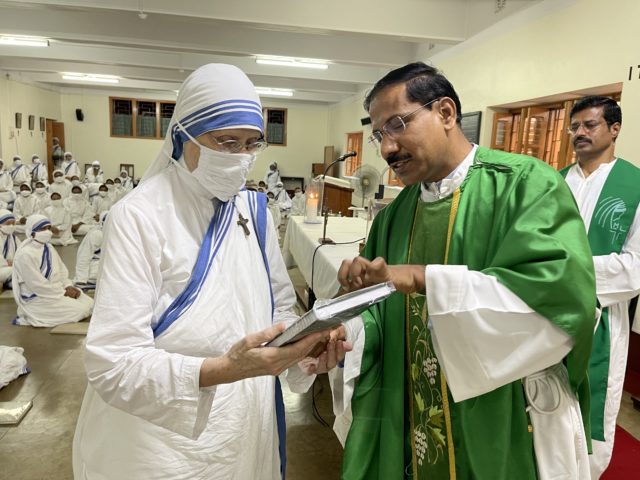
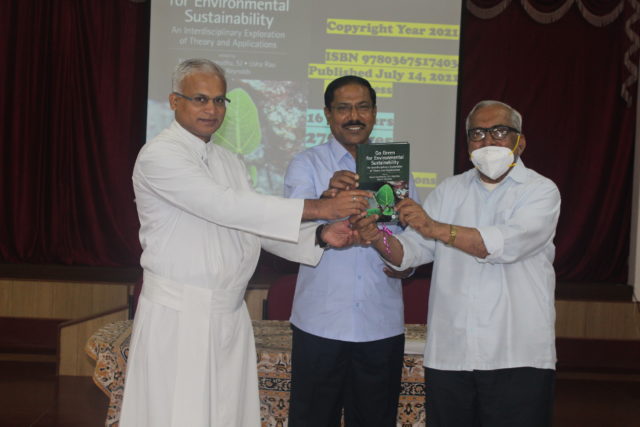
The Book that has done all this, and more, is “Go Green for Environmental Sustainability: An Interdisciplinary Exploration of The Theory and Applications”, edited by Dr Xavier Savarimuthu SJ, Dr Usha Rao and Dr Mark Reynolds. Published by the CRC Press (Taylor & Francis Group, Boca Raton, Florida, USA & Routledge Group, Oxfordshire, England, UK) whose credentials are naturally, or shall we say sustainably, beyond reproach. The book was formally launched on 8th of September 2021 by Sister Prema MC, the successor to Mother Teresa of the Missionaries of Charity in Kolkata.
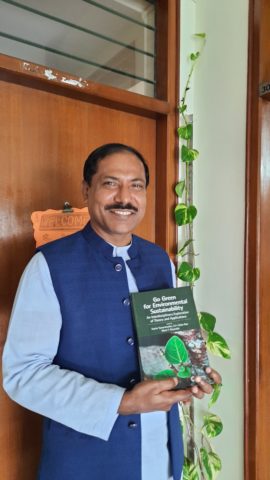
This weighty tome is spread across six parts, broken into sixteen chapters that cover areas as diverse as economics and agriculture, through Finance, Business & Industry, Engineering & Technology, and of course, Environment. While it addresses terms that are dangerously close to becoming common clichés like “green business” and “green technologies”, it also addresses issues bioremediation and green chemistry, underscoring the urgent need for action so that a sustainable tomorrow can be embraced but more importantly arguing how the solutions that are being thrown up today but not only be widely accessible but also be scalable and be capable of offering solutions cutting across boundaries to the world at large.
What makes the book stand apart, is the numerous case studies – spread from the frontiers around the world – that add an invaluable dimension, that will go a long way in shifting the grains from the chaff, leading to a clearer understanding of the issues that afflict us all. Stakeholders, from Governments and policy planners to environmentalists, not to mention academic researchers and students alike will do well to go through the book with the seriousness it deserves.
Dr Nancy C. Tuchman, Founding Dean, School of Environmental Sustainability, Loyola University, Chicago in her forward has succinctly highlighted the key features of the book hoping and observing that book will inspire new innovative academic research and experiential learning to prepare the next generation of environmental leaders from the higher education sector. Her words of wisdom have, in fact, added depth to the thoughts that have brought the book to life and should be read, not as an introduction, but as a part of the academic exercise itself.
The book is dedicated to His Holiness Pope Francis, for the Encyclical “Caring for our Common Home”; Rev. Fr. Arturo Sosa, SJ, The Superior General of the Jesuits, for prioritizing the Caring for our common home as a Universal Apostolic Preference of the Jesuits; Mr. Rajinder Singh, an oasis of hope in water starved state of Rajasthan, India; Dr. Al Gore, for his clarion call on action for climate change and Mrs. Wangarĩ Muta Maathai, for her environmental conservation efforts.
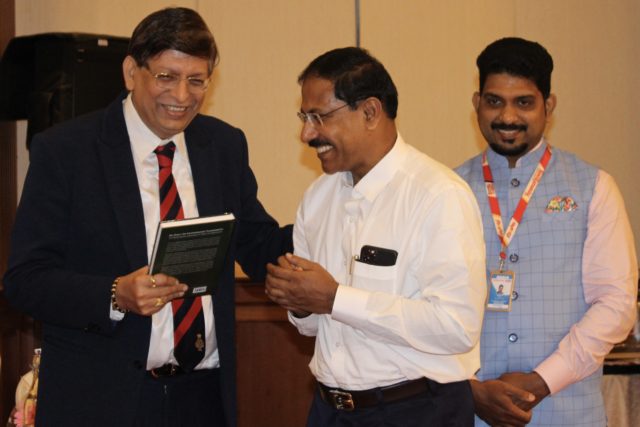
The credit of bringing on board such a diverse set of thinkers (and doers) from every possible corner of the intellectual world and to have strung together the different tongues into a rosary that is capable of providing the exercise with the spark of divine faith, of course goes to the editors who have done an excellent job from the conception to the creation of a book that promises not to teach but transform.
For more information about the book:
The post “Go Green for Environmental Sustainability: An Interdisciplinary Exploration of The Theory and Applications”, edited by Dr Xavier Savarimuthu SJ, Dr Usha Rao and Dr Mark Reynolds launched. appeared first on Core Sector Communique.
]]>The post Global nuclear arsenals grow as states continue to modernize–New SIPRI Yearbook out now appeared first on Core Sector Communique.
]]>(Stockholm, 14 June 2021) The Stockholm International Peace Research Institute (SIPRI) today launches the findings of SIPRI Yearbook 2021, which assesses the current state of armaments, disarmament and international security. A key finding is that despite an overall decrease in the number of nuclear warheads in 2020, more have been deployed with operational forces.
Signs that decline in nuclear arsenals has stalled
The nine nuclear-armed states—the United States, Russia, the United Kingdom, France, China, India, Pakistan, Israel and the Democratic People’s Republic of Korea (North Korea)—together possessed an estimated 13 080 nuclear weapons at the start of 2021. This marked a decrease from the 13 400 that SIPRI estimated these states possessed at the beginning of 2020 (see table below).
Despite this overall decrease, the estimated number of nuclear weapons currently deployed with operational forces increased to 3825, from 3720 last year. Around 2000 of these—nearly all of which belonged to Russia or the USA—were kept in a state of high operational alert.
While the USA and Russia continued to reduce their overall nuclear weapon inventories by dismantling retired warheads in 2020, both are estimated to have had around 50 more nuclear warheads in operational deployment at the start of 2021 than a year earlier. Russia also increased its overall military nuclear stockpile by around 180 warheads, mainly due to deployment of more multi-warhead land-based intercontinental ballistic missiles (ICBMs) and sea-launched ballistic missiles (SLBMs). Both countries’ deployed strategic nuclear forces remained within the limits set by the 2010 Treaty on Measures for the Further Reduction and Limitation of Strategic Offensive Arms (New START), although the treaty does not limit total nuclear warhead inventories.
‘The overall number of warheads in global military stockpiles now appears to be increasing, a worrisome sign that the declining trend that has characterized global nuclear arsenals since the end of the cold war has stalled,’ said Hans M. Kristensen, Associate Senior Fellow with SIPRI’s Nuclear Disarmament, Arms Control and Non-proliferation Programme and Director of the Nuclear Information Project at the Federation of American Scientists (FAS). ‘The last-minute extension of New START by Russia and the USA in February this year was a relief, but the prospects for additional bilateral nuclear arms control between the nuclear superpowers remain poor.’
Russia and the USA together possess over 90 per cent of global nuclear weapons. Both have extensive and expensive programmes under way to replace and modernize their nuclear warheads, missile and aircraft delivery systems, and production facilities.
‘Both Russia and the USA appear to be increasing the importance they attribute to nuclear weapons in their national security strategies,’ said Kristensen.
Other nuclear-armed states investing in future capabilities
All the other seven nuclear-armed states are also either developing or deploying new weapon systems or have announced their intention to do so. The UK’s ‘Integrated Review of Security, Defence, Development and Foreign Policy’, published in early 2021, reversed a policy of reducing the country’s nuclear arsenal and raised its planned ceiling for nuclear weapons from 180 to 260.
China is in the middle of a significant modernization and expansion of its nuclear weapon inventory, and India and Pakistan also appear to be expanding their nuclear arsenals.
North Korea continues to enhance its military nuclear programme as a central element of its national security strategy. While it conducted no nuclear test explosions or long-range ballistic missile tests during 2020, it continued production of fissile material and development of short- and long-range ballistic missiles.
‘The entry into force of the Treaty on the Prohibition of Nuclear Weapons in early 2021 highlights the growing divide between the nuclear-armed states, which are all investing in the long-term future of their nuclear forces, and other countries that are impatient to see progress on nuclear disarmament promised by the Nuclear Non-Proliferation Treaty,’ said Matt Korda, Associate Researcher with SIPRI’s Nuclear Disarmament, Arms Control and Non-proliferation Programme and Research Associate with the FAS Nuclear Information Project.
World nuclear forces, January 2021
| Country | Deployed warheads* | Other warheads** | Total 2021 | Total 2020 |
| USA | 1 800 | 3 750 | 5 550 | 5 800 |
| Russia | 1 625 | 4 630 | 6 255 | 6 375 |
| UK*** | 120 | 105 | 225 | 215 |
| France | 280 | 10 | 290 | 290 |
| China | 350 | 350 | 320 | |
| India | 156 | 156 | 150 | |
| Pakistan | 165 | 165 | 160 | |
| Israel | 90 | 90 | 90 | |
| North Korea**** | … | [40–50] | [40–50] | [30–40] |
| Total | 3 825 | 9 255 | 13 080 | 13 400 |
Source: SIPRI Yearbook 2021.
*‘Deployed warheads’ refers to warheads placed on missiles or located on bases with operational forces.
**‘Other warheads’ refers to stored or reserve warheads and retired warheads awaiting dismantlement.
***The British Government declared in 2010 that its nuclear weapon inventory would not exceed 225 warheads. SIPRI estimates that the inventory remained at that number in Jan. 2021. This is a revision of previous SIPRI assessments based on new information. A planned reduction to 180 warheads by the mid 2020s was ended by a government review undertaken in 2020 and published in early 2021. The review introduced a new ceiling of 260 warheads.
****The figures for North Korea are SIPRI’s estimates of the number of warheads that North Korea could potentially build with the amount of fissile material it has produced. There is no publicly available evidence that North Korea has produced an operational nuclear warhead for delivery by an intercontinental-range ballistic missile, but it might have a small number of warheads for medium-range ballistic missiles. The figures for North Korea are highly uncertain and are not included in the global totals.
Notes: All estimates are approximate. SIPRI revises its world nuclear forces data each year based on new information and updates to earlier assessments. The figures for Russia and the USA do not necessarily correspond to those in their 2010 Treaty on Measures for the Further Reduction and Limitation of Strategic Offensive Arms (New START) declarations because of the treaty’s counting rules. Global totals are rounded to the nearest 5 warheads.
A mixed outlook for global security and stability
The 52nd edition of the SIPRI Yearbook reveals some negative and some hopeful developments in 2020.
‘Despite outbreaks of conflict, rising military spending and of course the first year of a devastating global pandemic, overall global human security did not continue to deteriorate in 2020. The year’s crumbs of comfort included a significant drop in the number of people who died in armed conflicts around the world. Unlike previous years, the international arms trade did not expand. And the Climate Action Summit made some notable—if still insufficient—progress on climate goals,’ said SIPRI Director Dan Smith. In addition to its detailed coverage of nuclear arms control and non-proliferation issues, the latest edition of the SIPRI Yearbook includes insight on developments in conventional arms control in 2020; regional overviews of armed conflicts and conflict management; in-depth data and discussion on military expenditure, international arms transfers and arms production; and comprehensive coverage of efforts to counter chemical and biological security threats.
The SIPRI Yearbook is a compendium of cutting-edge information and analysis on developments in armaments, disarmament and international security. Four major SIPRI Yearbook 2021 data sets were pre-launched in 2020–21: total arms sales by the top 25 arms-producing companies (December 2020), international arms transfers (March 2021), world military expenditure (April 2021) and trends in multilateral peace operations (May 2021). The earlier releases are available at www.sipri.org/media/pressreleases. The SIPRI Yearbook is published by Oxford University Press.
Browse the SIPRI Yearbook 2021 and download the SIPRI Yearbook 2021 Summary (PDF).
The post Global nuclear arsenals grow as states continue to modernize–New SIPRI Yearbook out now appeared first on Core Sector Communique.
]]>The post Sasken launches Automotive Center of Excellence in Detroit, USA appeared first on Core Sector Communique.
]]>Center to focus on developing cutting-edge solutions for the next generation of connected vehicles

Detroit, USA and Bengaluru, India: January 16, 2019 – Sasken Technologies Ltd., (BSE: 532663, NSE: SASKEN) (formerly Sasken Communication Technologies Ltd.), a leading product engineering and digital transformation solutions provider, today announced that it has launched a state-of-the-art Automotive Center of Excellence (CoE) in Detroit, USA. The center, which was inaugurated by Dr. Kenson J. Siver, Mayor, City of Southfield, is part of Sasken’s nearshore strategy to cater to the needs of its customers in the Automotive segment.
Its main focus will be to develop cutting-edge solutions for the next generation of connected vehicles in areas such as Advanced Driver Assistance System (ADAS), Integrated Cockpit System (ICS), In-car Infotainment, and Telematics.
“Software is becoming a key differentiator in automotive today. Sasken brings a decade-long experience in delivering software solutions to its Automotive customers. And with our Automotive CoE, we aim to bring our key solutions closer to our customers in the region,” said Hari Haran, President-Global Sales, Marketing, and Business Lines, Sasken. “Our objective here is to anchor key programs while continuing to provide offshore delivery excellence,” he added.
Rajiv C Mody, Chairman, Managing Director & CEO, Sasken said, “A huge factor that went into our decision to set up this center in Detroit is the availability of great talent. Sasken’s new facility will provide an opportunity for local engineers to work on cutting-edge technologies in the automotive domain.”
“We are excited that Sasken has selected Southfield for its new Detroit Development Center,” said Dr. Kenson J. Siver, Mayor, City of Southfield. “Sasken joins a distinguished line up of technology companies on Southfield’s Telegraph Road high-tech corridor,” he added.
Sasken is a preferred partner to several leading Automotive Tier-1s and OEMs providing Product Engineering and Digital Transformation solutions. Sasken’s 10+ years of expertise in the automotive industry is backed by strong partnerships with leading silicon vendors, extensive experience in the communications space, and proven ability to scale. This facility will eventually be a hub for over 100 engineers and bringing employment opportunities to the region.
About Sasken:
Sasken is a specialist in Product Engineering and Digital Transformation providing concept-to-market, chip-to-cognition R&D services to global leaders in Semiconductor, Automotive, Industrials, Smart Devices & Wearables, Enterprise Grade Devices, Satcom and Transportation industries. For over 29 years and with multiple patents, Sasken has transformed the businesses of over 100 Fortune 500 companies, powering over a billion devices through its services and IP. For more details, visit www.sasken.com
The post Sasken launches Automotive Center of Excellence in Detroit, USA appeared first on Core Sector Communique.
]]>The post FlexFilms Presents the ‘Future of Packaging’ at PACK EXPO, USA appeared first on Core Sector Communique.
]]>Unveils VYOM, a ground-breaking Concept BOPET Film & Latest Innovations in BOPET Products that’s set to Redefine the Polyester Industry
October 15, 2018: FlexFilms is scaling newer heights with VYOM, a revolutionary futuristic technology Concept BOPET Film, it is presenting for the very first time for its visitors and customers at Pack Expo being hosted in Chicago from October 14 – October 17, 2018. FlexFilms Booth at Pack Expo is also showcasing a product portfolio of its latest innovations in BOPET Films – which range from high barrier films; more efficient films; and ones that are more sustainable too – all manufactured with its own proprietary technology.

At the mecca of packaging industry Pack Expo, here is what industry professionals from around the world can witness at FlexFilms Booth #N-5767:
- VYOM ( व्योम | v-yo-m) – The Centre stage at FlexFilms Booth at Pack Expo has been taken by a cutting edge Concept BOPET Film that uses an advanced proprietary technology method and is aptly named ‘VYOM’ (a Sanskrit term that means ‘endless’, ‘limitless’, ’expanse’) defining the endless solutions that this high-tech film offers to its customers. Envisioned as the next big revolution in BOPET films, the unique value proposition that the Concept BOPET Film offers against the existing BOPET films available in the market are:
- Creating right density films, lighter by 40% with a density of <1 making it the lightest film
- Creating barrier films, better by 100%, doubling the barrier
- Creating strong films, stronger by 100%, making it double the strength
- Creating green sustainable films, greener by 40% by using lesser plastic
To watch a video of VYOM, click on: http://flexfilm.com/flexfilms-at-packexpo2018.php
- Puncture Resistant, Nylon Replacement BOPET Film – FLEXPETTM F HPF is biaxially oriented nylon replacement (BON) film made with a newly developed patented proprietary technology offering important features of thermoforming performance, high puncture resistance and flexural fatigue strength that could formerly only be filled with bi-axially oriented nylon (BON) film. F-HPF is far more superior to nylon (BON) with fewer pin holes in terms of thermoform-ability whereas its puncture and flex crack resistance is at par with BON. Value propositions like better water resistance availability and compatibility with wide range of inks and adhesives makes it cost effective with greater yield per unit area, as compared to BON.
- Aluminum Foil Replacement Metallized High-Barrier BOPET Film –FLEXMETPROTECTTM F-HBP-M is metalized bi-axially oriented polyester (BOPET) film with a superior gas barrier that offers high moisture and oxygen barrier for virtually all applications including Aluminum foil replacement. High barrier comes from patented BOPET film technology, with high optical density specifically suitable for most flex pack product offerings. This film is 100% web inspected, for any metal defect, using our state-of-the- art vision system. The film is of great use in shipping moisture sensitive items in multi-layered pouch.
- F-HMB High Bond and Barrier Metallized Polyester Film – FLEXMETPROTECTTMF-HMB film is a High Barrier Metallized Polyester Film engineered by the company’s R&D team. The film is either untreated or corona treated on the other surface, while metallization is carried out on the specially treated composite surface imparting metal adhesion or bond strength of > 1200 gram-force/inch. F-HMB offers class leading high adhesion to metal under most aggressive environmental conditions; demonstrates improved scuff, scratch and craze resistance thereby improving yields up to four percent and offering unparalleled robustness in processing and performance for converters.
- Metallized High Barrier Balloon Film – FLEXMETPROTECTTM F-PAB-M is an advanced proprietary film structure developed by Flex Films Inc. USA and designed specifically to meet the needs of thin gauge, ultra-thin gauge high barrier specialty film markets. This includes the balloon film market and wherever low OTR and MVTR is needed, thus enabling balloon converters and end users to create dazzling, printable, metallized polyester inflatables that do not stress or snap and conserve seal property during the manufacturing process. F-PAB-M has an added ‘Green’ benefit due to the use of less material, giving high yield economics with an optical density of 2.8. The exceptional air barrier properties of the film prevent helium diffusing out of FLEX-PAB surface.
Excited at the show of trailblazing technology and product at Pack Expo, Anantshree Chaturvedi, Vice Chairman & CEO, FlexFilms International said, “Creating better is an endless quest at Flex! We prove that yet again with the introduction of VYOM, our innovative Concept BOPET Film. VYOM promises to be better in every key virtue that a film is built around – Light, Barrier, Strength and Green – with superior mechanical properties, thereby allowing us to deliver much higher yield, improved costs and reduced carbon footprint. All of this is in sync with the company’s efforts to continuously develop refined products and make our customers’ lives easier. Through our presentation at Pack Expo, we are going experiential in interacting with our customers in the real market and stimulate their imagination.”
Ashok Chaturvedi, Chairman & Managing Director of Uflex Limited, the parent company of FlexFilms spoke from the floor of Pack Expo, “The wonders of Flexfilms have a beginning but with boundless scope. The infinite talent pool of our scientists and engineers constantly design and explore solutions for our customers and eco-system, thereby helping us build ‘thought leadership’ in advanced polymer science application. We’re proud of our employees, products, customers and enablers for their contribution in creation of sustainable innovations for essential markets such as food, water, shelter and medicine.”
About FlexFilms:
FlexFilms is the global film manufacturing arm of India’s largest multinational flexible packaging solutions company, Uflex Limited. With State-of-the-Art film manufacturing facilities in all the 4 major continents Asia, Europe, North America and Africa, our cumulative production capacity stands in excess of 337,000 MT Per Annum. For more details, click on: http://flexfilm.com/
About Uflex:
Uflex is India’s largest multinational flexible packaging materials and Solution Company and an emerging global player. Since its inception back in 1985, Uflex has grown from strength to strength to evolve as a truly Indian Multinational with consumers spread across the world. Uflex today has state-of-the-art packaging facilities at multiple locations in India with installed capacity of around 100,000 TPA and has packaging film manufacturing facilities in India, UAE, Mexico Egypt, Poland and USA.
All Uflex plants are accredited with ISO 9001, 14001, HACCP & BRC certifications. Uflex caters to markets spanning across the globe in over 140 countries like USA, Canada, South American countries, UK and other European Countries, Russia, South Africa, CIS, Asian and African nations. Integrated within its core business profile are allied businesses like Engineering, Cylinders, Holography and Chemicals which further give Uflex a superior edge above competition.
Uflex Limited is also a part of the D&B Global Database and winner of various prestigious national and international awards for its products’ excellence. Uflex offers technologically superior packaging solutions for a wide variety of products such as snack foods, candy and confectionery, sugar, rice & other cereals, beverages, tea & coffee, dessert mixes, noodles, wheat flour, soaps and detergents, shampoos & conditioners, vegetable oil, spices, marinades & pastes, cheese & dairy products, frozen food, sea food, meat, anti-fog, pet food, pharmaceuticals, contraceptives, garden fertilizers and plant nutrients, motor oil and lubricants, automotive and engineering components etc.
Some of Uflex’s clients on the global turf include P&G, PepsiCo, Tata Global, Mondelez, L’ Oreal, Britannia, Haldiram’s, Amul, Kimberly Clark, Ferrero Rocher, Perfetti, GSK, Nestle, Agrotech Foods, Coca Cola, Wrigley, Johnson & Johnson, amongst others. For more details, click on: http://uflexltd.com/
The post FlexFilms Presents the ‘Future of Packaging’ at PACK EXPO, USA appeared first on Core Sector Communique.
]]>The post Airbus upgrades communication network at Fort Irwin in the USA appeared first on Core Sector Communique.
]]>The US Army’s premier training site in the US will be running a renewed secure communication system on Airbus’ Tetrapol Internet Protocol technology
UAE, Dubai, 8 August 2018 – Airbus is upgrading and expanding the US Army’s secure mobile communication system at the Fort Irwin National Training Center in the USA, California. As a result of this migration, the US Army will be able to communicate more efficiently and flexibly on one of the most important training site of the US military. A resilient and highly reliable on-site communication infrastructure supports the work of observers and controllers. Airbus expects the conclusion of the network modernisation by the end of 2018.
“We are proud to serve the US Army who required communication technology of the highest standards,” says Thierry Becker, Head of Sales of Western Europe, North America and Africa for Secure Land Communications at Airbus. “Since 2001, the army has been using our Tetrapol system, and now they want to bring it to the next level with upgraded Tetrapol Internet Protocol (IP) technology to challenge their future tasks.”

Airbus is upgrading the base’s simulcast voice network, consisting of 48 channels, as well as its extensions to China Lake NAWS Airport and Barstow Daggett Airport. The new IP technology facilitates the integration of IT-based network elements and the interoperability with 4G/5G broadband technology. It sets the ground for multimedia communication and real-time data transmission. The renewed Tetrapol network also offers a high capacity and carries out calls and data transmission very swiftly.
Trainings at Fort Irwin encompass many aspects that require precise mobile communication instruments: multinational army units and members of various governmental agencies simulate and train complex situations on ground. The army works with drones, multimedia communication and real-time data transmission. On the site, complete villages were built with video recording tools to analyse combat situations than can engage an entire brigade combat team in a fight.
Tetrapol technology is ideal for use on large sites, such as the 2,580 square kilometre (996 square miles) large Training Center in the Mojave Desert in the state of California. Each day, 150,000 group calls are handled by the Tetrapol communication system at Fort Irwin. Despite the extreme weather conditions of the Mojave Desert, the system has demonstrated the expected availability and reliability.
–
Airbus
Airbus is a global leader in aeronautics, space and related services. In 2017, it generated revenues of €67 billion and employed a workforce of around 129,000. Airbus offers the most comprehensive range of passenger airliners from 100 to more than 600 seats. Airbus is also a European leader providing tanker, combat, transport and mission aircraft, as well as one of the world’s leading space companies. In helicopters, Airbus provides the most efficient civil and military rotorcraft solutions worldwide.
Secure Land Communications (www.securelandcommunications.com)
Secure Land Communications (SLC), a business unit of Airbus, offers advanced communication solutions for public safety, defence and transport, utility and industry (TUI). The portfolio, based on Tetra, Tetrapol and broadband technologies, includes infrastructures, devices, applications and associated services. As a leading international player, SLC has deployed nearly 300 networks in more than 80 countries and employs approximately 1,150 people in 17 countries.
The post Airbus upgrades communication network at Fort Irwin in the USA appeared first on Core Sector Communique.
]]>The post US-India Trade & Investment with Craig Hall,Consul General,USA & Jonathan Ward,Principal Comm.Officer at MCCI appeared first on Core Sector Communique.
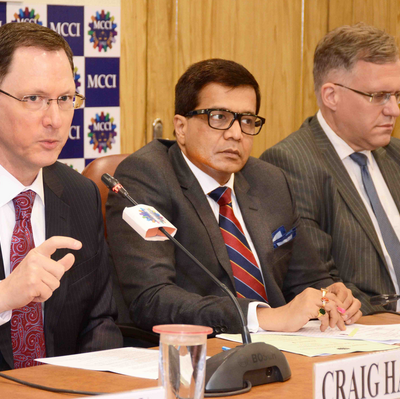
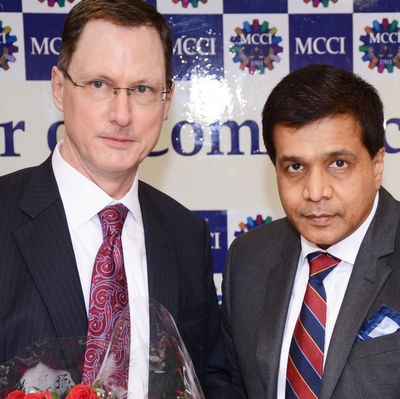
]]>MCCI organized an Interactive Session with Dr. Craig Hall, Consul General, Consulate General of the United States of America in Kolkata on the theme ‘U.S.-India Trade and Investment’ at the Chamber today. Mr. Jonathan Ward, Principal Commercial Officer, Consulate General of the United States of America in Kolkata was also present and spoke on the occasion.
Dr. Craig Hall said that bilateral trade which was only USD 20 billion in 2001 that has grown to USD 126 which is still relatively small given the large size of the economies. The US is India’s largest export destination while from the US perspective, India is its 18th largest market. The US has a deficit of USD 28 billion which will be unsustainable as trade between the two countries will continue to grow and so the US deficit will balloon.
The US is concerned about India’s restrictions in the agriculture sector, namely dairy products and pork. Also, India restricts poultry products with a 100 p.c. tariff. Similarly, India has closed its legal system to foreign law firms. Dr. Hall mentioned restrictions in the education sector and added that the 30 p.c. domestic content requirement in retail restricts foreign participation. The US is also concerned about weak copyrights in India and challenges to patents in agriculture and pharma. In pharma, Government of India is setting price ceiling on drugs, which is a violation of IPR.
The US is concerned about unfair trade in steel and China has contributed to excess capacity in steel. Overcapacity in steel is a threat to the US steel industry. President Trump has announced a tariff of 25 p.c. on steel imports.
India received USD 5.6 billion under Generalised System of Preferences (GSP). The US dairy industry which suffers from restrictions in India has questioned India’s benefits under GSP.
Dr. Hall said that the US imposes an average tariff of 3.4 p.c. which is 9.9 p.c. in the case of China and 13.4 p.c. in the case of India.
Dr. Hall highlighted several success stories of Indo – US collaboration such as Tata Boeing Aerospace, General Electric and Sikorsky. Honeywell has developed a system to test smart grid technologies. There are huge opportunities in all fields of energy.
With regard to H-1B visas, Dr. Hall said that it is a classic domestic debate between labour and business. The debate never had a link with India. It so happens that Indians capture 70 p.c. of the visas.
Dr. Hall ended by saying that ‘America First’ and ‘Make in India’ are not incompatible.
According to Mr. Jonathan Ward, The Foreign Direct Investment (FDI) from India to the USA stood at USD 12.1 billion in 2016. The top six sectors for investment in the USA (in declining order of importance) were Software and IT services followed by Business Services then Pharmaceuticals, Industrial Machinery, Plastics and lastly, Metals. India is one of the fastest growing sources of FDI in the US. The Foreign Direct Investment (FDI) from USA to India stood at USD 32.9 billion in 2016.
The 2018 SelectUSA Investment Summit is ‘the pre-eminent United States investment event, highlighting inbound investment opportunities throughout the United States,’ said Mr. Jonathan Ward. H. E. Mr. Kenneth I. Juster, Ambassador of the United States of America in India will lead the Indian delegation to 2018 SelectUSA Investment Summit. Registration is open for the 2018 SelectUSA Investment Summit, which will be held from 20 June to 22 June 2018 at the Gaylord National Resort and Convention Centre near Washington, D.C. The cost to attend is USD 850. For more information, visit www.selectusa.gov. For registration and information regarding the 2018 SelectUSA Investment Summit, go to www.selectusasummit.us or contact Mr. Jonathan Ward at jonathan.ward@trade.gov.
Earlier Mr. Ramesh Agarwal, President, MCCI in his welcome address said that India and US ties have developed into a ‘global strategic partnership’, based on shared democratic values and increasing convergence of interests. He expressed concern over the H4 visa restriction on employment of spouses and hoped that the US Administration will sympathetically look into this issue.
The post US-India Trade & Investment with Craig Hall,Consul General,USA & Jonathan Ward,Principal Comm.Officer at MCCI appeared first on Core Sector Communique.
]]>The post INDIA’S PERCUSSION PRODIGY, DEEPAK BHATT LIGHTS UP THE USA WITH THE MAGIC OF THE DHOL appeared first on Core Sector Communique.
]]>
Mumbai, 19 March 2018: As we all know that India is a hotpot for musical talents. Some of the best names in the music industry have all started off with humble beginnings. The story of Deepak Bhatt, who is now one of the best percussionists in the world, is nothing short of a fairy-tale. The video begins with Deepak playing the Dhol. The short act was part of Shankar Ehsan Loy’s tour of the United States in 2016. You can clearly see from the video that he is enjoying himself like there’s no tomorrow.
The video has taken Facebook by storm. People have shared the video more than 700 times. The video has also gathered more than ninety thousand views. It is insane the way he plays the Dhol. He starts off with just one single beat of the drum and then it’s just a fury of beats and sounds which has the audience cheering and Screaming. You have to watch this video to believe what I am saying.

Deepak Bhatt is a formidable element of Shankar Ehsan Loy’s band. They are seen performing at a number of gigs around the world. It was the 2016 US tour during which they both were seen as an amazing team. The video is a glimpse of the magic they both can offer.
Deepak Bhatt was cast into the band when he auditioned for the percussionist role during his early years. Shankar Ehsaan Loy knew that he was going to be a superstar in the coming years. He took him on board and the rest is history.
It is not just Shankar Ehsaan Loy with whom he has performed with, some of the biggest names such as Zakir Hussain, Amit Trivedi, Pritam, Salim-Sulaiman, Shankar Mahadevan and a host of other musical greats wanted him to be part of their shows. This is an amazing feat for a boy who had absolutely nothing in his childhood.
Deepak Bhatt can turn any show into a super show, as seen in the video. People were expecting just a few boring songs to be sung on stage, but he blew them away with his Dhol performance. Each and every tune had the audience cheering and dancing and it is evident in the video too. I never knew that the Dhol was such a super instrument. I am now proud to say that I am a Deepak Bhatt fan, straight from the heart.
The video has spread like wildfire on Facebook. The mere announcement of Deepak’s name brought cheers and claps from the crowd. As he slowly raced up the Dhol beats, people were dancing, whistling and cheering him on. I urge you to go and see the video and enjoy the super talent of Deepak Bhatt. There isn’t going to be another percussionist genius like him in the next hundred years!
The post INDIA’S PERCUSSION PRODIGY, DEEPAK BHATT LIGHTS UP THE USA WITH THE MAGIC OF THE DHOL appeared first on Core Sector Communique.
]]>The post KASHISH to facilitate screening of Indian LGBTQ films in UK, USA appeared first on Core Sector Communique.
]]>KASHISH Global recently screened at Australia, Pakistan, Mexico, South Korea, Canada, China, Taiwan, Czech Republic, Indonesia, Hong Kong
KASHISH Mumbai International Queer Film Festival – South Asia’s biggest LGBTQ film festival – will once again take Indian LGBTQ films across the world this year as part of its KASHISH Global Initiative. The forthcoming screenings are in the UK and USA.

“It is really gratifying to see the universal response to the package of Indian LGBTQ films that we have been facilitating at film festivals across the globe. The KASHISH Global program has resonated with many festivals because they are seeing a new India, which is coming out of the shadows and offering a diverse range of stories and emotions. Indian LGBTQ films have truly arrived on the global scene” – Sridhar Rangayan, festival director.

The forthcoming screenings in the months of March-May are as follows:
- BFI Flare, London, UK : FISH CURRY, DEVI, CHUDALA on March 23rdand March 24th
One of the world’s most prestigious LGBTQ film festival
- Feminist Border Arts Film Festival, New Mexico State University: DEVI on April 18th
- Translations, Seattle, USA: CHUDALA, AARSA between May 3-12, 2017
In the last two months KASHISH Global has facilitated screening of Indian LGBTQ films in USA, Australia, Mexico and Pakistan.
- Best of India Short Film Festival 2018, Los Angeles, USA: AARSA (Finalist), DEVI (Semi Finalist) and SISAK (Official Selection) between February 9-16th
- Mexico Silent International Film Festival, Mexico: SISAK on February 16th, winner of Best Short Film
- Brisbane Queer Film Festival, Australia: SISAK and DEVI on March 10th
- Aks Minority Film Festival, Lahore, Pakistan: DEVI, CHUDALA, AARSA, FISH CURRY, WAJOOD on March 11th
KASHISH Global screenings have also been recently facilitated in South Korea, Canada, China, Taiwan, Czech Republic, Indonesia, Hong Kong, etc.
What do Indian filmmakers who have made LGBTQ films have to say?
“After winning the KASHISH MIQFF title in 2017 and then being part of the Kashish Global made Maacher Jhol journey smooth and beautiful. With KASHISH, we went to IRIS, BFI Flare and had many other screenings in Colleges & Corporations. The film is presented in big LGBTQ festivals of the world and we were overwhelmed with the response, love and reaction. As a beginner filmmaker, I would have never able to take my film to such festivals. The film is not meant for Desktops but theatres.”
– Abhishek Verma, director of The Fish Curry (Maacher Jhol).
“Very few film festivals offer such a personalised approach as KASHISH does. It takes that extra mile to push someone’s work and experience its ripples all over and this festival does precisely that. I was thrilled to have my film here and was touched to see how the KASHISH team worked towards giving the film an additional platform in different places around the world. So not only am I grateful but also feel like I belong to an extended group in a way. In many respects, it is more than a film festival.”
– Maaria Sayed, director of Chudala.
“Now more than ever, there’s a need for platforms like KASHISH Global to help forge a connection for LGBTQ filmmakers with its audiences. KASHISH’s support of these works has expanded the life span of my short film to unimaginable level. Very grateful to KASHISH to have the film be seen.”
– Karishma Dube, director of Devi.
“What KASHISH has achieved for independent Indian queer cinema is mammoth. To provide a safe, all-inclusive space that celebrates and honours queer cinema & brings together the queer community in a country where homosexuality is a crime is something that’ll go down in history. As someone who identifies as a queer filmmaker, for me, KASHISH is more than a film festival. It is a celebration. And I hope it goes on until the end of time. Although my film Sisak, India’s First Silent LGBTQ Love Story, having won 38 International Awards, as of today, at some of the most prestigious film festivals across the world, didn’t win any award at Kashish, it did win a lot of hearts and a few producers for my first queer feature film.”
– Faraz Arif Ansari, director of Sisak
About KASHISH Mumbai International Queer Film Festival
The ninth edition of South Asia’s biggest LGBTQ film fest – KASHISH Mumbai International Queer Film Festival – is scheduled to be held from May 23-27, 2018. Voted as one of the Top 5 LGBT Film Festival in the World, KASHISH Mumbai International Queer Film Festival is South Asia’s biggest queer film festival and the only LGBT film festival in India to be held in a mainstream theatre. Founded in 2010, KASHISH is held over 5 days at three venues. It is the first Indian LGBT festival to be held with approval by the Information & Broadcasting Ministry, Government of India. KASHISH Mumbai International Queer Film Festival is presented by KASHISH Arts Foundation and organized by Solaris Pictures. Besides the annual film festival its other initiatives are KASHISH Forward – India’s first travelling campus LGBTQ film festival, KASHISH Global – that facilitates screening of Indian LGBTQ films across the world, Best of KASHISH film screenings and KASHISH Chalchitra Utsav – a festival of LGBTQ films in regional languages.
KASHISH 2018 FESTIVAL THEME
The 9th edition of KASHISH Mumbai International Queer Film Festival will celebrate pride and the infinite diversities of families, communities, gender, sex, ethnicity and body types. The fight for equal rights and societal acceptance is also a fight against discrimination of any sort, and equal rights can be only achieved when all of us – LGBTIQ and Allies – come together with pride to celebrate being ourselves.
KASHISH Mumbai International Queer Film Festival
Festival Website: http://www.mumbaiqueerfest.com/ | Festival Blog: http://kashishmiqff.blogspot.com/
Facebook: http://www.facebook.com/Kashish.MIQFF | Twitter: http://twitter.com/KashishMIQFF
YouTube: http://www.youtube.com/user/KASHISHfilmfest
Instagram: https://www.instagram.com/kashishfilmfest/
The post KASHISH to facilitate screening of Indian LGBTQ films in UK, USA appeared first on Core Sector Communique.
]]>The post All Weather Creations from IGJC – of peacock themes and perfect plumes appeared first on Core Sector Communique.
]]>Kolkata August, 2017. Indian Gem & Jewelry Creation (IGJC), one of the most revered names in the jewelry horizon of the Nation has unveiled its latest all-weather collection. Fondly christened Rimjhim Girey Baarish, the central theme of the collection is the peacock, the many splendored hues of whose plume has been sought to be replicated by some of India’s most acclaimed craftsmen in gold, platinum and a variety of precious stones.

“The peacock is a symbol of eternal love, of Radha’s soul stirring, of Meera’s all-encompassing devotion and yearning for Krishna. It has been our endeavour to synthesise the same celestial feelings in the line” said Punam Chand Dugar, the moving spirit behind IGJC and acknowledged doyen of the Jewelry Industry. The line has been spread across the entity’s most revered verticals – diamond, gold, ethnic and novelty, keeping in mind the needs of the modern woman in her search for the statement look that is contemporary in styling, but has its moorings, firmly embedded in solid traditionalism.
“The choice of the peacock is deliberate” said Pramod Dugar, proud second-generation carrier of the IGJC flag of creativity, as “it is also the personification of sustainability, playing a key role, not only as the harbinger of the rains that quench perched souls, but also acts as a custodian of the fragile ecological balance”. Call it empowerment if you may, but the chance of wearing your eco-friendliness and flaunting it too, is a silent scream against the twin menace threatening mankind – global warming and climate change – that the modern woman can hardly resist.
“The peacock has been a recurring theme in Indian Jewelry and it is our honour and pleasure to contribute to this age-old tradition” said Pratik Dugar, a Diamond Graduate from GIA, USA and an acknowledged expert on the history of Indian jewelry. “Everybody knows about the peacock throne, but the fact that the peacock lends itself to be cast in any precious metal of one’s choice and the riot of its colour that allow the artistic, unrestrained use of gems, has made it a perennial favourite with the master craftsmen from time immemorial. It will not be an exaggeration to say that peacock themed jewelry has adorned some of the most celebrated Indian beauties down the ages”.
“As a matter of fact,” said Prayas Dugar, who is spearheading the entity’s forays forward, “the Peacock Necklace – the diamond and emerald creation that used to rest in all its regal splendour on the Mogul Empress was no less celebrated than the Kohinoor. Our collection is as much a homage to our legacy of craftsmanship as it is to the peacock’s symbolic value that has transcended India’s diversities to emerge as a unifying force of divine creation”.
Considering the diverse needs of the modern woman whose accessories and accouterments must match the occasion and the mood, the collection has been made as inclusive as it is exclusive. From light weight and breezy pieces that replicate the peacock’s plumes for the corporate predator, to the heavy and intricately crafted chunks of solid class for the princess on an evening out, there is something for everyone. That too at multiple price points to pamper the connoisseurs. For the heiresses to celebrate hedonism to the fullest.

“At Indian Gems & Jewelry Creation we have now spent four generations, helping women deck up their dreams” said Punam Chand Dugar. “We are extremely exacting in all matters of quality and craftsmanship and it is not often, that we take time off to revel at our own creations. This peacock line has forced us to do just that and has won our hearts. All it needs now is you”.
The peacock themed all weather collection will be available in all the IGJC showrooms – at the address location in 9b Wood Street apart from signature stores at the South City Mall, Vardaan Market and the Durgapur City Centre.
Can you hear the flute playing?
For More Information:
For media feature assistance / exclusive requests contact:
Tristha Sharma
Azure Communications
The post All Weather Creations from IGJC – of peacock themes and perfect plumes appeared first on Core Sector Communique.
]]>The post Experts Call for Inclusive, Participatory Growth to Avert Looming Inequality Crisis appeared first on Core Sector Communique.
]]>- A deepening wealth divide fuelled by globalization is leading to a looming inequality crisis, one that will be exacerbated by technological innovations such as artificial intelligence and associated job displacement
- Fuelling inclusive growth through redeployment, reskilling, active social policy and reshaping of education will be the key ways to mitigate gaps between the haves and the have-nots
- For more information about the meeting, please visit: http://wef.ch/amnc17
 Dalian, People’s Republic of China, 28 June 2017 – As the Fourth Industrial Revolution starts to permeate all aspects of our lives, ensuring that economic growth is inclusive and participatory will be the only way to avert a looming inequality crisis. Science and technology are not ends and means in themselves, and neither is economic progress – that was the consensus of an expert panel gathered to discuss inclusive growth on the second day of the 11th Annual Meeting of the New Champions in Dalian.
“Globalization and national economies just haven’t played out in the way they should have,” observed Tharman Shanmugaratnam, Deputy Prime Minister and Coordinating Minister for Economic and Social Policies of Singapore, “The source of the problem, we know from middle class stagnation, is weak productivity growth.”
Contrary to conventional theory, noted Shanmugaratnam, economic growth has widened the gap between the haves and the have-nots, causing a deepening divide that has serious social and political ramifications – as evidenced by feelings of disenfranchisement expressed in the US election and Brexit vote in the UK.
“When we talk about inclusive growth, what that means to me is equality,” noted Marc R. Benioff, Chairman and Chief Executive Officer of Salesforce, USA. “We include everyone, we treat them equally, give them equal opportunities, and we pay them equally … Some studies show it is going take 170 years before we have gender equality; this should be a sign that we have throughout our organizations these very serious problems that need to be addressed today.”
While there was agreement among panellists that technological innovation, especially artificial intelligence, will have a dramatic and disruptive effect on society and inevitably lead to job displacement, Jean Liu, President of Xiaoju Science and Technology, People’s Republic of China, noted that firms have to take a lead role on initiating more-inclusive work environments.
“The sharing economy promotes access, inclusivity,” said Liu, a Co-Chair of the meeting, and the head of Didi Chuxing, China’s largest mobile transport platform, “Didi has 50% women employees, and executives, and we encourage women to work from home one day a week,” she pointed out.
Confessing that he is not “anti-tech” – and indeed is pushing for more disruption and entrepreneurship – Tyler Cowen, Professor of Economics at George Mason University, USA, noted that beyond the hype around Silicon Valley heroes, real work is needed to make a tangible impact on GDP.
“If we look at most of the Western world, for at least 15 years, real wages for the middle class have been stagnant or in a few cases even falling. This is the most important fact of our times,” explained Cowen, “So if you are reading that we are receiving a new technological cornucopia of new products, basically that cannot be true; it would be showing up in the real wages of most people.”
To mitigate future disruptions and stimulate more inclusive growth, Shanmugaratnam called for more active social strategies, a focus on reskilling and the need to “reshape education” to match existing realities.
The World Economic Forum’s 11th Annual Meeting of the New Champions is taking place on 27-29 June in Dalian, People’s Republic of China. Convening under the theme Achieving Inclusive Growth in the Fourth Industrial Revolution, nearly 2,000 business leaders, policy-makers and experts from over 80 countries will explore more than 200 sessions over the three days of the meeting.
The World Economic Forum, committed to improving the state of the world, is the International Organization for Public-Private Cooperation.
The Forum engages the foremost political, business and other leaders of society to shape global, regional and industry agendas. (www.weforum.org).
The post Experts Call for Inclusive, Participatory Growth to Avert Looming Inequality Crisis appeared first on Core Sector Communique.
]]>