The post Survey: ASEAN Youth Bullish about Impact of Technology on Jobs appeared first on Core Sector Communique.
]]>Ha Noi, Viet Nam, 11 September 2018 – The youth of ASEAN are highly optimistic about the impact of technology on their job prospects and incomes, according to a survey from the World Economic Forum.
Some 52% of the under-35 generation across South-East Asia said they believe that technology will increase the number of jobs available, while 67% said they believe that technology will increase their ability to earn higher incomes.
The survey, which was run in partnership with Sea, one of South-East Asia’s leading internet companies, gathered results from 64,000 ASEAN citizens through users of Garena and Shopee, Sea’s online games and e-commerce platforms, respectively. The majority of respondents were from six countries: Indonesia, Malaysia, Thailand, Viet Nam, Singapore and the Philippines.

The degree of optimism about the impact of technology on the future of work varied strongly by country. The youth of Singapore and Thailand were much more pessimistic in their responses, while the youth of Indonesia and the Philippines were much more optimistic. In Singapore, only 31% said they believe that technology would increase the number of jobs, compared to 60% in the Philippines. The results also vary by level of education. Among those who stated they have no schooling, some 56% said they believe that technology would increase jobs. Among those with a university degree or higher, only 47% felt the same way.
“Fourth Industrial Revolution technologies like artificial intelligence, advanced robotics and self-driving vehicles will bring significant disruption to the job market,” said Justin Wood, Head of Asia Pacific, and Member of the Executive Committee at the World Economic Forum. “No one knows yet what impact these technologies will have on jobs and salaries. Globally there is concern that technological change may bring rising inequality and joblessness. But in ASEAN, the sentiment seems to be much more positive.”
Jobs in multinationals and government considered most desirable
The survey also asked young people to reveal what type of company they work for today and where they would like to work in the future. Today, 58% of the respondents work for small businesses – either for themselves, for their family business, or for a small or medium-sized enterprise (SME). A significant portion of youths (one in four) aspire to work for themselves and start their own business. However, many working for SMEs said that they would like to work for a different organization. Today, 17% work in an SME, but only 7% said that they would like to work in an SME in the future. In contrast, the results show a strong preference to work for foreign multinational companies (10% work for one today, but 17% want to work for one in future) and for governments (13% today compared to 16% in future).
These results suggest a preference for income stability, given the more unpredictable nature of employment in small organizations versus large ones. But there are nonetheless some countries that show a rising appetite for entrepreneurialism and the associated risk-taking it involves. In Thailand, for example, 26% of young people work for themselves today, but 36% said they would like to in future. In Viet Nam, 19% work for themselves today, compared to 25% that say they want to be self-employed in future.
Santitarn Sathirathai, Group Chief Economist at Sea, said: “It is encouraging to see such strong entrepreneurial drive among ASEAN’s young population, with one-quarter of respondents wanting to start their own business. However, the findings also suggest that SMEs may struggle for talent in the future, with a smaller share of the region’s youth willing to work for SMEs. Looking ahead, it will be important to continue to enhance SME adoption of digital technologies to ensure young entrepreneurs and small businesses have the resources they need to succeed.”
The survey also reveals that, across ASEAN, the youth spend an average of six hours and four minutes online every day, with 61% of that time spent on leisure, and 39% spent on work activities. Among the countries surveyed, the youth of Thailand spend the most time online – an average of seven hours and six minutes. The youth of Viet Nam spend the least time online – an average of five hours and 10 minutes.
About Sea
Sea’s mission is to better the lives of the consumers and small businesses of its region with technology. The region includes the key markets of Indonesia, Taiwan, Viet Nam, Thailand, the Philippines, Malaysia and Singapore. Sea operates three platforms across digital entertainment, e-commerce and digital financial services, known as Garena, Shopee and AirPay, respectively. For more information, please visit www.seagroup.com.
The World Economic Forum, committed to improving the state of the world, is the International Organization for Public-Private Cooperation.
The Forum engages the foremost political, business and other leaders of society to shape global, regional and industry agendas. (www.weforum.org)
The post Survey: ASEAN Youth Bullish about Impact of Technology on Jobs appeared first on Core Sector Communique.
]]>The post One year of GST – impact on real estate appeared first on Core Sector Communique.
]]>Anuj Puri, Chairman – ANAROCK Property Consultants
The Goods and Services Tax (GST), a revolutionary tax reform rolled out on the 1st of July 2017, has effectively replaced the previous Gordian Knot of multiple taxes like VAT, central excise duty, commercial tax, service tax, octroi, etc. It has made India a ‘tax-neutral’ nation – and while it evoked a response best described as ‘mixed’ from real estate buyers, most of them are in favour of it.
This is natural, as the unitary tax compliance system has simplified the homebuying process – and with the passage of Input Tax Credit (ITC), there may not be a significant additional burden to buying a home. Homebuyers in the affordable housing segment – specifically homes of up to 60 sq.m carpet area in size – have benefited significantly from the reduction of GST by 4% (from 12% to 8%).

However, even almost a year after GST implementation, the only real clarity that exists for property buyers is on the prevailing GST rate of 12% on under-construction projects. There is still confusion about the amount of rebate that a prospective homebuyer is entitled to on the back of the pass-over of ITC. The confusion is not only about the percentage of ITC but also on the mode and tranche of the rebate.
On their part, developers are stating that they have to do multiple calculations to arrive at ITC and will pass it on only during the final tranches only. With this lack of transparency on ITC, homebuyers are understandably upset because as of now, their overall payment has increased.
The Ready-to-move Vs Under-construction Debacle
On the one hand, ready-to-move (RTM) properties which have been issued completion certificates are out of the GST ambit and attract no tax from homebuyers. On the other hand, under-construction (UC) properties attract 12% GST with full input tax credit (ITC). This is causing homebuyers to abstain from the UC option, which was earlier the more attractive one due to the cost arbitrage developers offered on them.
The added benefits to ready-to-move-in property buyers are immediate possession – read instant gratification – and freedom from stress with regards to completion risk and the uncertainty of construction-linked home loan EMIs.
Ongoing Challenges
Real estate stakeholders still face considerable challenges in the metamorphosis period from the pre-GST regime to the post-GST era. These include:
- Complex tax slabs
- Hiccups in the deployment of supporting IT infrastructure
- Confusion about the integration of Input Tax Credit (ITC), and
- Various blurred components of GST such as abatement for land values and anti-profiteering provisions
The lack of clarity on the rules and regulations under the anti-profiteering clause which was incorporated to pass on the benefits of ITC to end-users is a particularly prominent pain-point with GST as of now.
GST’s Impact on Pricing & Transparency
Although it was anticipated that GST will reduce property prices pan-India, we have in fact not seen such a significant impact on the ground. If the stamp duty and registration fees would be subsumed under the GST regime, we would definitely see the overall cost of property purchase come down.
GST definitely is reducing developers’ construction costs by negating the morass of double or triple taxation to a more moderate level through input tax credit. While there are no significant variations in the overall taxes, GST has certainly eliminated the tax-on-tax system. Also, shady transactions are being minimised considerably, bringing in transparency and accountability into the sector.
However, end-users have not received a consummate benefit because of the inherent ineffectiveness of the anti-profiteering provisions. They will only benefit if the base property prices are reduced and the developers pass on the tax credits to their customers.
While the tax-on-tax has been eliminated with the advent of GST, the overall outgo from homebuyers’ pockets seems to have increased, considering that even after passing on of ITC, they may have to pay 3-4% more than in the earlier service tax + VAT regime. However, shady transactions are definitely reducing to a considerable extent and the cause of bringing more transparency and accountability into the sector is served. Additionally, the input tax credit is a boon to developers as it aids in bringing down the construction cost.
The Road Ahead
In line with its ‘One Nation, One Market, One Tax’ philosophy, the GST reform will in all probability benefit the Indian economy in the long run. As the realty sector becomes more streamlined on the back of GST and other landmark reforms such as RERA, investor and consumer sentiments will become more positive and further strengthen the entire system in the future.
The post One year of GST – impact on real estate appeared first on Core Sector Communique.
]]>The post Ed-Tech Company CogitoHub all set to make an impact in the Middle-East appeared first on Core Sector Communique.
]]>CogitoHub Partners with GEMS Modern Academy – Dubai, to empower its students to make clear decisions on subjects, college courses & careers
New Delhi, May, 2018: CogitoHub, an Education Technology company specializing in Student Assessments has partnered with GEMS Modern Academy, one of the leading Indian Schools of Dubai, to help their students make clear decisions on subject selection, college course recommendations and career streams. After successfully working with leading schools in India and South East Asia, CogitoHub will now be providing its Student Assessment to GEMS Modern Academy for grades 8th – 10th. The assessment provides contextual recommendations based on a patented algorithm that classifies students across a unique combination of four profiles (Builder, Communicator, Innovator, Enabler) by testing them on four parameters of behaviours, aptitudes, motivations and interests.
CogitoHub, known for its robust Student Assessment Tool, uses Predictive Analytics, Advanced Algorithms and Machine Learning to create contextual and relevant outcomes for students with 95% success rate and has assessed over 35,000 students worldwide.

Talking on the program, GEMS Modern Academy – Dubai, Principal, Nargish Khambatta said, “At GEMS Modern Academy, we take the responsibility of nurturing our children’s dreams seriously and ensure they enjoy their academic journey. One important element of this journey is to provide students with continuous guidance and support to make informed decisions about subjects, college courses and careers. We have a strong Career Counseling Department that works closely with all our students and parents. The CogitoHub Student Assessment fits well within our philosophy by bringing in a standardized and scientific approach to subjects, college courses and career selection. We’re looking forward to a fruitful partnership with CogitoHub.” CogitoHub Student Assessment improves decision-making and helps students realize their true potential and get a better understanding of the way forward.
Talking about the collaboration, Kunal Sandhu, CEO& Founder, CogitoHub says, “GEMS Modern Academy– Dubai, under the leadership of its acclaimed principal Ms. Nargish Khambatta, is one of the top schools globally. We’re proud to be running our program at this prestigious institution. We look forward to helping students of GEMS Modern Academy make informed decisions about their next steps.”
About CogitoHub:
At CogitoHub, we envision a world where Students are empowered to realise their true potential and make decisions that are relevant and right for them.
CogitoHub’s Online Student Assessment Platform empowers Students across Grades 8th-12th to make clear decisions about Subjects, College Courses & Careers. CogitoHub uses Predictive Analytics, Advanced Algorithms and Machine Learning to create contextual outcomes for Students. Over 35,000 Students across India and South East Asia have used our tools to improve decision-making and get a better understanding of their next steps. CogitoHub has a strong team of consultants from premier institutes among whom are HR Specialists, Psychologists, Engineers & Software Developers, who bring with them varied experiences and expertise. In 2015, India Today recognized CogitoHub as a Top Recruiter at leading undergraduate colleges in India, in the league of titans such as Morgan Stanley, American Express, McKinsey and Deutsche Bank.
To know more about our Programs and offerings, visit www.cogitohub.com.
The post Ed-Tech Company CogitoHub all set to make an impact in the Middle-East appeared first on Core Sector Communique.
]]>The post Adulterated milk and its impact on fertility in Indians appeared first on Core Sector Communique.
]]>New Delhi: Milk is known for its numerous health benefits in people of all age groups ranging from children to old people. But lately the problem of adulteration of food products has multiplied to alarming extents thus posing serious health issues. Milk and dairy products are no exception. Cattle are fed with many steroids and hormonal injections to boost the delivery of milk production.
“Oxytocin is one such injection that not only affects the cattle but indirectly the humans in the form of dairy products we consume. The injected oxytocin reaches the human body through consumption of milk or any other dairy product causing several side effects on all. This is one of the reasons for early onset of puberty among girls, development of breast in male and lack of testosterone production due to hormonal imbalance. Milk adulterated with oxytocin should be avoided by pregnant women as it may lead to abortion and babies may be born with deformities. It increases the risk of haemorrhage in mothers after birth and can also inhibit breastfeeding” Says Dr . Arvind Vaid, IVF Expert, Indira IVF Hospital, New Delhi.

It is a general thought among us that milk is a rich source of calcium, but we tend to overlook the other components. Hormones like prolactin, lutenizing hormone(LH), estrogens, progesterone, oxytocin, growth hormone, thyroid stimulating hormone are present in the milk which may cause hormonal imbalance leading to infertility in humans as well.
“Among females, PCOS and endometriosis has become more common which may be attributed to drinking milk containing excess estrogen. Over 70% of the estrogen levels in the humans are from animal derived dairy products. Such hormones are known to be endocrine disruptors and play havoc with the hormonal balance causing anovulation.”
It can adversely affect the production of cervical mucus, which in limited quantity helps the sperm reach the fallopian tube and protects the vaginal lining from acidic environment. If the cervical mucus turns hostile it can act like a barrier in the fallopian tube preventing women from conceiving.
Most of the people are either intolerant to lactose (sugar found in milk) or allergic to casein (protein in milk) which often goes unnoticed. The most common symptom starts off with fatigue, irritable bowel syndrome, and repeated exposure to such allergies sets off a whole body immune response that halts down the fertility by causing improper ovulation, missing periods, degrading the egg quality and recurrent miscarriage.
“Certain amount of estrogen in male is required especially in the elderly age, but normally excess of estrogen in the male body leads to disruption of re-absorption of the luminal fluids in the epididymis leading to infertility. Consumption of more than the limit estrogen through diet leads to significant reduction in the epididymal weight causing decreased sperm motility and concentration”
added Dr. Ishita Lunkad, Pune Based Gynaecologist.
Moreover it is also noted that 70% of the Indian population get packed milk (especially in plastics). Plastic contains BPA (endocrine disruptor), which is directly linked to cause fertility issues in both male and female. It is one of the reasons in female that causes high levels of FSH, low levels of AMH, problems in implantation, PCOS and depleted ovarian reserve.
Thus it is important to understand how adulterated milk can cause serious health issues in both males and females. Boiling milk can help eliminate traces of oxytocin. Thus a little vigilance can help save us from a number of health and fertility issues.
The post Adulterated milk and its impact on fertility in Indians appeared first on Core Sector Communique.
]]>The post Key EdTech trends of 2017 that will continue to impact Education in 2018 – Sivaramakrishnan V, Managing Director, Oxford University Press India appeared first on Core Sector Communique.
]]>The Indian Education sector is poised at an interesting juncture – on the one hand, there is a growing focus on achieving learning outcomes, while on the other, technology is being adopted quickly and content is being rewritten and redesigned to adapt to a variety of emerging media. Amongst all modern-day developments ‘Technology’ has clearly emerged as the single biggest theme to impact the sector in the last few years. This augurs well for the present-day learner, as also for educators and others in the teaching-learning process. The advent of digitally enabled classrooms, cloud-based content, ebooks and online assessments among others have enabled our education system to reach an inflection point. Let us look at EdTech trends that have the potential to upturn the Education landscape forever.

Virtual and Augmented Reality (VR and AR): This has probably been the most talked about trend of 2017. Virtual Reality immerses the user in a virtual or imaginary environment. Immersive educational environments are already being used to provide learners a life-like experience in subjects as diverse as history and chemistry. Augmented Reality on the other hand is a technology used to present an enhanced version of reality where elements of physical real-world environment are augmented with digital learning experiences. AR/VR technologies help learners experience and interact with digital learning objects to support their learning. Educators, who earlier had print or digital images/animations for teaching support, now can leverage these high-fidelity educational experiences to achieve better learning outcomes.
Adaptive learning through Artificial Intelligence: Adaptive learning has the potential to solve a crucial challenge in classroom learning – how to engage learners of different abilities in the same classroom! Adaptive learning systems use machine learning and to help personalize the presentation of learning material based on their learning speed, interest and problem areas. In the hands of teachers, this can become an important tool to ensure more uniform learning. Machine learning along with natural processing and speech recognition technologies are also facilitating the development of conversational programs, also called chatbots. The bots can be programmed to provide a wide variety of services such as tutoring.
Learning Analytics: It is often said “what gets measured is what gets done”. The focus is shifting from big data to ‘little’ data. Little data is personal activity data which when analyzed by intelligent systems, is able to provide key insights into the way students learn. It may well become an important source of information and insight for decision-making for educators. It may also unlock new potential for personalization of tools and content. By adding the right information capture mechanisms and real-time insight capabilities, traditional Learning Management Systems (LMS) can now vastly enhance the teaching-learning experience. The implications of a data driven approach will be far reaching and will permeate not just teaching & learning but other areas including guidance on career choices. One of OUP’s more recent integrated learning solution, launched last year, provides detailed learning analytics for the student, teacher and also the parent.
Online Assessments: New forms of technology mediated assessments have enabled a big shift from fixed-in-point summative assessments, which are today at the core of the learning process, to more continuous and adaptive formative assessments. Online assessment solutions are clearly more customizable, interactive, secure and quick to deliver. They work across multiple platforms (mobile included) and offer detailed interactive dashboards to analyze performance from various aspects. The ability to store historical assessment data and compare progress over time can be used to establish a trend and also draw inferences on the learners’ progress in the context of learning. Online testing also brings in the benefits of anytime testing, remote proctoring, real-time audio-video integration and also more personalized testing.
2018 promises to be an interesting year for Education, clearly with EdTech disrupting traditional methods, pedagogies and mindsets. Its seamless integration with print and classroom practices will be central to its success in the Indian context, and wider acceptance by stakeholders the key to its longevity!
It is important not to lose sight of the evolving needs of the educator in the context of the fast-paced EdTech developments. Teacher Training programmes, offered online, offline or in a combination, are key to upskilling our educators who are often the primary consumers of these EdTech solutions and play a pivotal role in seeding and growing adoption among learners.
The post Key EdTech trends of 2017 that will continue to impact Education in 2018 – Sivaramakrishnan V, Managing Director, Oxford University Press India appeared first on Core Sector Communique.
]]>The post The Outstanding Speakers’ Bureau, CLP India and Client Associates’ Power Talk Emerging World Order and its Impact on Business appeared first on Core Sector Communique.
]]>December 7, 2017: The Outstanding Speakers’ Bureau, CLP India, and Client Associates partnered to organize the Power Talk on “Emerging World Order and its Impact on Business” an interesting and insightful conversation between Former National Security Advisor, MK Narayanan and Renowned Journalist, Shekhar Gupta, today morning, at the Magnolia Club in Gurgaon.
MK Narayanan, Former NSA Chief, started the morning with insights on the evolving global paradigm, geo politics and global trends impacting how the world conducts business. He dwelled on the two main transformational changes taking place in the existing world order: perceived decline of the US and the rise of China as a super power. Elaborating on this, he stated that NATO is no longer a force it once was and China is soon becoming the second most economic power after US. It has increased its role and become the most important trading partner of 92 countries. Additionally, China has the second or third most powerful military in the world, thereby, securing its place as a new economic super power.

On being asked whether politics drives economics or is it the other way? MK Narayanan stated, “We cannot separate politicas and economics. They do intersect and will continue to intersect more and more. Having said that, we need to focus more on economics in order to see continues growth”
The conversation ended on a high note with an off-the-cuff style question from Shekhar Gupta asking MK Narayanan on the 20th year anniversary of the NSA Chief position being established, “ every top position in the country is taken by IAS. What is it about NSA that it goes only to IPS & IFS officials?” To which MK Narayanan replied, “the NSA position was modeled on the foreign policy advisory services – it was not supposed to be part of the PM office. Brijesh Mishra increased its scope and said it should be a part of the main center of the government. And by nature of work, foreign services have a broader working knowledge of what’s going on outside, and what’s going on inside, the borders, making them the best choice for the role of NSA Chief”. The audience interaction post session had a very interesting take on the emerging world order budget and its scope around Ind-China-Pak relations, France and its scope of re-inventing itself and also the declining power of the US, as compared to its role earlier in a global scenario.
A division of Genesis Burson-Marsteller, The Outstanding Speakers’ Bureau’s Power Talk regularly engages exemplary speakers in thought-provoking conversations with an aim to ignite powerful ideas. Kriti Makhija, Business Leader, The Outstanding Speakers’ Bureau, said, “The third edition of the Power Talk convened eminent industry experts from The Outstanding Speakers’ Bureau, CLP India & Client Associates’, sharing insights on the Emerging World Order. The Power Talk was created with a vision to be a wealth bank of knowledge and events such as this discussion help foster a meeting of like minds and sharing of perspectives.”

About The Outstanding Speakers’ Bureau:
The Outstanding Speakers’ Bureau (The OSB), a division of Genesis Burson-Marsteller, represents a range of speakers who deliver insightful content with impact across domains and expertise areas. Exemplary representatives of their fields, they include motivational speakers, industry leaders, storytellers, brand gurus, sports and entertainment stars, bureaucrats, thinkers and activists, inspiring entrepreneurs, and more. The OSB clients include several Fortune 500 multinational and Indian organisations and the speakers bring an external, expert perspective to help them take informed, evolved business decisions, engage various stakeholders, and lead from the front.
The post The Outstanding Speakers’ Bureau, CLP India and Client Associates’ Power Talk Emerging World Order and its Impact on Business appeared first on Core Sector Communique.
]]>The post Cisco 2017 Midyear Cybersecurity Report Predicts New “Destruction of Service” Attacks; Scale and Impact of Threats Grow appeared first on Core Sector Communique.
]]>Key industries need to improve security posture as information technology and operational technology converge
 India, July 21, 2017 – The Cisco® (NASDAQ: CISCO) 2017 Midyear Cybersecurity Report (MCR) uncovers the rapid evolution of threats and the increasing magnitude of attacks, and forecasts potential “destruction of service” (DeOS) attacks. These could eliminate organizations’ backups and safety nets, required to restore systems and data after an attack. Also, with the advent of the Internet of Things (IoT), key industries are bringing more operations online, increasing attack surfaces and the potential scale and impact of these threats.
Recent cyber incidents such as WannaCry and Nyetya show the rapid spread and wide impact of attacks that look like traditional ransomware, but are much more destructive. These events foreshadow what Cisco is calling destruction of service attacks, which can be far more damaging, leaving businesses with no way to recover.
The Internet of Things continues to offer new opportunities for cybercriminals, and its security weaknesses, ripe for exploitation, will play a central role in enabling these campaigns with escalating impact. Recent IoT botnet activity already suggests that some attackers may be laying the foundation for a wide-reaching, high-impact cyber-threat event that could potentially disrupt the Internet itself.
Measuring effectiveness of security practices in the face of these attacks is critical. Cisco tracks progress in reducing “time to detection” (TTD), the window of time between a compromise and the detection of a threat. Faster time to detection is critical to constrain attackers’ operational space and minimize damage from intrusions. Since November 2015, Cisco decreased its median time-to-detection (TTD) from just over 39 hours to about 3.5 hours for the period from November 2016 to May 2017. This figure is based on opt-in telemetry gathered from Cisco security products deployed worldwide.
Threat Landscape: What’s Hot and What’s Not
Cisco security researchers watched the evolution of malware during the first half of 2017 and identified shifts in how adversaries are tailoring their delivery, obfuscation and evasion techniques. Specifically, Cisco saw they increasingly require victims to activate threats by clicking on links or opening files. They are developing fileless malware that lives in memory and is harder to detect or investigate as it is wiped out when a device restarts. Finally adversaries are relying on anonymized and decentralized infrastructure, such as a Tor proxy service, to obscure command and control activities.
While Cisco has seen a striking decline in exploit kits, other traditional attacks are seeing a resurgence:
- Spam volumes are significantly increasing, as adversaries turn to other tried-and-true methods, like email, to distribute malware and generate revenue. Cisco threat researchers anticipate that the volume of spam with malicious attachments will continue to rise while the exploit kit landscape remains in flux.
- Spyware and adware, often dismissed by security professionals as more nuisance than harm, are forms of malware that persist and bring risks to the enterprise. Cisco research sampled 300 companies over a four-month period and found that three prevalent spyware families infected 20 percent of the sample. In a corporate environment, spyware can steal user and company information, weaken the security posture of devices and increase malware infections.
- Evolutions in ransomware, such as the growth of Ransomware-as-a-Service, make it easier for criminals, regardless of skill set, to carry out these attacks. Ransomware has been grabbing headlines and reportedly brought in more than $1 billion in 2016, but this may be misdirecting some organizations, who face an even greater, underreported threat. Business email compromise (BEC), a social engineering attack in which an email is designed to trick organizations into transferring money to attackers, is becoming highly lucrative. Between October 2013 and December 2016, $5.3 billion was stolen via BEC, according to the Internet Crime Complaint Center.
Unique Industries Face Common Challenges
As criminals continue to increase the sophistication and intensity of attacks, businesses across industries are challenged to keep up with even foundational cybersecurity requirements. As Information Technology and Operational Technology converge in the Internet of Things, organizations struggle with visibility and complexity. As part of its Security Capabilities Benchmark Study, Cisco surveyed close to 3,000 security leaders across 13 countries and found that across industries, security teams are increasingly overwhelmed by the volume of attacks. This leads many to become more reactive in their protection efforts.
- No more than two-thirds of organizations are investigating security alerts. In certain industries (such as healthcare and transportation), this number is closer to 50 percent.
- Even in the most responsive industries (such as finance and healthcare), businesses are mitigating less than 50 percent of attacks they know are legitimate.
- Breaches are a wake-up call. Across most industries, breaches drove at least modest security improvements in at least 90 percent of organizations. Some industries (such as transportation) are less responsive, falling just above 80 percent.
Important findings per industry include:
- Public Sector – Of threats investigated, 32 percent are identified as legitimate threats, but only 47 percent of those legitimate threats are eventually remediated.
- Retail – Thirty-two percent said they’d lost revenue due to attacks in the past year with about one-fourth losing customers or business opportunities.
- Manufacturing – Forty percent of the manufacturing security professionals said they do not have a formal security strategy, nor do they follow standardized information security policy practices such as ISO 27001 or NIST 800-53.
- Utilities – Security professionals said targeted attacks (42 percent) and advanced persistent threats, or APTs (40 percent), were the most critical security risks to their organizations.
- Healthcare – Thirty-seven percent of the healthcare organizations said that targeted attacks are high-security risks to their organizations.
Cisco’s Advice for Organizations
To combat today’s increasingly sophisticated attackers, organizations must take a proactive stance in their protection efforts. Cisco Security advises:
- Keeping infrastructure and applications up to date, so that attackers can’t exploit publicly known weaknesses.
- Battle complexity through an integrated defense. Limit siloed investments.
- Engage executive leadership early to ensure complete understanding of risks, rewards and budgetary constraints.
- Establish clear metrics. Use them to validate and improve security practices.
- Examine employee security training with role-based training versus one-size-fits-all.
- Balance defense with an active response. Don’t “set and forget” security controls or processes.
For the 2017 MCR, a diverse group of 10 security technology partners were invited to share data from which to jointly draw threat landscape conclusions. Partners that contributed to the report include Anomali, Flashpoint, Lumeta, Qualys, Radware, Rapid7, RSA, SAINT Corporation, ThreatConnect and TrapX. Cisco’s security technology partner ecosystem is a key component of the company’s vision to bring security that is simple, open and automated to customers.
“As recent incidents like WannaCry and Nyetya illustrate, our adversaries are becoming more and more creative in how they architect their attacks. While the majority of organizations took steps to improve security following a breach, businesses across industries are in a constant race against the attackers. Security effectiveness starts with closing the obvious gaps and making security a business priority.”
‑ Steve Martino, Vice President and Chief Information Security Officer, Cisco
“Complexity continues to hinder many organziations’ security efforts. It’s obvious that the years of investing in point products that can’t integrate is creating huge opportunities for attackers who can easily identify overlooked vulnerabilities or gaps in security efforts. To effectively reduce Time to Detection and limit the impact of an attack, the industry must move to a more integrated, architectural approach that increases visibility and manageability, empowering security teams to close gaps.”
‑ David Ulevitch, Senior Vice President and General Manager, Security Business Group, Cisco
About the Report
The Cisco 2017 Midyear Cybersecurity Report examines the latest threat intelligence gathered by Cisco Collective Security Intelligence. The report provides data-driven industry insights and cybersecurity trends from the first half of the year, along with actionable recommendations to improve security posture. It is based on data from a vast footprint, amounting to a daily ingest of over 40 billion points of telemetry. Cisco researchers translate intelligence into real-time protections for our products and service offerings that are immediately delivered globally to Cisco customers.
About Cisco
Cisco (NASDAQ: CSCO) is the worldwide technology leader that has been making the Internet work since 1984. Our people, products, and partners help society securely connect and seize tomorrow’s digital opportunity today. Discover more at newsroom.cisco.com and follow us on Twitter at @Cisco.
Cisco, the Cisco logo, Cisco Systems and Cisco IOS are registered trademarks or trademarks of Cisco Systems, Inc. and/or its affiliates in the United States and certain other countries. All other trademarks mentioned in this document are the property of their respective owners. The use of the word partner does not imply a partnership relationship between Cisco and any other company. This document is Cisco Public Information.
The post Cisco 2017 Midyear Cybersecurity Report Predicts New “Destruction of Service” Attacks; Scale and Impact of Threats Grow appeared first on Core Sector Communique.
]]>The post Job Losses to Impact Residential Property Demand in IT Cities – Shubhranshu Pani, Managing Director – Strategic Consulting, JLL India appeared first on Core Sector Communique.
]]>With job losses looming large for those employed in the IT industry, demand for residential realty across Indian IT hubs of Bangalore, Hyderabad, Pune, as also Navi Mumbai in Mumbai and Noida in NCR could be impacted. Among cities, Bangalore and Pune both rely heavily on IT companies for not only job creation but also to drive office and residential real estate demand. Resultantly, these real estate markets face the maximum risk from an IT meltdown.
According to industry body estimates, the Indian IT and BPO sectors employ close to four million people in over 16,000 companies and the middle management is at maximum risk of job loss in these times of disruption, increased automation and artificial intelligence. Professionals aged 30-40 years and above, typically earn anywhere between 20-60 lakh per annum, and form an average of 17% of the population across leading economic centers of Bangalore, Mumbai, Delhi, Hyderabad, Pune and Chennai.
According to Indicus data, this share of population for Bangalore is around 19%, or over two lakh people, in absolute terms. For real estate developers here, these mid-level managers are an important set. Over the years, they have not only set aside huge savings to make down-payments for a house purchase, but their choice of homes would incline more towards mid-premium housing projects, a category that is both lucrative and in demand at the moment.
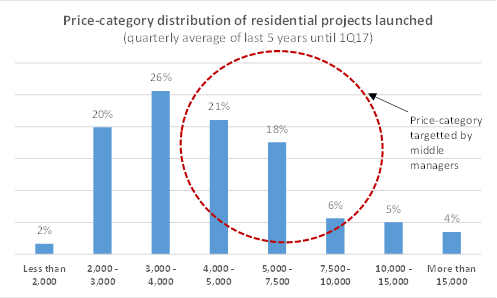
With this bracket of consumers coming under serious risk of a job loss, there is a possibility that recovery of residential sector in the mid-premium category will be delayed. JLL India’s REIS data on project launches over the last five years confirms this linkage here. The price category that middle management employees typically target are apartments in the price range of INR 4,000-10,000 per sft, which contributed close to 45% of the total project launches on an average in the five-year period until 1Q2017.
Source: JLL REIS
Due to the slowdown witnessed over last few years in Indian residential sector, luxury sales have been affected to a great extent. Mid-segment homes, however, were continuing to witness momentum, especially in projects of reputed developers. So, are we looking at a prolonged recovery in the residential asset class, given the current slack in IT job market?
If the current job market scenario continues for a long time, it could quite possibly have a negative impact on residential demand, especially in the mid-premium segment. Affordable and mid-segment homes, however, could see momentum thanks to a strong push by the government, low interest rates and the current slackening of prices.
The post Job Losses to Impact Residential Property Demand in IT Cities – Shubhranshu Pani, Managing Director – Strategic Consulting, JLL India appeared first on Core Sector Communique.
]]>The post Global survey reveals the impact of declining trust in the Internet on e-commerce appeared first on Core Sector Communique.
]]>24 April 2017 (Geneva) – A new global survey reveals that Internet users are increasingly concerned about their online privacy, and that 49 percent of users polled say lack of trust is their main reason for not shopping online.
 The survey, conducted by Ipsos and the Centre for International Governance Innovation (CIGI), in collaboration with the United Nations Conference on Trade and Development (UNCTAD) and the Internet Society, comes as data breaches and the reported hacking of elections in several European countries continues to capture international headlines. The survey results suggest that the resulting impact on trust is hindering further development of the digital economy.
Released today at the UNCTAD E-Commerce Week in Geneva, the 2017 CIGI-Ipsos Global Survey on Internet Security & Trust shows that among those worried about their privacy, the top sources of concern were cybercriminals (82%), Internet companies (74%) and governments (65%).
“The lifeblood of the Internet is trust, and when that is damaged, the consequences for the digital economy are nearly irreparable,” said Director of CIGI’s Global Security & Politics program Fen Osler Hampson. “The results of this global survey offer a glimpse into why policymakers should be concerned, and why there is a strong link between user trust and the health of e-commerce,” he said.
Lack of trust is most likely to keep people off e-commerce platforms in the Middle East, Africa and Latin America, suggesting that the potential gains of e-commerce are not spread evenly around the globe.
The survey also revealed great differences in e-commerce behavior when it came to how users are purchasing goods online. For example, in China, India and Indonesia, more than 86 percent of respondents expect to make mobile payments on their smartphone in the next year, compared with less than 30 percent in France, Germany and Japan.
Even in the digital world, location still matters. Fifty-five percent of global respondents indicated that they prefer purchasing online goods and services made in their own country.
“The survey confirms the importance of having adequate consumer protection and data protection in place, areas where many developing countries are lagging behind,” said Shamika N. Sirimanne, Director of UNCTAD’s Division on Technology and Logistics. “More capacity-building is therefore urgently needed,” she added.
The survey of 24,225 Internet users was conducted by global research company Ipsos, on behalf of the Centre for International Governance Innovation (CIGI) between December 23, 2016, and March 21, 2017. The survey was conducted in 24 countries—Australia, Brazil, Canada, China, Egypt, France, Germany, Hong Kong (China), India, Indonesia, Italy, Japan, Kenya, Mexico, Nigeria, Pakistan, Poland, Republic of Korea, South Africa, Sweden, Tunisia, Turkey, United Kingdom and the United States.
“Nearly 50 percent of Internet users surveyed do not trust the Internet and this lack of trust is affecting the way they use it. The findings of this year’s CIGI-Ipsos survey underscore the importance of taking action now to build stronger online trust by addressing users’ concerns and using technologies such as encryption to secure communications,” said Sally Wentworth, Vice President of Global Policy for the Internet Society.
For more information and to see additional data collected as part of the 2017 CIGI-Ipsos Global Survey on Internet Security and Trust, please visit: www.cigionline.org/internet-survey
We are the Centre for International Governance Innovation: an independent, non-partisan think tank with an objective and uniquely global perspective. Our research, opinions and public voice make a difference in today’s world by bringing clarity and innovative thinking to global policy making. By working across disciplines and in partnership with the best peers and experts, we are the benchmark for influential research and trusted analysis. More at: www.cigionline.org.
CIGI would like to recognize and thank the following sponsors for their generous support which facilitated the work of the Global Survey on one of the most pressing global public policy issues of our time, Internet governance: International Development Research Centre (IDRC), the Internet Society (ISOC), and the United Nations Conference on Trade and Development (UNCTAD).
The post Global survey reveals the impact of declining trust in the Internet on e-commerce appeared first on Core Sector Communique.
]]>The post A Cure for Paralysis, Tackling the Global Water Crisis, And How Self-Driving Cars Make Decisions – 300 Young Global Leaders Bring Ideas and Impact to Latin America appeared first on Core Sector Communique.
]]>
- Over 300 Young Global Leaders from across the world will take part in their Annual Summit in the run-up to the World Economic Forum on Latin America
- Nominated before the age of 40, they include artists, activists, entrepreneurs, policy-makers and technology pioneers; together, they highlight the need for new solutions to correct the shortcomings of market-driven capitalism and globalization
- Initiatives launched by Young Global Leaders include finding a cure for spinal paralysis, tackling water scarcity, creating a global emergency response network and pioneering waste-free economies
- For more information about the YGLs, please visit http://wef.ch/ygl
 Buenos Aires, Argentina, 30 March 2017 – Over 300 of the world’s top young artists, activists, business leaders, social entrepreneurs, technology pioneers, thinkers and policy-makers are coming to Buenos Aires, Argentina, for the Young Global Leaders and Alumni Annual Summit ahead of the World Economic Forum on Latin America.
The Annual Summit, held this year on 2-5 April, is the main gathering of the Forum of Young Global Leaders, a diverse and multidisciplinary community of young innovators who are collectively searching for solutions to some of the world’s biggest challenges. Initiatives launched by the Young Global Leaders have helped to search for a cure for spinal paralysis, develop the world’s largest vertical farm, and raise awareness of global water scarcity. A full list of YGL collaborations and impacts is available here: https://www.weforum.org/pages/ygl-collaborations.
Young Global Leaders at the summit include:
- Gina Badenoch, Photographer, Artist, Founder and Chief Executive Officer of Ojos que Sienten, Mexico; the organization encourages blind people to connect with the sighted world using the language of photography
- Mina Guli, corporate-lawyer-turned-activist, ultramarathon runner and Chief Executive Officer of Thirst – an organization that educates consumers about water conservation
- Pia Mancini, Co-Founder of OpenCollective and Chair of Democracy Earth, is re-imagining democracy for the digital era through non-profit organizations and venture-backed collaborative projects that could change the way citizens engage with politics
- Alec Oxenford co-founded tech unicorn OLX, one of the world’s biggest internet brands developed outside Silicon Valley; he is head of Letgo, which is taking on mobile marketplace giant Craigslist
- Luhan Yang of eGenesis Biosciences, is one of the world’s top scientists in genome editing; she co-invented the revolutionary genome-editing tool CRISPR-Cas9, and is engineering personalized organs for drug screening and, eventually, transplantation
- Rina Gee Kupferschmid-Rojas, Global Head of Sustainable Investing at UBS, founded ESG Analytics, a company that gives investors the research and rankings to integrate environmental, social and governance criteria into their investment choices
A full list of participants is available here.
“The world faces a leadership crisis. New solutions are needed and we believe that, by bringing together Young Global Leaders, we can help them build coalitions for change and find new ways to create an inclusive future. They are the role models that bring to this meeting the vision, boldness and collective experience that is so urgently needed in the world right now,” said Joanna Sparber, Deputy Head of the Forum of Young Global Leaders.
The World Economic Forum recently announced 100 new members who have been asked to join the community. Over 40 of them will meet their fellow YGLs in Buenos Aires for the first time. The full list of 100 is available at http://wef.ch/ygl17.
The World Economic Forum, committed to improving the state of the world, is the International Organization for Public-Private Cooperation.
The Forum engages the foremost political, business and other leaders of society to shape global, regional and industry agendas. (www.weforum.org).
The post A Cure for Paralysis, Tackling the Global Water Crisis, And How Self-Driving Cars Make Decisions – 300 Young Global Leaders Bring Ideas and Impact to Latin America appeared first on Core Sector Communique.
]]>