The post AfDB launches three projects worth US $26 million in Zimbabwe appeared first on Core Sector Communique.
]]>Harare, Zimbabwe, February 23, 2017 – The African Development Bank and the Government of Zimbabwe officially launched three projects worth US $26 million that were recently approved by the Bank’s Board of Directors. The three ventures are Alaska Karoi Transmission Reinforcement Project (US $18 million); the Youth and Women Empowerment Project (US $4 million) and the Institutional Support for State Enterprise Reform and Delivery Project (US $ 4 million).
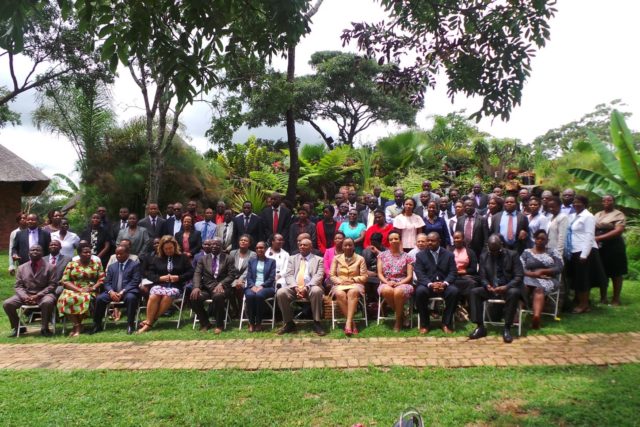
The project launch ceremony was officially opened by the Officer-in-Charge of the Zimbabwe Country Office, Mary Monyau, and the Minister of Finance and Economic Development, Accountant General, Daniel Muchemwa.
Muchemwa thanked the Bank for supporting the three projects that are aligned with the Government’s development agenda as outlined in Interim Poverty Reduction Strategy Paper (I-PRSP) and ZimAsset. “Approval of these projects is a testament to the cordial relationship between the AfDB and the Government of Zimbabwe”, he said.
The objective of the Alaska Karoi Transmission Reinforcement Project is to strengthen and increase the country’s sub-transmission network capacity resulting in increased reliability and quality of electricity supply in and around Karoi area (agricultural hub) and to develop a national masterplan for the generation, transmission and distribution of energy in the country.
The Youth and Women Empowerment Project will support the creation of employment opportunities and the improvement of the incomes of targeted women and youth groups, as well as, the improvement of gender mainstreaming in the country’s ministerial programmes.
The Institutional Support for State Enterprise Reform and Delivery Project will contribute to improved governance of State-owned enterprises and strengthening of results-based management systems within Government.
For her part, Monyau noted that the projects are consistent with the Government’s priorities as enshrined in the country’s main policy blue prints and strategies, the Bank’s Ten Year Strategy and the Bank’s High 5 priority areas, which focus on inclusive growth and economic transformation with support for lighting up and powering Africa, feeding Africa, industrializing Africa, integrating Africa, and improving the quality of life of the people of Africa. She congratulated the country for its collaborative efforts with the AfDB, which are a strong testimony of the importance the country is placing on issues of access to power and energy; women and youth development; and the governance of State-owned enterprises, in promoting economic growth and development that is inclusive and sustainable. She also emphasized the importance of absolute prudence in project execution for maximum development impact.
Speaking at the same occasion the Permanent Secretary in the Ministry of Energy and Power Development, P. I. Mbiriri, commended the African Development Bank for its support to the country.
The ceremony was attended by senior officials from the Office of the President and Cabinet, Ministry of Energy and Power Development, Ministry of Finance and Economic Development, State Enterprises Restructuring Agency (SERA), International Labour Organisation, African Capacity Building Foundation (ACBF), the German development agency GIZ and Zimbabwe Electricity Transmission and Distribution Company (ZETDC).
The launch was followed by a four-day training workshop for project beneficiaries on AfDB rules and procedures, including procurement and financial management.
The post AfDB launches three projects worth US $26 million in Zimbabwe appeared first on Core Sector Communique.
]]>The post ANIMAL PLANET’S NEW REALITY SERIES LODGING WITH LIONS FOLLOWS THE LION CONSERVATION PROJECT IN AFRICA appeared first on Core Sector Communique.
]]> New Delhi, July 13, 2015: Lions once roamed from the southern tip of Africa all the way to northwestern India. But today, their populations have declined drastically in Africa. Since 1975, 80-90% of the African lion population has been decimated, due to hunting, habitat loss, and disease. Several efforts are on-going to help save these animals, which play an important role in the food chain and Africa’s ecosystem.
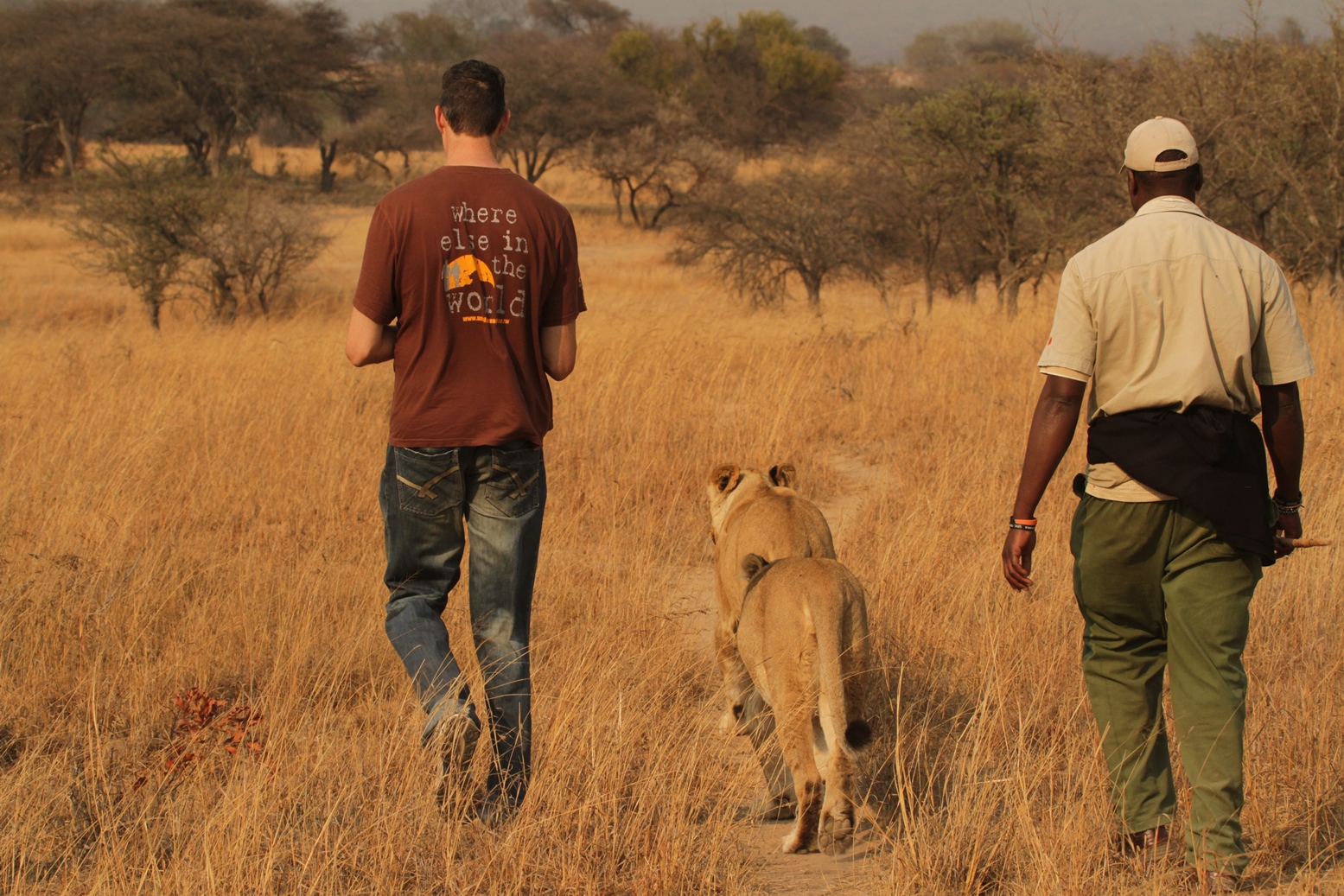
There is a place in Africa where you can walk with lions. Where you can be part of the pride. And this is exactly what a group of volunteers are doing, as they take part in a unique conservation programme at Zimbabwe’s Antelope Park. Animal Planet’s new series LODGING WITH LIONS follows the volunteers as they venture into the lions’ domain and find out more about these majestic animals – from how they hunt and stalk their prey, to how they play and nurture their young. This July, LODGING WITH LIONS airs on Animal Planet, every Monday to Friday at 9 pm.
At Antelope Park, Zimbabwe, a group of volunteers from all over the world have signed up for a unique conservation programme, which is part of the efforts of the African Lion and Environmental Research Trust (ALERT). For their own safety and survival, the volunteers must first learn how to read a lion’s posture, how to approach the lions in a non-threatening manner, and what to do when faced with a dangerous situation. Dan Matthews, who heads the volunteer programme, then introduces the volunteers to the lions affectionately known as the ‘Ds’ and the ‘Rs’. Over the course of two weeks, the volunteers will observe the lions, walk with them, watch them feed their cubs, follow them on hunts, and even tag them with microchips to obtain invaluable data which could help save lion populations. They also witness firsthand the devastating effects of poaching, and discover that in the African bush there are other dangers apart from wild beasts.
Follow these passionate volunteers who are LODGING WITH LIONS, discover the threats faced by the African lions, and find out what is being done to save these iconic animals known as ‘The King of the Beasts’.


About Animal Planet
Animal Planet is the world’s only brand that immerses viewers in emotional, engaging and passionate content devoted to animals – from wildlife to pets. Animal Planet connects humans and animals with rich, deep content and offers animal lovers access to entertainment, information and enrichment. Animal Planet launched in Asia Pacific in 1998 and is currently distributed to 180 million subscribers in the region.
About Discovery Networks Asia-Pacific
Discovery Networks Asia-Pacific, a division of the number-one pay-TV programmer Discovery Communications, is dedicated to satisfying curiosity, engaging and entertaining viewers with high-quality content through its portfolio of 14 brands. From survival to natural history, wonders of science to extreme jobs, motoring to travel and lifestyle, and the latest engineering marvels to live sporting events, each channel offers distinct must-watch programming to engage viewers across the region. The network’s 14 brands reach 674 million cumulative subscribers in 36 countries and territories with programming customised in 14 languages and dialects. For more information, please visit www.asia.discovery.com.
LODGING WITH LIONS – EPISODE DESCRIPTIONS
Episode 1 – New volunteers arrive at Antelope Park and Dan, the manager, takes them through the procedure of walking with lions. Natalia, one of the lion management interns feeds three baby cubs. The volunteers build a boma to entice zebra and wildebeest to come and eat. Once trapped the prey species will be transported to the release site. In the early evening the R lions make an impala kill on a walk.
Episode 2 – The volunteers participate in an exciting game capture mission. Once the boma is completed, the helicopter drives wildebeest into the funnel and the impala get caught up in the nets. Two intern researchers observe how lions react to different species and find out that catnip really does have a euphoric reaction. We learn about the cubs’ eating habits. A devastating poaching incident is discovered during a snare sweep. And a bush fire runs wild as the volunteers fight to control it.
Episode 3 – Dan takes the Rs on a routine walk that lead to a few chases. Volunteers make an enrichment toy for the lions in the form of a zebra skin with wooden legs! This gets the lions’ curiosity buzzing with excitement as they attack it. Leigh-Anne and the interns dart a microchip into the cubs. The Ds sharpen their hunting tactics and put their skills to the test as they chase after the prey, but did not succeed. A delicious snack is hidden in the enclosure for the lions to find.
Episode 4 – In this episode we catch the cubs being energetic on their routine walk. Leigh-Anne tries everything to trick the elephants for deworming. It takes a lot to mask the smell but they manage to do it in the end. Cub spoor is carefully measured and assessed for statistics. The volunteers visit and explore the local orphanage that Antelope Park supports. The lions show how high they are willing to jump for what they want, and the filming quad chopper has a narrow escape!
Episode 5 – A celebrity guest to Antelope Park studying human body language goes on her first lion walk and is intrigued by the various lion body language cues. Volunteers get their hands dirty in meat prep for a cub feast. The lions try to take on a zebra herd, and the volunteers come face to face with charging wildebeest and zebra. Laeli and Leywa take down an impala in front of Nicola, the celebrity guest, leaving her feeling shocked and amazed.
Episode 6 – Volunteers get down and dirty as they make a mud wallow for the elephants. A new volunteer group is introduced to the cubs and they get to learn the rules and regulations. Nathan teaches how to habituate animals in the new boma. Volunteers put in hard work as they repair huge gullies in the road. The Ngamo pride has an exciting hunt as a herd of wildebeest comes trotting right into the lions’ path. We then say farewell to some faithful volunteers.
Episode 7 – Dala and Rusizi go exploring and take great delight in getting wet in the process. The elephants put on an animated show for the horse safari at the Antelope Park dam. Leigh-Anne darts a male lion for relocation. A harrowing tale is told by Megan, the lion researcher whose father was killed by lions several years ago. Matthew, a photography intern captures a lion kill on his camera and he relays the story.
Episode 8 – Join Kate as she walks with lions for the first time and experiences them on the hunt for zebra. The two lions try their luck all morning but the zebra stallions dominate them. Volunteers are put to the test while building a hide to observe vultures from close range. Kate helps out during the lion enrichment building, and also experiences the gory side of Antelope Park.
Episode 9 – The volunteers witness a different side to elephants, as they are protected by the pachyderms during a wildebeest intrusion. Close encounters on a horse safari get the horses hot and bothered. Leigh-Anne darts a lioness for relocation. For the first time, the Antelope Park has six lions that go out on a walk together.
Episode 10 – Volunteers witness an exciting chase by the lions as they attempt to pursue wildebeest. A baby mongoose that was abandoned by its mother is found, and this new arrival is already making Antelope Part its home! Leigh-Anne needs to dart another lioness for relocation. The elephants of the park overwhelm an individual out on an elephant walk.
Episode 11 – Photographic volunteer witnesses Wakanaka kill an impala and was able to capture it on her camera. Leigh-Anne builds a den in preparation for a new cub. A zebra stallion attacks Ruvubu and bites her flank, and the cubs discover a tortoise on a walk.
Episode 12 – Leigh-Anne introduces us to the latest cub additions to the park. The cubs’ climbing abilities are put to the test on a walk. Nathan encounters two lionesses that succeed in killing an impala in the darkness – all of which is captured on camera by the photography intern. Volunteers say goodbye to the cubs on their final walk.
Episode 13 – The cubs are lively and playful on their morning walk. Volunteers are introduced to a different species… snakes! Nathan then shows them how to release snakes back into the bush. The T’s try their luck with a herd of wildebeest. A research intern talks about her experiments with the pride. The lions go on an exhilarating night encounter and take down an impala.
The post ANIMAL PLANET’S NEW REALITY SERIES LODGING WITH LIONS FOLLOWS THE LION CONSERVATION PROJECT IN AFRICA appeared first on Core Sector Communique.
]]>The post CLIMATE CHANGE AND AGRICULTURE IN SOUTHERN AFRICA appeared first on Core Sector Communique.
]]> CLIMATE CHANGE AND AGRICULTURE IN SOUTHERN AFRICA: New book helps region understand what might be in store and what to do about it
September 3, 2013, Maseru, Lesotho—The southern region of Africa could be the hardest hit by rising temperatures from climate change, leaving many to wonder what this means for agriculture. Will some areas become unsuitable for farming? Will farmers face lower yields, or turn to new crops? Will climate change threaten food security? These are challenging questions for policymakers, who must plan for the future without available information and analysis.
A new book, published by the International Food Policy Research Institute (IFPRI), and released today by three research organizations, starts to fill this information gap. Southern African Agriculture and Climate Change offers an analysis of the impact of climate change on the area’s agriculture, including full-color maps illustrating a variety of scenarios for eight of the region’s countries : Botswana, Lesotho, Malawi, Mozambique, South Africa, Swaziland, Zambia, and Zimbabwe.
“National climate change adaptation policies are not informed by robust research evidence combining socioeconomic and biophysical models,” said Sepo Hachingonta, program manager for the Food, Agriculture, and Natural Resources Policy Analysis Network (FANRPAN), a regional agricultural research and development organization. “This book offers that evidence but also urges additional and extensive cost-benefit analysis research on climate change adaptation alternatives.”
The book is the result of a collaboration between IFPRI, the CGIAR research program on Climate Change, Agriculture and Food Security (CCAFS), FANRPAN, and scientists from each of the countries. Using sophisticated modeling and available data to develop future scenarios and explore a range of climate change consequences for agriculture, food security, and resource management, the book offers recommendations to national governments and regional agencies.
Some findings from the book:
- Wheat is particularly vulnerable to high temperatures in most of the tropics, but in relatively temperate South Africa, yields could increase.
- Maize and sorghum yields, on average, will decline, yet some areas are bright spots and will see a rise, such as southern Mozambique.
- Crop yields might struggle to keep pace with anticipated population growth, but this could be offset by a projected doubling of incomes across the region.
- Migration patterns could change as people migrate out of areas hard hit by climate change to cities or to areas favored by climate change.
- Successful agricultural adaptation to climate change is not just about better seeds and practices, but building better roads and education systems, which give farmers greater access to markets and the background necessary to make fully informed decisions about new agricultural practices.
“Having data available in one place will provide national and regional policymakers with the necessary information to inform policy and decisionmaking,” said Tim Thomas, IFPRI research fellow. “The book serves as a compendium of scenarios looking at the impacts of climate change on agriculture in southern Africa and how it will affect farmers,” he added.
Southern African Agriculture and Climate Change is one of a three-part series examining climate change and agriculture in three regions of Africa: West Africa, East Africa, and southern Africa. It will be launched today at the FANRPAN High-Level Food Security Multi-Stakeholder Policy Dialogue, which is focused on scaling up agriculture best adapted to climate change. West African Agriculture and Climate Change was launched in April; East African Agriculture and Climate Change will be launched in Burundi at the 2nd Association for Strengthening Agricultural Research in Eastern and Central Africa General Assembly and Scientific Conference in December.
For more information, including country-specific reports, please visit: http://www.ifpri.org/pressroom/briefing/coping-climate-change-southern-africa
The International Food Policy Research Institute (IFPRI) seeks sustainable solutions for ending hunger and poverty. IFPRI was established in 1975 to identify and analyze alternative national and international strategies and policies for meeting the food needs of the developing world, with particular emphasis on low-income countries and on the poorer groups in those countries. It is a member of the CGIAR Consortium. www.ifpri.org.
The CGIAR Research Program on Climate Change, Agriculture and Food Security (CCAFS) is a strategic partnership of CGIAR and Future Earth, led by the International Center for Tropical Agriculture (CIAT). CCAFS brings together the world’s best researchers in agricultural science, development research, climate science and Earth System science, to identify and address the most important interactions, synergies and tradeoffs between climate change, agriculture and food security. www.ccafs.cgiar.org.
The Food, Agriculture and Natural Resources Policy Analysis Network (FANRPAN) is a multi-stakeholder, multi-national policy network that supports the development and implementation of better food, agriculture and national resources (FANR) policies in Africa. Its members include universities, research institutes, the business sector, farmer groups and other civil society organizations that have a stake in FANR policies. FANRPAN’s membership is organized into national nodes in sixteen countries, with a national secretariat hosted by an existing national institution that has a mandate for agricultural policy research and advocacy. FANRPAN also has a mandate to work Africa wide. www.fanrpan.org.
The post CLIMATE CHANGE AND AGRICULTURE IN SOUTHERN AFRICA appeared first on Core Sector Communique.
]]>The post Shadow trade: how North Korea’s barter trade violates United Nations sanctions appeared first on Core Sector Communique.
]]> (Stockholm, 17 July 2013) Barter trade in essential goods and long-standing diplomatic relations are key to understanding the most recent attempted violation of the United Nations arms embargo on the Democratic People’s Republic of Korea (DPRK, North Korea).
Expert Comment by SIPRI Researchers Hugh Griffiths and Lawrence Dermody
.On 16 July the President of Panama announced that his country had seized a North Korean ship transporting undeclared military cargo from Cuba destined for North Korea. The cargo consists of missile components, prohibited under the UN arms embargo.
However, while the world’s media focuses on the illicit missile technology it is the Cuban sugar destined for famine-stricken North Korea that highlights the barter trade that has played a central role in North Korea’s relations with countries willing to flout the highly restrictive sanctions regime imposed by the UN Security Council.
North Korea’s abundances and shortages
North Korea is poor and its people hungry but it has an abundance of Soviet-era military equipment as well as the technicians to service, repair and upgrade old Soviet or Chinese military equipment in exchange for food or much-needed foreign currency. In the past, this could have been rice (in the case of Myanmar) and Cuba is not short of sugar. Both commodities are in short supply in Pyongyang.
North Korea’s elite seeks to capitalize on the narrow range of goods and services its highly militarized society has to offer in exchange for basic foodstuffs. In a world of globalized, international trade, North Korea’s poverty and in particular its isolation makes its few remaining traditional ties to states such as Cuba all the more important for the regime’s psychological well-being.
Cold war era connections with Cuba
In the post-cold war era, North Korea’s trading partners outside of North East Asia – including Burma, Cuba, Democratic Republic of the Congo (DRC), Congo (Brazzaville), Eritrea, Ethiopia, Iran, Pakistan, Yemen and Zimbabwe – have also been named in connection to North Korean military or sensitive dual use missile technology transfers.
In some of these cases, precious foreign currency earnings played a major role but in the case of Cuba – another poor country — the value of the relationship is barter trade and a highly prized diplomatic and political relationship for North Korea, now the world’s most isolated UN member state.
North Korea’s Cuban connection has its roots in a bygone age when both countries benefited from subsidies and favourable trade agreements with the former Soviet Union. However, there are echoes from that past today. For example, a number of North Korean arms brokers — one of whom offered North Korean missiles to a British arms dealer subsequently convicted in the United Kingdom in 2012 — speak fluent Spanish.
The need for greater international information sharing
Nevertheless, the world has moved on since 1989 and North Korea’s most recent missile and nuclear tests have isolated the country further and have led to a tightening of UN sanctions that provide explicit wording on the inspection of suspect North Korean vessels. While barter trade and associated military transfers will continue to occur, greater international cooperation and information-sharing may also lead to an increase in the number of seizures.
For detailed analysis of North Korean ships and their involvement in arms and narcotics trafficking, download Maritime Transport and Destabilizing Commodity Flows, SIPRI Policy Paper No. 32, by Hugh Griffiths and Michael Jenks.
Hugh Griffiths (United Kingdom) is Head of the SIPRI Countering Illicit Trafficking—Mechanism Assessment Projects (CIT-MAP).
Lawrence Dermody (Australia) is a Researcher with CIT-MAP.
Stockholm International Peace Research Institute (SIPRI)
SIPRI is an independent international institute dedicated to research into conflict, armaments, arms control and disarmament. Established in 1966, SIPRI provides data, analysis and recommendations, based on open sources, to policymakers, researchers, media and the interested public.
SIPRI is regularly ranked among the top five international ‘go-to’ think tanks.
www.sipri.org
The post Shadow trade: how North Korea’s barter trade violates United Nations sanctions appeared first on Core Sector Communique.
]]>The post Rio Tinto opts to retain diamonds businesses appeared first on Core Sector Communique.
]]> Rio Tinto has decided to retain its diamonds businesses after concluding a strategic review which considered a range of options, including potential divestment.
Rio Tinto Diamonds & Minerals chief executive Alan Davies said “The medium to long-term market fundamentals for diamonds remain robust, fuelled by growing demand for luxury goods in Asia and continuing strong demand in North America.
“We have valuable, high-quality diamonds businesses that are well positioned to capitalise on the positive market outlook.
“After considering a number of alternative strategic ownership options it is clear the best path to generate maximum value for our shareholders is to retain these businesses.”
About Rio Tinto Diamonds
Rio Tinto operates a fully integrated diamonds business from exploration through to sales and marketing. It is one of the world’s major diamond producers through its 100 per cent ownership of the Argyle mine in Australia, 60 per cent of the Diavik mine in Canada and a 78 per cent interest in the Murowa mine in Zimbabwe. These three mines allow Rio Tinto to produce the full range of diamonds for all market segments. Rio Tinto also has an advanced diamond project, Bunder, in India.
Rio Tinto’s share of the production from its three operating diamond mines is sold through its sales and marketing headquarters in Antwerp, with representative offices in Mumbai, Hong Kong and New York. It also operates a niche cutting and polishing factory in Perth for the rare pink diamonds from its Argyle mine. Rio Tinto is a leading supporter of the Kimberley Process as well as a founding member of Bunder, in India.
Website: www.riotintodiamonds.com
About Rio Tinto
Rio Tinto is a leading international mining group headquartered in the UK, combining Rio Tinto plc, a London and New York Stock Exchange listed company, and Rio Tinto Limited, which is listed on the Australian Securities Exchange.
Rio Tinto’s business is finding, mining, and processing mineral resources. Major products are aluminium, copper, diamonds, thermal and metallurgical coal, uranium, gold, industrial minerals (borax, titanium dioxide and salt) and iron ore. Activities span the world and are strongly represented in Australia and North America with significant businesses in Asia, Europe, Africa and South America.
The post Rio Tinto opts to retain diamonds businesses appeared first on Core Sector Communique.
]]>The post Steel Minister Leads Delegation to Zimbabwe appeared first on Core Sector Communique.
]]> The Union Minister of Steel, Shri Beni Prasad Verma led a delegation to Zimbabwe to strengthen relations between the two countries in the areas of steel and mining. The Minister of Steel was received at the Harare airport by Prof Welshman Ncube, Minister of Industry and Commerce of the Republic of Zimbabwe on 8th April, 2013. Shri Verma was accompanied by Shri D.R.S. Chaudhary, Secretary (Steel), other senior officials of Ministry of Steel and CMDs of Public Sector companies under Ministry of Steel.
Shri Beni Prasad Verma had a series of meetings with different Ministers, starting with Minister of Mines and Mining Development, Mr. Obert Moses Mpofu. It was mentioned by Mr. Mpofu that the existence of a relationship over the years between the two countries could be seen in the cordial talks between the two Ministers. He acknowledged India’s role in the growth of Zimbabwe stating that many of the present functionaries have been educated in India. He requested the Minister of Steel to support Zimbabwe in developing its mineral resources. Shri Beni Prasad Verma was quick to respond with the assurance that companies in India will be in touch with the mines ministry to take it forward.
Speaking on the occasion Shri Verma said, “Zimbabwe has large reserves of low grade iron ore, the Indian steel industry can be a partner in developing and gainfully utilizing these resources.” He added that such ventures would be extremely beneficial and would further strengthen ties between the two countries. The Minister assured support to Zimbabwean entrepreneurs trying to set up base in India.
This was followed by a meeting with Mr. Walter Mzembi, Minister of Tourism and Hospitality, Government of Zimbabwe. The Zimbabwean Minister requested the Steel Minister to help in developing projects in the area of Iron ore, Coal, Gold, Diamond and Chrome. An MoU is under consideration between NMDC and a Govt Company of Zimbabwe.
This was followed by a meeting with Prof. Welshman Ncube, Minister of Industry and Commerce, Government of Zimbabwe.
The visit will strengthen relations between the two countries and give thrust to the possibility of exploration and development of mineral assets.
The post Steel Minister Leads Delegation to Zimbabwe appeared first on Core Sector Communique.
]]>The post Zimbabwe Diamond Conference ends on high positive note, Zimbabwe declared fully compliant with KP requirements appeared first on Core Sector Communique.
]]>|
Victoria Falls, Zimbabwe — November 13, 2012: The Zimbabwe Diamond Conference 2012 concluded today successfully after two days of talks, presentations and discussions in the presence of His Excellency President Robert Mugabe, former president of South Africa, Thabo Mbeki, ministers of mining from other African diamond producing countries and many international diamond industry leaders and diamond company captains.
The conference focused on resolving the outstanding obstacles that currently continue to restrict the free flow of rough diamonds from Zimbabwe into the downstream markets.
In his closing statement, Honourable Minister of Mines and Mine Development, Obert Moses Mpofu said that he is delighted with the unequivocal reaffirmation issued by the Kimberley Process Certification System Chair that Zimbabwe is fully KP compliant.
Minister Mpofu reported that the conference had attracted more than 480 participants, deeming it one of the best attended diamond conferences in recent times. He recognized, lauded and thanked the many governmental dignitaries and captains of industry for making their way to Victoria Falls and for their valuable contributions to the conference’s programme, presentations and discussions.
“It was our great pleasure and honour to host you here and we hope this visit will serve as standing invitation for you all to come back soon,” he said.
Noting that Zimbabwe may well hold in excess of 25 percent of the world’s diamond deposits, and adding that wide prospective areas are still to be explored, he elaborated: “At this conference, it has become very clear how important and pivotal our country’s diamond mining sector is, not only for the economy of Zimbabwe at large but also for the social and economic development of local communities,” he said.
“Therefore, to assure that Zimbabwe will continue toward positive economic development, it is pertinent that we can successfully trade rough diamonds and that there is a free flow of funds between – legitimate – diamond trading companies,” Minister Mpofu added.
At the concluding session, on the conference’s second day, Eli Izhakoff, president of the World Diamond Council, announced that, pending WDC board approval, he will engage the United States Treasury and the European Community to lift sanctions on diamonds from Zimbabwe, to preserve the integrity of the KP system.
Thanking the WDC president for his initiative, minister Mpofu said that he consequently intends to call upon the NGO’s to desist their campaigning against Zimbabwe in the various downstream markets.
|
|
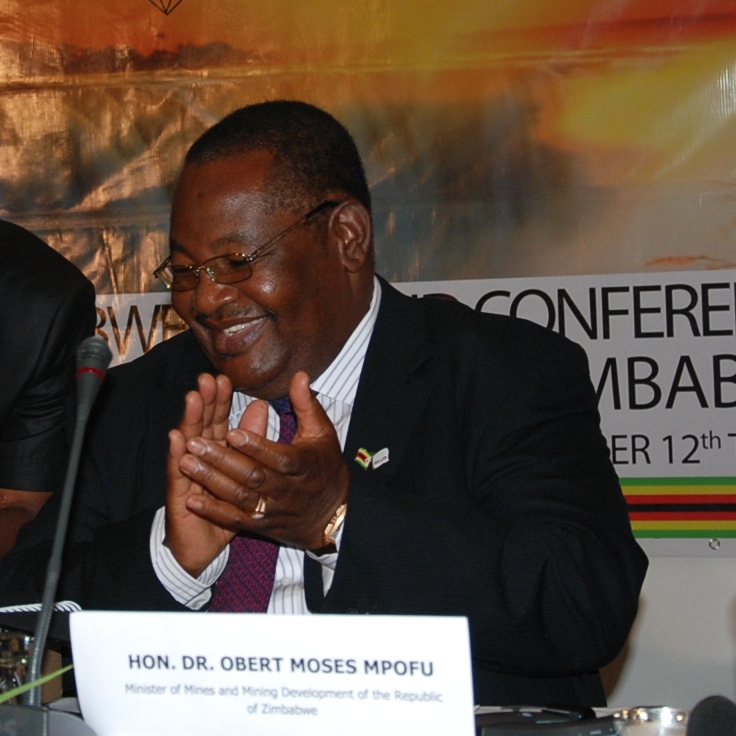
Obert Moses Mpofu, Minister of Mining and Mine Development Mugabe of Zimbabwe, at the Zim Diamond Conference on November 13, 2012, at the Elephant Hills Resort in Victoria Falls, Zimbabwe.
|

The post Zimbabwe Diamond Conference ends on high positive note, Zimbabwe declared fully compliant with KP requirements appeared first on Core Sector Communique.
]]>