The post Catalyst CEO Champions for Change Outperform the S&P 500 for Advancing Women Leadership in the Workplace appeared first on Core Sector Communique.
]]>
Pitney Bowes is a Proud Member of Catalyst CEO Champions for Change
STAMFORD, CT, November 7, 2017: Pitney Bowes (NYSE: PBI), a global technology company that provides innovative products and solutions to power commerce, is being recognized today by the Catalyst CEO Champions For Change initiative. Catalyst CEO Champions for Change is a collective of 50 high-profile CEOs who visibly support and drive diversity, inclusion and gender equality within their organizations to advance women into leadership roles. According to a progress report released today by Catalyst, using baseline data mined from all Catalyst Champion companies, findings show that the Catalyst Champion organizations, including Pitney Bowes, are outperforming their peers in the S&P 500 in all areas of women’s representation.

Pitney Bowes has previously earned the Catalyst Award for its diverse and inclusive practices toward women who now represent 42% of its global workforce, 27% of its senior management, 30% of direct reports to the CEO, and 36% of its Board of Directors.
“We commend Pitney Bowes along with the other Catalyst Champion CEOs who represent a passionate group of change agents. They are already leaders and champions of gender equality and inclusion. Now they are taking bold action, holding themselves publicly accountable for doing the right thing and inspiring all of us to do more,” says Deborah Gillis, President and CEO, Catalyst.
“Our commitment to diversity, inclusion, and open markets is the right thing to do, it’s imperative for our business, and it is core to who Pitney Bowes has been for nearly 100 years,” said Marc Lautenbach, President and CEO of Pitney Bowes. “Our company has evolved and adapted throughout almost a century of change, guided by these unassailable truths. We will continue to be vigilant to our values which are that we do the right thing the right way.”
Findings from the report include:
- Catalyst Champion companies outperform their S&P 500 peers in advancing women at all levels of the organization, specifically among board seats (29.0% Catalyst Champion vs. 21.2% S&P 500), executive/senior-level positions (27.9% Catalyst Champion vs. 26.5% S&P 500) and first-/mid-level positions (38.4% Catalyst Champion vs. 36.9% S&P 500).
- Catalyst Champion companies outperform their S&P 500 peers in advancing women of color at all levels of the organization, specifically among board seats (6.0% Catalyst Champion vs. 3.8% Fortune 500[1]), executive/senior-level positions (5.2% Catalyst Champion vs. 4.7% S&P 500) and first-/mid-level positions (11.3% Catalyst Champion vs. 10.5% S&P 500).
To add context, even what looks like relatively small progress in some cases can have a large impact. For example, Catalyst’s analysis shows that improving the total number of women in leadership roles by 1% across all S&P 500 companies would result in 12,000 more women in these roles.
About Pitney Bowes
Pitney Bowes (NYSE:PBI) is a global technology company powering billions of transactions – physical and digital – in the connected and borderless world of commerce. Clients around the world, including 90 percent of the Fortune 500, rely on products, solutions, services and data from Pitney Bowes in the areas of customer information management, location intelligence, customer engagement, shipping, mailing, and global ecommerce. And with the innovative Pitney Bowes Commerce Cloud, clients can access the broad range of Pitney Bowes solutions, analytics, and APIs to drive commerce. For additional information visit Pitney Bowes, the Craftsmen of Commerce, at www.pitneybowes.com.
About Catalyst
Catalyst is a global nonprofit working with some of the world’s most powerful CEOs and leading companies to help build workplaces that work for women. Founded in 1962, Catalyst drives change with pioneering research, practical tools, and proven solutions to accelerate and advance the progress of women into leadership — because progress for women is progress for everyone.
The post Catalyst CEO Champions for Change Outperform the S&P 500 for Advancing Women Leadership in the Workplace appeared first on Core Sector Communique.
]]>The post How a Workplace Can Truly Win Employees’ Hearts appeared first on Core Sector Communique.
]]> Anurag Mathur, CEO – Project & Development Services, JLL India
A survey-based report recently released by JLL confirms that Indian employees are the most engaged in the world. 69% of the Indian respondents feel ‘very engaged’ at work – way above the global average of 40%. China ranks second-highest with a 50% score, while Japan lags far behind with a mere 27% feeling engaged at work.
Basis these findings, here’s how India stacks up against the world:
| Country | Employees feeling ‘very engaged’ at work | Employees feel they can work effectively | Working in an open plan setup | Office density |
| India | 69% | 74% | 43% | 52% |
| Hong Kong | 23% | 35% | 70% | 39% |
| Japan | 27% | 37% | 60% | 68% |
| Australia | 38% | 48% | 51% | 37% |
| China | 36% | 49% | 20% | 32% |
| Global | 40% | 51% | 40% | 45% |
These findings led to an interesting question – what is the key ingredient for an effective and engaging workplace which can truly win the hearts of its employees? JLL dove deeper to analyse this, and found that the fairly simple answer to what contributes to a high employee engagement score– great workplace design – may only be superficial.
While 69% of the Indian employees feel ‘very engaged’ at work, only 43% currently working in an open-plan setup. Further, an interesting finding on Japan surfaced. Japan is a front-runner of the open workspaces concept in APAC, but it still reports only 27% employee engagement at work. This would indicate that it may not be only an open plan office setup that makes a workplace highly conducive for employee engagement. There has to be more to it.
To second this, we discovered that while China is second after India with 50% respondents reporting engagement at work, only 20% of its working population currently work in open plan setups. JLL also discovered that Chinese offices are the least crowded (32%) – half the density seen in Japan (68%).
This is certainly food for thought. Low office density means higher penetration of innovative facilities and amenities, which directly correlate to higher employee engagement and effectiveness. Matching this finding to the fact that close to 50% of the Chinese respondents report feel that their organisations let them work effectively, we can conclude that office density has a role to play in making workplaces effective and engaging. This is further vouchsafed by the fact that Japan reports 27% employee engagement with 68% office density.
Another interesting China-related finding was that Chinese employees are most willing to embrace change. 76% are willing to move to an open-plan layout in exchange for better workplace amenities, and 60% are willing to relinquish their personal workspaces in favour of hot-desking.
Australia presents an interesting contrast – though 51% of polled employees report being comfortable with working in open-plan offices, there is also some resistance for further change evident – nearly 1/3rd of employees are reluctant to shift to hot-desking. What can we learn from this?
Certainly, it could indicate that change management programmes are as important as change itself in driving employee effectiveness and engagement, especially in the more agile workplace environments of today where new office layouts and innovative space offerings are on the rise.
A key take-away: The question is no more related to which workplace design works best. The real question is how a workplace can create excellent Human Experiences and win the trust of employees to make them more receptive to change. Basically, it is all about creating workplaces that really work for their employees – and here, change management plays an inevitable role.
The post How a Workplace Can Truly Win Employees’ Hearts appeared first on Core Sector Communique.
]]>The post 70% women employees regret their workplace is NOT female friendly: reveals TimesJobs’ TJinsite Report appeared first on Core Sector Communique.
]]> Talk of women empowerment and progression in India Inc. seems to have ignored the basics when it comes to providing meaningful career opportunities to its women employees, as most women professionals don’t consider their workplaces women friendly, reveals a TimesJobs study.
April 04, 2017: As part of the celebrations for International Women’s Day last month, TimesJobs undertook an in-depth TJinsite study to gauge the pulse of working women in India with candid inputs from over 2,500 working women.
This report reveals that though, most organizations claim to offer equal opportunities to men and women but their own women employees feel very differently, as nearly 90% women professionals say there isn’t much equality in their organization when it comes to career progression. Stating promotions, opportunities for leadership roles, salary increases and incentive programs are biased towards men.
While rating the work aspects which directly or indirectly help in creating a women friendly workplace, 70% women disagreed that their own workplace was female friendly.
Here is what they have to say on other key workplace aspects:
Leadership opportunities
Almost 95% respondents rated female representation in their organization’s top leadership as poor. Sadly, none of the surveyed women professionals rated women representation in top leadership at their organization as good.
Career opportunities
Over 75% women rated the management opportunities provided by their organization for female professionals as poor. In addition, 40% women professionals rated satisfaction with their salaries as poor, 50% as just average and only 10% rated it as good.
Learning opportunities
Given that role transition is now a routine part of working life, continued learning should be viewed as a necessity, but this clearly is not the case for many women professionals who feel they miss out on growth opportunities because of lack of proper training and upskilling initiatives. Almost 75% of women state that learning opportunities at their company is poor.
Mentorship initiatives
In addition, 80% women professionals rated sponsorship or mentorship initiatives at their organization as poor. This is surprising, considering corporate mentoring is on the rise with most Fortune 500 companies offering professional mentoring programs to their employees.
Flexibility options
Workplace flexibility remains one of the key reasons for people to join or leave a company. However, 70% women employees rate flexibility in their organization as poor. Almost 80% of these women professionals are even ready to forego promotions in favor of better work life balance. In addition, 60% women professionals rated the ability to telecommute for work as poor, and only 5% voted it as good in their organizations.
Maternity provisions
35% women professionals rated maternity provisions at their workplace as poor, 55% voted them as average and only 10% agreed that these provisions were good. While the recent amendments to the maternity bill have given hope to women professionals, the ground reality is that these changes have not been adopted by many companies yet.
“It is disturbing that even after decades of aggressive efforts to create a level field for women, inequity appears entrenched in Indian organizations. We hope this TimesJobs study is a clarion call for companies to acknowledge this gaping need – look at the problem areas highlighted and find practical solutions to help talented women professionals advance in their careers,” says Nilanjan Roy, Head of Strategy, Times Business Solutions.
Click here to download the complete TimesJobs TJinsite report – http://bit.ly/2ny3pYg
About TimesJobs.com:
TimesJobs.com, a flagship business of Times Business Solutions (TBS), is a platform to help competent professionals make smarter career decisions. With over 25 million registered jobseekers across the board and more than 60 million page views every month, it is fast becoming the most preferred career portal among the candidates.
TimesJobs is leading in the recruitment and employment space with its pioneering and dynamic divisions because it successfully meets all the needs of the jobseekers. Its major platforms include:
- TechGig: India’s biggest dais for tech professionals to help them Learn, Showcase & Compete in the IT industry.
- JobBuzz: A well-known portal that provides information & insights about different companies, job profiles and interview processes.
- StepAhead: StepAhead offers Professional Resume writing and distribution services, career astrology, resume improvement to help jobseekers accelerate their career.
Also, TimesJobs has the largest collection of jobs in the market, which ensures that whenever and wherever there is a great opportunity, jobseekers will discover it on the platform.
In the recruitment market as well, being the biggest platform for competent professionals who think of their careers first, TimesJobs has become the destination of choice for recruiters who seek to engage with the right talent.
The post 70% women employees regret their workplace is NOT female friendly: reveals TimesJobs’ TJinsite Report appeared first on Core Sector Communique.
]]>The post Konica Minolta announces Workplace Hub, the world’s most connected intelligent edge platform for the workplace of the future appeared first on Core Sector Communique.
]]>
~Konica Minolta partners with Microsoft, HPE, Sophos, Canonical and BrainTribe to future-proof business IT management~
 India: March 31, 2017 – Konica Minolta Inc. (Konica Minolta) has introduced Workplace Hub, an innovative new enterprise IT solution that unifies all of an organisation’s technology via a single centralised platform. Designed to future-proof workplaces of every size as they work towards digital transformation, version one of Workplace Hub, available from October 2017, directly addresses growing IT complexity by providing more efficient and effective management of the disparate array of tools, services and devices used by modern organisations.
This new platform represents the next phase of Konica Minolta’s long history in innovation, marking its position in the IT services market and perfectly placing the firm to meet the evolving needs of business customers. Acting as a central hub that simplifies IT for an organisation, Workplace Hub drives efficiencies by reducing the overall costs of IT management and service provision, and providing real-time data-driven insights that help to improve business processes. By creating an ecosystem to manage and coordinate the entire IT infrastructure and services across existing and future IT systems, devices and services, Workplace Hub provides users with a central dashboard showing 360-degree visibility of IT usage patterns across the whole business, allowing for simple management and optimisation of systems.This new platform represents the next phase of Konica Minolta’s long history in innovation, marking its position in the IT services market and perfectly placing the firm to meet the evolving needs of business customers. Acting as a central hub that simplifies IT for an organisation, Workplace Hub drives efficiencies by reducing the overall costs of IT management and service provision, and providing real-time data-driven insights that help to improve business processes. By creating an ecosystem to manage and coordinate the entire IT infrastructure and services across existing and future IT systems, devices and services, Workplace Hub provides users with a central dashboard showing 360-degree visibility of IT usage patterns across the whole business, allowing for simple management and optimisation of systems.
Moreover, the platform’s product roadmap includes future integration of IoT, Artificial Intelligence, Intelligent Edge and Decision Support capabilities as they become more central to the business environment of tomorrow. Adding this cognitive layer of organisational insight unleashes an intuitive understanding of the world that empowers people to collaborate better and to make smarter, data-driven decisions more effectively and easily.
Global partnerships with HPE, Sophos and Microsoft deliver best in class hardware, security and IT solutions. Additional services from Canonical and BrainTribe bring the power of open source and advanced data management, helping to facilitate effective digital transformation for any business.
Dennis Curry, a Vice President and Director of Business Innovation and R&D at Konica Minolta, said “Workplace Hub will evolve to become the most comprehensive platform for the services and capabilities demanded by the workplace of the future. It means businesses can grow and manage their IT in tandem with changing business needs. It simplifies IT operations today and paves the way for exciting new integrations, such as AI and intelligent edge computing, to become a central part of the digital organisation of the future.”
This strategic shift will allow Konica Minolta to deliver more comprehensive digital transformation solutions, while continuing its heritage of providing the very best products and services for the business market as a whole.
”The new age businesses have dynamic workloads, giving rise to the need for a holistic solution synched in a single platform. Workplace hub come as an answer to the growing complexities associated with diverse work related requirements, furnishing unprecedented management of a host of different devices, platforms and tools. This will not only help businesses in significantly enhancing their output but will also lead to increased in house efficiency,” said Yuji Nakata, Managing Director, Konica Minolta India.
“The workplace is evolving at an unparalleled rate and digital transformation is becoming increasingly important to both survival and future prosperity,” said Shoei Yamana, CEO and President of Konica Minolta Inc. “Workplace Hub not only allows businesses of all sizes to achieve effective transformation, but future-proof themselves against the next wave of technology innovations already infiltrating the business environment.”
Workplace Hub version one will be available from October 2017 to organisations looking for enterprise quality managed services at an affordable price.
More information on the launch event, keynote speakers and panel discussions can be found at workplacehub.konicaminolta.com.
About Konica Minolta
Konica Minolta, Inc. is a global technology company that provides innovative solutions to businesses and society. With its strengths in the combination of its core technologies in advanced imaging, optics, sensing, materials and nano-processing, Konica Minolta is committed to create new values that help customers address challenges in their operations and work processes. Advancing its expertise in digital technologies, the company has been going through business transformation into problem-solving digital company across the board as One Konica Minolta in the era of Internet of the Things (IoT). Konica Minolta is also active in open innovation through various collaborations and alliances with academic, industrial and entrepreneurial partners.
The post Konica Minolta announces Workplace Hub, the world’s most connected intelligent edge platform for the workplace of the future appeared first on Core Sector Communique.
]]>The post Zulekha Hospital encourages tranquillity, happiness in workplace by promoting balanced lifestyle appeared first on Core Sector Communique.
]]>‘HAPPINESS WITH YOGA’ SESSION BOOSTS EMPLOYEES, FAMILIES WELLBEING
Zulekha Hospital encourages tranquillity, happiness in workplace by promoting balanced lifestyle
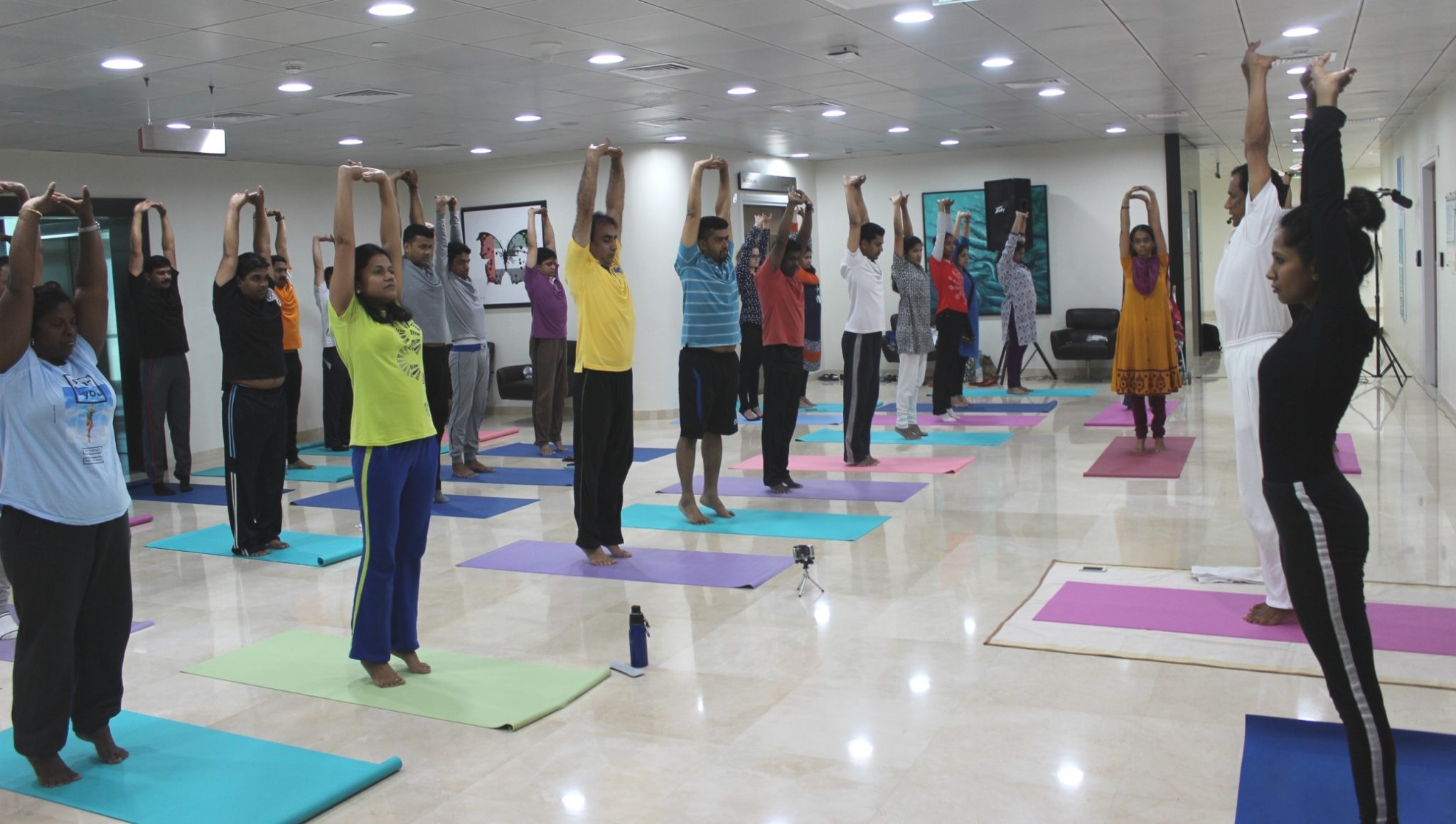
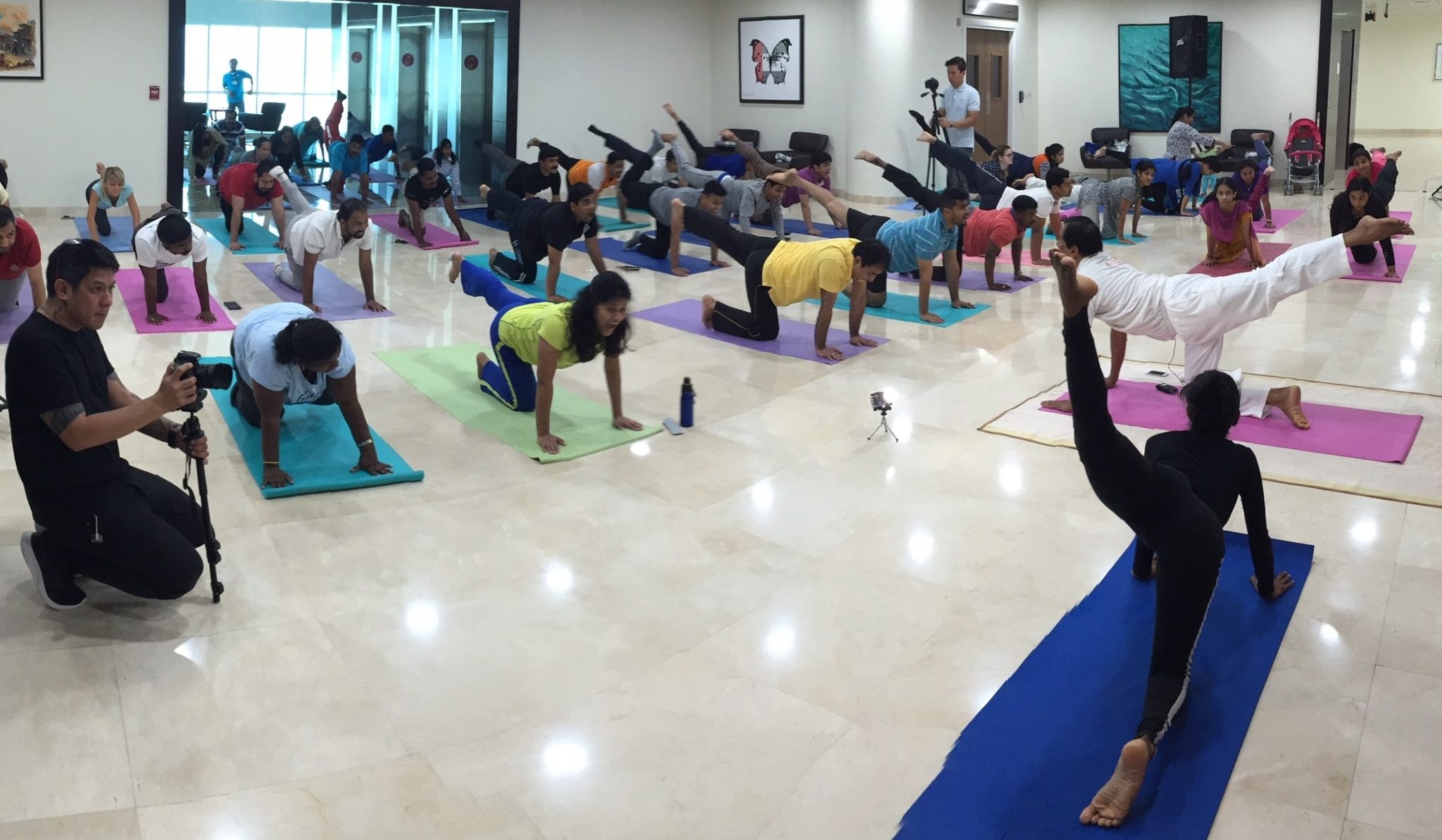
Dubai, UAE, 9 June, 2016: Dozens of nurses, doctors, admin officers and their families took part in a new ‘Happiness with Yoga’ session organised by Zulekha Hospital as part of their commitment to boosting their staff health and the wellbeing of the UAE community.
Leading up to the celebrations of International Yoga Day (21 June), the ‘Happiness with Yoga’ session was delivered by Augustine Joseph, a well-known yoga instructor, awarded with the Certificate of Honour from the Institute of Naturopathy and Yogic Sciences in Bangalore, India for his outstanding contribution in promoting yoga.
As a long-standing member of Friends of Yoga, Augustine shared his knowledge and passion for the practice alongside Afreen Khan, Marketing Executive at Zulekha Hospital and a yoga enthusiast. Together, they demonstrated to the hospital staff, their partners and families twelve easy sun salutation poses, and practiced laughing, clapping, and meditation techniques that can be done at a workplace to help improve concentration while decreasing stress levels.
Ms Zanubia Shams, Co-Chairperson of Zulekha Hospitals, took part in the session alongside colleagues at the Sharjah facility. She said: “It was a great session and it was heart-warming to see our staff taking part in this body and mind event with so much enthusiasm.
“Recent United Nations statistics position the UAE as the 28th happiest country in the world and we want to leverage its ranking by promoting a healthy lifestyle within the organisation as we recognise that only healthy, relaxed and content employees are capable of contributing to the happiness of our patients and the UAE community at large.”
Celebrated globally, International Yoga Day was originally proposed in India with support from 175 United Nations member states before becoming officially established by United Nations General Assembly (UNGA) in 2014. It has been observed in the UAE since, and numerous official organisations, such as the Indian Consulate at the Dubai World Trade Centre will hold yoga sessions this year.
Ms Shams added: “We want to contribute to the series of events organised in the run-up to International Yoga Day as we feel it’s extremely important to raise awareness of the benefits of practicing yoga on a community, national and international level.”
 Zulekha Hospital has received multiple awards for their health awareness initiatives aimed at improving the lifestyle, wellbeing, and the environment of the UAE community. From organising blood donation drives, sustainability-themed initiatives, to cancer awareness campaigns, the hospital has developed a versatile plan for inspiring wellness and happiness.
Aligned to its “Your Health Matters” approach, Zulekha Hospital is currently running a ‘Smear, Don’t Fear’ Cervical Cancer Awareness Campaign, offering free specialist consultations and Pap tests until June 30.
The post Zulekha Hospital encourages tranquillity, happiness in workplace by promoting balanced lifestyle appeared first on Core Sector Communique.
]]>The post Aiming for Gender Parity in the Workplace and at Home: It Has to Be a Men’s Issue too appeared first on Core Sector Communique.
]]>- A key step in achieving progress towards gender parity is to gather the data needed to get an accurate picture of the positions of men and women in the world today
- It is important to address gender expectations even when young, said Facebook’s Sandberg: “Men are expected to lead and women are expected to nurture”
- Canadian PM Trudeau: “Men have to be a big part of this conversation.”
- For more information about the Annual Meeting 2016, visit www.weforum.org
 Davos-Klosters, Switzerland, 22 January 2016 – In a session on gender parity at the World Economic Forum Annual Meeting 2016, government and business leaders agreed that to make meaningful progress in narrowing the gender gap requires abandoning set expectations for the roles of men and women, recognizing the benefits of diversity, and getting more men to commit to addressing this global challenge.
Even from a young age, “men are expected to lead and women are expected to nurture,” said Sheryl Sandberg, Chief Operating Officer and Member of the Board of Facebook in the US. Added Jonas Prising, Chairman and Chief Executive Officer of ManpowerGroup, USA: “To have women not participate when they do have the skills is sub-optimization on a massive scale.”
A key step to making progress towards gender parity is to have a clear and accurate picture of the gaps, said Melinda Gates, Co-Chair of the Bill & Melinda Gates Foundation in the US. “We need a good repository of data to know where we are with men and women in the world,” she noted. Gender inclusion has a multiplier effect, Gates argued. “When society gets that virtual circle going for men and women, everybody is lifted up.”
Sandberg agreed. “The reason to work towards equality – whether woman or man – is that it is better for you,” she explained. “We should be doing this not because it’s the right thing, but because it’s the smart thing. If you engage and build diverse teams, you will outperform. So do it because it will help you,” she said.
On becoming prime minister of Canada in November last year, Justin Trudeau appointed a gender-equal cabinet. Asked about that decision, Trudeau explained that he could not have achieved the balance if he and his party had not made concerted efforts in the years running up to the election to recruit women to run for parliament. “There was a lot of hard work we had to do,” he acknowledged. “With gender parity and diversity, you are getting better decision-making and governance.” It allows for a more conciliatory and problem-solving approach to government and politics, Trudeau reckoned.
The use of quotas to bolster women’s participation in leadership positions can have a positive impact. “I believe in such quotas,” said real estate entrepreneur Zhang Xin, Chief Executive Officer and Co-Founder of SOHO China. Sandberg had reservations: “While quotas may be good in certain circumstances, we can’t rely on them to change things to which they are not applied.”
Trudeau asserted that, to achieve a gender-balanced cabinet, he did not have to compromise on the quality of the ministers he selected. His priority for speeding up progress in achieving gender parity: Get men involved. “Men have to be a big part of this conversation,” the prime minister said. Men, he concluded, “shouldn’t be afraid of the word ‘feminist’ and men and women shouldn’t be afraid of describing themselves as feminist.”
Separately, members of the World Economic Forum’s Oil & Gas community released a “Call to Action” for the industry to close the gender gap within the sector. Endorsed by 22 leading companies and posted on the Forum website, the declaration includes seven guiding principles for the group’s efforts to address the gender gap.
The post Aiming for Gender Parity in the Workplace and at Home: It Has to Be a Men’s Issue too appeared first on Core Sector Communique.
]]>The post MENA EMPLOYERS SHARE U.S. CONCERNS OVER STUDENT SKILLS FOR WORKPLACE – EDUCATION EXPERT appeared first on Core Sector Communique.
]]>
MENA Higher Education Leadership Forum in Abu Dhabi will be told students fear they are not well prepared by universities for careers
Dubai, UAE, 26 October, 2015: MENA region employers share the concern of counterparts in the U.S. that universities are not preparing students with sufficient key skills needed for the workplace, an American higher education expert says.
Dr. Kathleen S. Ives, CEO & Executive Director, Online Learning Consortium – formerly known as Sloan Consortium, will tell the second MENA Higher Education Leadership Forum in Abu Dhabi next month that growing numbers of students also fear they are not well equipped to pursue their chosen careers. Ives joins the list of international speakers and will address audiences on the overriding theme of innovation and technology.
“Emerging trends in the MENA region parallel those occurring in the United States,” said Dr. Ives, one of 25 influential speakers who will be addressing the forum taking place from 9-11 November at the Dusit Thani Abu-Dhabi.
“Research indicates 71% of MENA region employers remained apprehensive as to whether the current education system produces students with capabilities and skills deemed appropriate for the workforce.
“In the United States, one in five employers believe higher education institutions do not prepare students with important workplace competencies, such as soft skills like collaboration, communication, leadership, and real-world experiences, which would be supported through participation in internships and, or apprenticeships.”
Added Dr. Ives: “Students are also beginning to feel the pressure. One in two in the UAE are currently pursuing a field in either business or engineering, yet 32% believe they are not truly equipped with the skills and training required for their chosen career.
“Similarly, in Saudi Arabia nearly half of all local students reported these concerns. Meanwhile, in the United States, 10.5% of young college graduates are neither enrolled in graduate courses nor employed , compared with 8.4% in 2007.”
Higher education leaders and decision makers from 50 countries across the region and worldwide will attend the second MENA Higher Education Leadership Forum, which is being held under the patronage of H.E. Sheikh Nahyan bin Mubarak Al Nahyan, Minister of Culture, Youth, and Community.
The event is organised by the Dubai-based Center for Learning Innovations and Customized Knowledge Solutions in partnership with the Association of Arab Universities, the International Council for Open and Distance Education and the Leadership Higher Education Foundation.
The forum is supported by Forum Partners, International Council for Open and Distance Education, Leadership Foundation for Higher Education; Diamond Sponsor, ITS; Bronze Sponsors, Turning Technologies, Intaglio; and Supporter, C&K Management ltd.
Dr. Ives places a big emphasis on technology and innovation in the future improvement of higher education. “Advances in technology are now inexpensive and abundantly available,” she says. “Online learning and competency-based models, where learners earn credit based on how much they learn rather than time spent in class, can reduce the cost of post-secondary education.
“What is key to this educational transformation is a focus on professional development for both faculty members and higher education administrators. If universities and colleges are to play a pivotal role in the stability, development, economic prosperity of society, the spirit of innovation must be embraced..”
More details of the event and a full list of keynote speakers and panelists can be found on the Forum’s official website at www.menahelf.com
The post MENA EMPLOYERS SHARE U.S. CONCERNS OVER STUDENT SKILLS FOR WORKPLACE – EDUCATION EXPERT appeared first on Core Sector Communique.
]]>The post 2095: The Year of Gender Equality in the Workplace, Maybe appeared first on Core Sector Communique.
]]>- Nine years of the Global Gender Gap Report suggests we’ll have to wait 81 years for gender parity in the workplace
- Overall gains in gender equality worldwide since 2006 are offset by reversals in a small number of countries
- Nordic nations dominate the Global Gender Gap Index in 2014; Nicaragua, Rwanda and the Philippines all make the top 10
Geneva, Switzerland, 28 October 2014 – In nine years of measuring the global gender gap, the world has seen only a small improvement in equality for women in the workplace. According to theGlobal Gender Gap Report 2014, launched today, the gender gap for economic participation and opportunity now stands at 60% worldwide, having closed by 4% from 56% in 2006 when the Forum first started measuring it. Based on this trajectory, with all else remaining equal, it will take 81 years for the world to close this gap completely. The ninth edition of the report finds that, among the 142 countries measured, the gender gap is narrowest in terms of health and survival. This gap stands at 96% globally, with 35 countries having closed the gap entirely. This includes three countries that have closed the gap in the past 12 months. The educational attainment gap is the next narrowest, standing at 94% globally. Here, 25 countries have closed the gap entirely. While the gender gap for economic participation and opportunity lags stubbornly behind, the gap for political empowerment, the fourth pillar measured, remains wider still, standing at just 21%, although this area has seen the most improvement since 2006. With no one country having closed its overall gender gap, Nordic nations remain the most gender-equal societies in the world. Last year’s leading four nations – Iceland (1), Finland (2), Norway (3) and Sweden (4) – are joined by Denmark, which climbs from eighth place to fifth. Elsewhere in the top 10 there is considerable movement, with Nicaragua climbing four places to sixth, Rwanda entering the index for the first time at seventh, Ireland falling to eighth, the Philippines declining four places to ninth and Belgium climbing one place to tenth. Further up the index, the United States climbs three places to 20 in 2014, after narrowing its wage gap and improving the number of women in parliamentary and ministerial level positions. Among the BRICS grouping, the highest-placed nation is South Africa (18), supported by strong scores on political participation. Brazil is next at 71, followed by Russia (75), China (87) and India (114). Regional Analysis Countries from Europe and Central Asia occupy 12 of the top 20 positions in the index, one less than last year. Of the region’s major economies, Germany climbs two places to 12th, France leaps from 45th to 16th, while the UK falls eight places to 26th. France’s gain is mostly due to increases in the number of women in politics, including 49% women ministers – one of the highest ratios in the world, and narrowing wage gaps. The UK’s lower position can be mainly attributed to changes in income estimates. In Asia and the Pacific, the Philippines remains the region’s highest-ranked country, followed by New Zealand (13) and Australia (24). These nations are regional outliers, however, as only one other nation, Mongolia (42), places in the top 50. Singapore, the People’s Democratic Republic of Laos and Thailand come next in 59th, 60th and 61st place, respectively. Japan climbs one place to 104th; China falls 18 places to 87th, largely due to its very low sex ratio at birth; and India slumps to 114th, making it the lowest-ranked BRICS nation and one of the few countries where female labour force participation is shrinking. At sixth, Nicaragua reinforces it position as Latin America and the Caribbean’s gender parity leader, due to strong performance in health, education and political gaps. It is one of 10 countries from the region that make the top 50 this year. Among the larger economies, Brazil’s nine-place decline to 71st happened in spite of having successfully closed both its educational attainment and health and survival gender gaps. Its priority must now be to secure returns on its investment through higher female participation in the labour force. Mexico’s drop to 80th, on the other hand, comes as a result of reduced female representation in politics, but is partially offset by improvements in labour force participation and income gaps. In the Middle East and North Africa, Kuwait, at 113th, is the highest-placed country in the region, after making significant gains in overall income, including for women. The United Arab Emirates, at 115th, falls in the rankings but shows major improvement relative to its past performance on economic and political participation and remains the second highest-ranked country in the region. The region is also home to the lowest-ranked country in the index, Yemen, which, at 142nd, has remained at the bottom of the index since 2006; but it has significantly improved relative to its own past scores. Sub-Saharan Africa, meanwhile, boasts three countries in the top 20 of the index. The highest placed, Rwanda, scores highly in terms of economic and political participation and is the highest-ranked developing country in the index. Next is Burundi, which climbs five places to 17th, followed by South Africa. Nigeria, the region’s largest economy, falls 12 places to 118th. Nine Years of Data Nine years of data from the Global Gender Gap Report – first published in 2006 – reveal the pattern of change around the world relative to countries’ own past performance and in relation to each other. “Much of the progress on gender equality over the last 10 years has come from more women entering politics and the workforce. While more women and more men have joined the workforce over the last decade, more women than men entered the labour force in 49 countries. And in the case of politics, globally, there are now 26% more female parliamentarians and 50% more female ministers than nine years ago. These are far-reaching changes – for economies and national cultures, however it is clear that much work still remains to be done, and that the pace of change must in some areas be accelerated, ” said Saadia Zahidi, Head of the Gender Parity Programme at the World Economic Forum and lead author of the report. Progress has not been even across the four pillars of economy, politics, health and education. On educational attainment and health and survival, although many countries have already reached parity, the trend is actually reversing in some parts of the world. In fact, nearly 30% of the countries covered have wider education gaps than they did nine years ago, and over 40% of countries have wider health and survival gaps than they did nine years ago. The direction of change within countries from 2006 to the present day has been largely positive, but not universally so. Of the 111 countries that have been continuously covered in the report over the last nine years, 105 have narrowed their gender gaps, but another six have seen prospects for women deteriorate. These six countries are spread across regions: in Asia, it is Sri Lanka; in Africa, Mali; in Europe, Croatia and Macedonia; and in the Middle East, Jordan and Tunisia. In the Americas, no country has widening gender gaps. While the Nordic nations continue to act as role models in terms of their ability to achieve gender parity, some of the biggest absolute and relative improvements of the past nine years have come from countries that are low in the rankings. For example, the most improved country relative to its starting point nine years ago for economic participation and opportunity is Saudi Arabia; Burkina Faso for educational attainment; Angola for health and survival; and the United Arab Emirates for political empowerment. In absolute terms, the most improved countries include Guatemala for economic participation; Nepal for educational attainment; Angola for health and survival; and Nicaragua for political empowerment. Within the economic participation category, Nepal, Botswana and Nigeria have had the most absolute gain in terms of increased rates of female labour force participation. Kuwait, Luxembourg and Singapore have seen the largest absolute gains on women’s income. The largest gains on women in senior roles – legislator, senior official and manager positions – have come from France, Madagascar and Honduras, while on high-skilled roles in general – professional and technical workers – Bulgaria, Honduras and Ecuador have the lead. The countries with the most losses relative to their past performance are: Jordan on economic participation; Angola on educational attainment; India on health; and Botswana on political empowerment. The least-improved countries in absolute terms are: Mali for economic participation; Angola for educational attainment; India for health and survival; and Sri Lanka for political empowerment. The region with the largest absolute change is Latin America, followed by North America, sub-Saharan Africa, Asia and the Pacific, and the Middle East and North Africa. Europe has shown the smallest absolute change. When compared to their own starting points nearly a decade ago, however, the order of relative change is slightly different, with the Middle East outperforming Asia. Business and Policy Implications “Achieving gender equality is obviously necessary for economic reasons. Only those economies who have full access to all their talent will remain competitive and will prosper. But even more important, gender equality is a matter of justice. As a humanity, we also have the obligation to ensure a balanced set of values,” said Klaus Schwab, Founder and Executive Chairman of the World Economic Forum. Healthy and educated women are likely to have healthier and more educated children, creating a virtuous cycle for any community or country. When the number of women involved in political decision-making reaches a critical mass, their decisions – which take into account the needs of a wider segment of society – lead to more inclusive results. Companies that recruit and retain women, and ensure that they attain leadership positions, outperform those that do not. The report covers the latest research on the benefits of gender equality from a variety of sectors, the current use of policy tools and business practices, and future implications for business leaders and policy-makers. Methodology The Global Gender Gap Index ranks 142 countries on the gap between women and men on health, education, economic and political indicators. It aims to understand whether countries are distributing their resources and opportunities equitably between women and men, irrespective of their overall income levels. The report measures the size of the gender inequality gap in four areas:
- Economic participation and opportunity – salaries, participation and leadership
- Education – access to basic and higher levels of education
- Political empowerment – representation in decision-making structures
- Health and survival – life expectancy and sex ratio
Index scores can be interpreted as the percentage of the gap that has been closed between women and men, and allow countries to compare their current performance relative to their past performance. In addition, the rankings allow for comparisons between countries. Thirteen out of the 14 variables used to create the index are from publicly available hard data indicators from international organizations such as the International Labour Organization, the United Nations Development Programme and the World Health Organization. Gender Parity Programme In addition to benchmarking gender gaps through the Global Gender Gap Report series and other topical studies, the World Economic Forum’s Gender Parity Programme disseminates actionable best practices to close economic gender gaps, collaborates on public-private partnerships (Gender Parity Task Forces) in selected countries and works with multistakeholder communities of leaders and experts dedicated to closing gender gaps. Partners of the Gender Parity Programme are: Aetna, Bank of America, Burda Media, The Coca-Cola Company, EY, Heidrick & Struggles, JLL, ManpowerGroup, McKinsey & Company, NYSE, The Olayan Group, Old Mutual, Omnilife-Angelissima Group, Ooredoo, PwC, Renault-Nissan Alliance, SABMiller, Takeda Pharmaceutical and Tupperware.
The World Economic Forum is an international institution committed to improving the state of the world through public-private cooperation in the spirit of global citizenship. It engages with business, political, academic and other leaders of society to shape global, regional and industry agendas.
Incorporated as a not-for-profit foundation in 1971 and headquartered in Geneva, Switzerland, the Forum is independent, impartial and not tied to any interests. It cooperates closely with all leading international organizations ( www.weforum.org ).
The post 2095: The Year of Gender Equality in the Workplace, Maybe appeared first on Core Sector Communique.
]]>The post BRINGING CIVILITY AND RESPECT BACK TO THE WORKPLACE appeared first on Core Sector Communique.
]]> New Book Explores How Technology Has Undermined Respect And Human Interaction
The post BRINGING CIVILITY AND RESPECT BACK TO THE WORKPLACE appeared first on Core Sector Communique.
]]>The post In The Workplace: Better Results By Better Thinking : Herrmann International research appeared first on Core Sector Communique.
]]>
 Lake Lure, NC, April 19, 2013 – Sales training and coaching strategies that focus primarily on behaviors aren’t adequately preparing sales professionals to connect, persuade and win in today’s tough environment. The reason, according to Herrmann International research, is that selling approaches and buying decisions are rooted in thinking, not behaviors. By embedding thinking into development strategies, companies will be able to improve sales training results and generate higher revenue, account penetration and client loyalty levels.
“Our more than 30 years of research on the brain and business performance has shown that thinking styles impact how we process information, how we buy and sell, what we pay most attention to, and how we make decisions,” says Ann Herrmann-Nehdi, CEO of Herrmann International. “Behavioral approaches can help the salesperson manage a sales conversation in an efficient way, but they don’t reflect the mental processes that actually drive sales activities or purchasing decisions, so they don’t provide the complete set of tools to be persuasive, effective and responsive. Particularly in today’s demanding world, many external factors are impacting behavior; thinking is what’s constant.”
Herrmann-Nehdi says the company advises clients to look at the entire sales process for opportunities to maximize efforts through a framework of thinking, including:
• Mapping the mental demands of the sales job to find alignment and uncover gaps
• Using thinking preference data to maximize time spent in training
• Optimizing coaching strategies by taking into account the thinking styles of the manager/coach and the salesperson
• Providing training and tools to uncover customer thinking preferences and communicate, present and sell with the customer in mind
“The best part is this doesn’t require throwing out everything you’re already doing or slowing down the process,” Orin Salas, VP of Sales at Herrmann International, adds. “It actually helps salespeople get prepared, proficient and closing larger, more profitable deals on a faster pace. In fact, one client reduced training time from 24 months to 7 using this approach. It also allows the salesperson to focus their attention in the most high-value way, which is especially important in today’s noisy, pressure-filled environment.”
Herrmann International has compiled best practices, research and tips for using a thinking-based framework to improve sales performance in the free white paper, Wired for Sales: Supercharge Sales Professionals’ Performance in a Demanding World. The paper explores the reasons traditional behavior-based sales training comes up short, the role thinking preferences play in buying decisions and selling approaches, tips for assessing and applying thinking to sales development strategies, and techniques to quickly build the proficiency and performance sales professionals.
For more information, please visit: www.herrmannsolutions.com.
About Herrmann International
The originator of the Whole Brain® system and the Herrmann Brain Dominance Instrument® (HBDI®) thinking styles assessment, Herrmann International works with organizations around the world to help them put their full brainpower to work to outthink, outpace and outperform the competition. The company’s Whole Brain® Thinking framework, which includes a variety of learning solutions, facilitation resources, job aids and business tools, has helped nine out of 10 of the Fortune 100 harness their collective intelligence to sell more, spend less, innovate faster, and develop and retain the best talent.
The post In The Workplace: Better Results By Better Thinking : Herrmann International research appeared first on Core Sector Communique.
]]>