The post States invest in nuclear arsenals as geopolitical relations deteriorate—New SIPRI Yearbook out now appeared first on Core Sector Communique.
]]>(Stockholm, 12 June 2023) The Stockholm International Peace Research Institute (SIPRI) today launches its annual assessment of the state of armaments, disarmament and international security. A key finding of SIPRI Yearbook 2023 is that the number of operational nuclear weapons started to rise as countries’ long-term force modernization and expansion plans progressed.
Nuclear arsenals being fortified around the world
The nine nuclear-armed states—the United States, Russia, the United Kingdom, France, China, India, Pakistan, the Democratic People’s Republic of Korea (North Korea) and Israel—continue to modernize their nuclear arsenals and several deployed new nuclear-armed or nuclear-capable weapon systems in 2022.
Of the total global inventory of an estimated 12 512 warheads in January 2023, about 9576 were in military stockpiles for potential use—86 more than in January 2022 (see the table below). Of those, an estimated 3844 warheads were deployed with missiles and aircraft, and around 2000—nearly all of which belonged to Russia or the USA—were kept in a state of high operational alert, meaning that they were fitted to missiles or held at airbases hosting nuclear bombers.
Russia and the USA together possess almost 90 per cent of all nuclear weapons. The sizes of their respective nuclear arsenals (i.e. useable warheads) seem to have remained relatively stable in 2022, although transparency regarding nuclear forces declined in both countries in the wake of Russia’s invasion of Ukraine in February 2022.
In addition to their useable nuclear weapons, Russia and the USA each hold more than 1000 warheads previously retired from military service, which they are gradually dismantling.
SIPRI’s estimate of the size of China’s nuclear arsenal increased from 350 warheads in January 2022 to 410 in January 2023, and it is expected to keep growing. Depending on how it decides to structure its forces, China could potentially have at least as many intercontinental ballistic missiles (ICBMs) as either the USA or Russia by the turn of the decade.
‘China has started a significant expansion of its nuclear arsenal,’ says Hans M. Kristensen, Associate Senior Fellow with SIPRI’s Weapons of Mass Destruction Programme and Director of the Nuclear Information Project at the Federation of American Scientists (FAS). ‘It is increasingly difficult to square this trend with China’s declared aim of having only the minimum nuclear forces needed to maintain its national security.’
Although the UK is not thought to have increased its nuclear weapon arsenal in 2022, the warhead stockpile is expected to grow in the future as a result of the British government’s announcement in 2021 that it was raising its limit from 225 to 260 warheads. The government also said it would no longer publicly disclose its quantities of nuclear weapons, deployed warheads or deployed missiles. In 2022 France continued its programmes to develop a third-generation nuclear-powered ballistic missile submarine (SSBN) and a new air-launched cruise missile, as well as to refurbish and upgrade existing systems
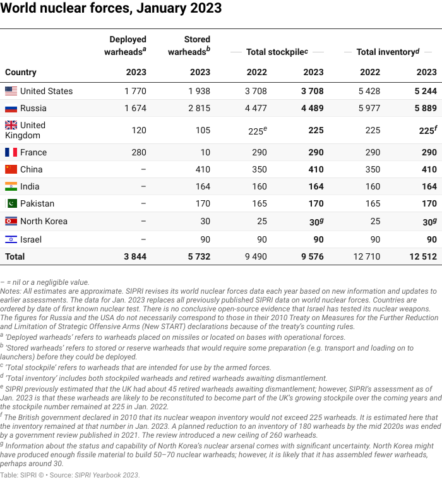
India and Pakistan appear to be expanding their nuclear arsenals, and both countries introduced and continued to develop new types of nuclear delivery system in 2022. While Pakistan remains the main focus of India’s nuclear deterrent, India appears to be placing growing emphasis on longer-range weapons, including those capable of reaching targets across China.
North Korea continues to prioritize its military nuclear programme as a central element of its national security strategy. While North Korea conducted no nuclear test explosions in 2022, it conducted more than 90 tests of missiles. Some of these missiles, which include new ICBMs, may be capable of carrying nuclear warheads. SIPRI estimates that the country has now assembled around 30 warheads and possesses enough fissile material for a total of 50–70 warheads, both significant increases over the estimates for January 2022.
Israel—which does not publicly acknowledge possessing nuclear weapons—is also believed to be modernizing its nuclear arsenal.
‘Most of the nuclear-armed states are hardening their rhetoric about the importance of nuclear weapons, and some are even issuing explicit or implicit threats about potentially using them,’ said Matt Korda, Associate Researcher with SIPRI’s Weapons of Mass Destruction Programme and Senior Research Associate with the FAS Nuclear Information Project. ‘This elevated nuclear competition has dramatically increased the risk that nuclear weapons might be used in anger for the first time since World War II.’
‘With billion-dollar programmes to modernize, and in some cases expand, nuclear arsenals, the five nuclear weapon states recognized by the Nuclear Non-Proliferation Treaty seem to be moving further and further from their commitment to disarmament under the treaty,’ said Wilfred Wan, Director of SIPRI’s Weapons of Mass Destruction Programme.
Nuclear diplomacy dealt a further blow by Russia’s invasion of Ukraine
Nuclear arms control and disarmament diplomacy suffered major setbacks following Russia’s full-scale invasion of Ukraine in February 2022. In the wake of the invasion, the USA suspended its bilateral strategic stability dialogue with Russia. In February 2023 Russia announced it was suspending its participation in the 2010 Treaty on Measures for the Further Reduction and Limitation of Strategic Offensive Arms (New START)—the last remaining nuclear arms control treaty limiting Russian and US strategic nuclear forces. Talks about a follow-on treaty to New START, which expires in 2026, were also suspended. Nevertheless, by SIPRI’s assessment, both countries’ deployed strategic nuclear forces remained within the New START limits as of January 2023.
Iran’s military support to Russian forces in Ukraine and the political situation in Iran also overshadowed talks on reviving the Joint Comprehensive Plan of Action (JCPOA), the 2015 agreement meant to prevent Iran from developing nuclear weapons. The JCPOA’s revival now seems increasingly unlikely.
The USA and the UK both declined to release information to the public concerning their nuclear forces in 2022, which they had done in previous years.
‘In this period of high geopolitical tension and mistrust, with communication channels between nuclear-armed rivals closed or barely functioning, the risks of miscalculation, misunderstanding or accident are unacceptably high,’ says Dan Smith, SIPRI Director. ‘There is an urgent need to restore nuclear diplomacy and strengthen international controls on nuclear arms.’
Global security and stability in increasing peril
The 54th edition of the SIPRI Yearbook reveals the continuing deterioration of global security over the past year. The impacts of the war in Ukraine are visible in almost every aspect of the issues connected to armaments, disarmament and international security examined in the Yearbook. Nevertheless, it was far from being the only major conflict being waged in 2022, and acute geopolitical tensions, mistrust and division had been growing long before Russia’s full-scale invasion of its neighbour.
‘We are drifting into one of the most dangerous periods in human history,’ says Dan Smith, SIPRI Director. ‘It is imperative that the world’s governments find ways to cooperate in order to calm geopolitical tensions, slow arms races and deal with the worsening consequences of environmental breakdown and rising world hunger.’ In addition to the usual detailed coverage of nuclear arms control, disarmament and non-proliferation issues, the SIPRI Yearbook presents data and analysis on developments in world military expenditure, international arms transfers, arms production, multilateral peace operations, armed conflicts and more. Special sections in SIPRI Yearbook 2023 explore the rise of private military and security companies such as the Wagner Group, and the related impact on peace and security; how the war in Ukraine has affected governance of space and cyberspace; the attacks on nuclear power plants during the fighting in Ukraine, and their implications; and the regulation of new technologies such as autonomous weapon systems.
About the SIPRI Yearbook
The SIPRI Yearbook is a compendium of cutting-edge information and analysis on developments in armaments, disarmament and international security. Three major SIPRI Yearbook 2023 data sets were pre-launched in 2022–23: total arms sales by the top 100 arms-producing companies (December 2022), international arms transfers (March 2023) and world military expenditure (April 2023). The SIPRI Yearbook is published by Oxford University Press. Learn more at www.sipriyearbook.org.
Stockholm International Peace Research Institute (SIPRI)
SIPRI is an independent international institute dedicated to research into conflict, armaments, arms control and disarmament. Established in 1966, SIPRI provides data, analysis and recommendations, based on open sources, to policymakers, researchers, media and the interested public.
The post States invest in nuclear arsenals as geopolitical relations deteriorate—New SIPRI Yearbook out now appeared first on Core Sector Communique.
]]>The post World stumbling into a new era of risk, concludes SIPRI report appeared first on Core Sector Communique.
]]>Stockholm, 23 May 2022) World leaders are failing to prepare for a new era of complex and often unpredictable risks to peace as profound environmental and security crises converge and intensify, according to a major report by the Stockholm International Peace Research Institute (SIPRI). The report, Environment of Peace: Security in a New Era of Risk, offers policymakers principles and recommendations for navigating this volatile future. It will be launched today in a special session before the opening of the ninth Stockholm Forum on Peace and Development.
Download the Environment of Peace report.
Join the briefing event for the report (12.00–12.45 CEST).
Environment of Peace provides the most comprehensive account to date of how different aspects of environmental crisis—including climate change, mass extinctions and resource scarcity—are interacting with today’s darkening security horizon and other phenomena such as the fallout of the Covid-19 pandemic. It also offers governments and other decision-making bodies recommendations for action, and principles to guide them.
‘Our new report for policymakers goes beyond simply showing that environmental change can increase risks to peace and security. That’s established,’ said SIPRI Director and Environment of Peace author Dan Smith. ‘What our research reveals is the complexity and breadth of that relationship, the many forms it can take. And most of all, we show what can be done about it; how we can deliver peace and security in a new era of risk.’
More than 30 researchers from SIPRI and other institutions contributed to the Environment of Peace report, guided by a panel of international experts on environment and security led by Margot Wallström, the former Swedish Foreign Minister and European Commissioner for the Environment.
Twin crises, complex risks
The report paints a vivid picture of the escalating security crisis. For example, it notes that between 2010 and 2020 the number of state-based armed conflicts roughly doubled (to 56), as did the number of conflict deaths. The number of refugees and other forcibly displaced people also doubled, to 82.4 million. In 2020 the number of operationally deployed nuclear warheads increased after years of reductions, and in 2021 military spending surpassed $2 trillion for the first time ever.
Regarding the environmental crisis, around a quarter of all species are at risk of extinction, pollinating insects are in rapid decline and soil quality is falling, while exploitation of natural resources such as forests and fish continues at unsustainable levels. Climate change is making extreme weather events such as storms and heatwaves more common and more intense, reducing the yield of major food crops and increasing the risk of large-scale harvest failures.
The report illustrates some of the complex ways that these two crises are starting to interact around the world; for example:
- In Somalia, where prolonged drought and other climate change impacts, combined with poverty, lack of preparedness and weak government, have driven people into the arms of the extremist group al-Shabab.
- Across the Sahel, where drought and the expansion of farmland to feed a growing population are pushing farmers and nomadic herders into competition over access to resources such as land and water, and this competition often turns violent.
- In Central America, where the impact of climate change on crops combined with violence and corruption increased the number of people attempting to migrate to the securitized United States border.
- In the Middle East and North Africa, where in the early 2010s, failure of the Russian grain harvest due to a climate change-linked heatwave combined with the impacts of a US biofuels policy to raise the price of bread, exacerbating tensions that led to the Arab Spring series of uprisings across the Middle East and North Africa.
‘These examples show clearly that it’s much more complex than environmental degradation leading to conflict,’ said Environment of Peace expert panellist Chibeze Ezekiel, Coordinator of the Strategic Youth Network for Development in Ghana. ‘At the start of the Arab Spring in 2011, a climate change impact in one continent and a well-intentioned renewable energy policy in another combined with existing unrest in a third to increase the risks of conflict—nobody had seen that combination coming.’
Principles for policy
The report sets out five principles to guide policymakers in addressing these issues:
- Think fast, think ahead, act now. Establishing an environment of peace requires a far-sighted vision, but also swift, short-term action.
- Cooperate to survive and thrive. The new era of risk demands a new mode of cooperation to address common threats.
- Expect the unexpected—be prepared to adapt. Continuous horizon scanning, far-sighted analysis and adaptive implementation are needed to keep ahead of unpredictably changing risks.
- Only a just and peaceful transition will succeed. In making the transition to environmentally sustainable societies, we must avoid creating new risks to peace.
- By everyone, for everyone. Decision-making processes from the United Nations down to community projects should include the people most affected.
Cooperation is the new realism
The last decade has been marked by increasingly tense geopolitics, with disputes simmering and sometimes erupting between major states and blocs, and populism on the rise. The report argues that cooperation is essential for managing the environmental and security crises, along with the risks they create.
‘No government can secure the well-being of its citizens against the escalating global crises without international cooperation,’ said Helen Clark, the former Prime Minister of New Zealand and a member of the Environment of Peace advisory panel. ‘We must urgently find ways to cooperate on addressing common environment-related security threats, even in today’s toxic geopolitical landscape. Against global threats, cooperation is self-interest. In fact, cooperation is the new realism.’
Pandemic highlights need to expect the unexpected
The Covid-19 pandemic has highlighted the gains countries make by preparing for an event whose potential for devastation is clear even if its timing and nature may not be.
For example, by applying lessons from the 2002 SARS outbreak, South Korea managed to keep its Covid-19 mortality rate down to around 10 per cent of that of countries with comparable populations in the first two years of the pandemic. This not only saved lives but also allowed South Korea to avoid much of the destabilizing economic and social impact felt in other countries that chose not to prepare despite regular warnings of pandemic risks from bodies such as the World Health Organization.
‘The pandemic shows us clearly the risks we run when we choose not to prepare,’ said Margot Wallström. ‘As the environmental and security crises get worse, governments need to assess what risks lie ahead, to develop the capacity to deal with them, and to make societies more resilient. The poorest countries will need international support to do this, and they should receive it.’
Environment of Peace recommends that environmental stressors should be included in early-warning systems for conflict risk, and urges that treaties on sharing resources such as fisheries, water and forests should be updated to make them fit for purpose in this new era of complex risks.
Only a just and peaceful transition will succeed
To tackle climate change and the wider environmental crisis, governments around the world need to bring about major transitions in areas such as energy and land use. Keeping global warming to the Paris Agreement 1.5C target means reaching net zero carbon emissions globally within three decades. In the area of biodiversity, governments are discussing initiatives such as 30×30—protecting 30 per cent of land and ocean area by 2030.
Environment of Peace argues that these transitions have to succeed because of the immense security risks that would result from failure. However, change at the scale and pace needed is unavoidably fraught with risk. The history of measures such as biofuels and hydropower dams shows that they can exacerbate insecurity, with hydropower alone having displaced an estimated 80 million people from their homes.
‘We must learn from the mistakes of the past so we do not repeat them on a much larger scale,’ said Geoff Dabelko, one of the report’s lead authors and a professor at Ohio University’s Voinovich School of Leadership and Public Service. ‘Conservation needs to happen, but it cannot be coercive. A rapid zero-carbon transition is essential but it must be done fairly. Tackling the environmental crisis must go hand-in-hand with justice, equity and rights, building peace rather than undermining it.’
Fund peace, not risk
Currently, governments spend an estimated $5–7 trillion per year on activities that can harm the natural environment, such as subsidizing fossil fuels, destructive fishing and forest clearance. Governments have promised to phase out subsidies that promote fossil fuels, but they have routinely failed to deliver.
‘If governments want to secure peace in this new era of risk, they need to redirect their financing away from activities that undermine it,’ said Environment of Peace expert panellist Arunabha Ghosh of the Council on Energy, Environment and Water (CEEW). ‘Funding conflict risk is in no-one’s interest. But many governments continue to fund non-essential and ill-targeted fossil fuel development and other environmentally destructive activities, which neither serve the interests of sustainability nor protect vulnerable communities. We need a wholesale redirection of investment towards peace, environmental stability and resilience.’
Environment of Peace cites many examples of initiatives that are building peace and environmental integrity together, which could be scaled up and adapted. It shows that to be effective, solutions need to be inclusive, with sectors of society that are often marginalized (such as Indigenous Peoples, women and youth) included in decision-making processes and sharing the benefits. ‘The challenges are immense and the timescale tight,’ said Dan Smith. ‘Even as governments deal with acute situations such as the invasion of Ukraine or the Covid-19 pandemic, they cannot lose sight of the profound challenges that lie ahead.’
| Stockholm International Peace Research Institute (SIPRI) |
| SIPRI is an independent international institute dedicated to research into conflict, armaments, arms control and disarmament. Established in 1966, SIPRI provides data, analysis and recommendations, based on open sources, to policymakers, researchers, media and the interested public. |
The post World stumbling into a new era of risk, concludes SIPRI report appeared first on Core Sector Communique.
]]>The post World military expenditure passes $2 trillion for first time – SIPRI appeared first on Core Sector Communique.
]]>(Stockholm, 25 April 2022) Total global military expenditure increased by 0.7 per cent in real terms in 2021, to reach $2113 billion. The five largest spenders in 2021 were the United States, China, India, the United Kingdom and Russia, together accounting for 62 per cent of expenditure, according to new data on global military spending published today by the Stockholm International Peace Research Institute (SIPRI).
Download the SIPRI Fact Sheet.
Military expenditure reaches record level in the second year of the pandemic
World military spending continued to grow in 2021, reaching an all-time high of $2.1 trillion. This was the seventh consecutive year that spending increased.
‘Even amid the economic fallout of the Covid-19 pandemic, world military spending hit record levels,’ said Dr Diego Lopes da Silva, Senior Researcher with SIPRI’s Military Expenditure and Arms Production Programme. ‘There was a slowdown in the rate of real-terms growth due to inflation. In nominal terms, however, military spending grew by 6.1 per cent.’
As a result of a sharp economic recovery in 2021, the global military burden—world military expenditure as a share of world gross domestic product (GDP)—fell by 0.1 percentage points, from 2.3 per cent in 2020 to 2.2 per cent in 2021.
United States focuses on military research and development
US military spending amounted to $801 billion in 2021, a drop of 1.4 per cent from 2020. The US military burden decreased slightly from 3.7 per cent of GDP in 2020 to 3.5 per cent in 2021.
US funding for military research and development (R&D) rose by 24 per cent between 2012 and 2021, while arms procurement funding fell by 6.4 per cent over the same period. In 2021 spending on both decreased. However, the drop in R&D spending (–1.2 per cent) was smaller than that in arms procurement spending (–5.4 per cent).
‘The increase in R&D spending over the decade 2012–21 suggests that the United States is focusing more on next-generation technologies,’ said Alexandra Marksteiner, Researcher with SIPRI’s Military Expenditure and Arms Production Programme. ‘The US Government has repeatedly stressed the need to preserve the US military’s technological edge over strategic competitors.’
Russia increases military budget in run-up to war
Russia increased its military expenditure by 2.9 per cent in 2021, to $65.9 billion, at a time when it was building up its forces along the Ukrainian border. This was the third consecutive year of growth and Russia’s military spending reached 4.1 per cent of GDP in 2021.
‘High oil and gas revenues helped Russia to boost its military spending in 2021. Russian military expenditure had been in decline between 2016 and 2019 as a result of low energy prices combined with sanctions in response to Russia’s annexation of Crimea in 2014,’ said Lucie Béraud-Sudreau, Director of SIPRI’s Military Expenditure and Arms Production Programme.
The ‘national defence’ budget line, which accounts for around three-quarters of Russia’s total military spending and includes funding for operational costs as well as arms procurement, was revised upwards over the course of the year. The final figure was $48.4 billion, 14 per cent higher than had been budgeted at the end of 2020.
As it has strengthened its defences against Russia, Ukraine’s military spending has risen by 72 per cent since the annexation of Crimea in 2014. Spending fell in 2021, to $5.9 billion, but still accounted for 3.2 per cent of the country’s GDP.
Continued increases by major spenders in Asia and Oceania
China, the world’s second largest spender, allocated an estimated $293 billion to its military in 2021, an increase of 4.7 per cent compared with 2020. China’s military spending has grown for 27 consecutive years. The 2021 Chinese budget was the first under the 14th Five-Year Plan, which runs until 2025.
Following initial approval of its 2021 budget, the Japanese Government added $7.0 billion to military spending. As a result, spending rose by 7.3 per cent, to $54.1 billion in 2021, the highest annual increase since 1972. Australian military spending also increased in 2021: by 4.0 per cent, to reach $31.8 billion.
‘China’s growing assertiveness in and around the South and the East China seas have become a major driver of military spending in countries such as Australia and Japan,’ said SIPRI Senior Researcher Dr Nan Tian. ‘An example is the AUKUS trilateral security agreement between Australia, the United Kingdom and the United States that foresees the supply of eight nuclear-powered submarines to Australia at an estimated cost of up to $128 billion.’
Other notable developments:
- In 2021 Iran’s military budget increased for the first time in four years, to $24.6 billion. Funding for the Islamic Revolutionary Guard Corps continued to grow in 2021—by 14 per cent compared with 2020—and accounted for 34 per cent of Iran’s total military spending.
- Eight European North Atlantic Treaty Organization (NATO) members reached the Alliance’s target of spending 2 per cent or more of GDP on their armed forces in 2021. This is one fewer than in 2020 but up from two in 2014.
- Nigeria raised its military spending by 56 per cent in 2021, to reach $4.5 billion. The rise came in response to numerous security challenges such as violent extremism and separatist insurgencies.
- Germany—the third largest spender in Central and Western Europe—spent $56.0 billion on its military in 2021, or 1.3 per cent of its GDP. Military spending was 1.4 per cent lower compared with 2020 due to inflation.
- In 2021 Qatar’s military spending was $11.6 billion, making it the fifth largest spender in the Middle East. Qatar’s military spending in 2021 was 434 per cent higher than in 2010, when the country last released spending data before 2021.
India’s military spending of $76.6 billion ranked third highest in the world. This was up by 0.9 per cent from 2020 and by 33 per cent from 2012. In a push to strengthen the indigenous arms industry, 64 per cent of capital outlays in the military budget of 2021 were earmarked for acquisitions of domestically produced arms.
Note:
SIPRI monitors developments in military expenditure worldwide and maintains the most comprehensive, consistent and extensive publicly available data source on military expenditure. The comprehensive annual update of the SIPRI Military Expenditure Database is accessible from today at www.sipri.org.
All percentage changes are expressed in real terms (constant 2020 prices) unless otherwise stated. Military expenditure refers to all government spending on current military forces and activities, including salaries and benefits, operational expenses, arms and equipment purchases, military construction, research and development, and central administration, command and support. SIPRI therefore discourages the use of terms such as ‘arms spending’ when referring to military expenditure, as this represents only one category of expenditure.
Stockholm International Peace Research Institute (SIPRI)
SIPRI is an independent international institute dedicated to research into conflict, armaments, arms control and disarmament. Established in 1966, SIPRI provides data, analysis and recommendations, based on open sources, to policymakers, researchers, media and the interested public.
The post World military expenditure passes $2 trillion for first time – SIPRI appeared first on Core Sector Communique.
]]>The post Global nuclear arsenals grow as states continue to modernize–New SIPRI Yearbook out now appeared first on Core Sector Communique.
]]>(Stockholm, 14 June 2021) The Stockholm International Peace Research Institute (SIPRI) today launches the findings of SIPRI Yearbook 2021, which assesses the current state of armaments, disarmament and international security. A key finding is that despite an overall decrease in the number of nuclear warheads in 2020, more have been deployed with operational forces.
Signs that decline in nuclear arsenals has stalled
The nine nuclear-armed states—the United States, Russia, the United Kingdom, France, China, India, Pakistan, Israel and the Democratic People’s Republic of Korea (North Korea)—together possessed an estimated 13 080 nuclear weapons at the start of 2021. This marked a decrease from the 13 400 that SIPRI estimated these states possessed at the beginning of 2020 (see table below).
Despite this overall decrease, the estimated number of nuclear weapons currently deployed with operational forces increased to 3825, from 3720 last year. Around 2000 of these—nearly all of which belonged to Russia or the USA—were kept in a state of high operational alert.
While the USA and Russia continued to reduce their overall nuclear weapon inventories by dismantling retired warheads in 2020, both are estimated to have had around 50 more nuclear warheads in operational deployment at the start of 2021 than a year earlier. Russia also increased its overall military nuclear stockpile by around 180 warheads, mainly due to deployment of more multi-warhead land-based intercontinental ballistic missiles (ICBMs) and sea-launched ballistic missiles (SLBMs). Both countries’ deployed strategic nuclear forces remained within the limits set by the 2010 Treaty on Measures for the Further Reduction and Limitation of Strategic Offensive Arms (New START), although the treaty does not limit total nuclear warhead inventories.
‘The overall number of warheads in global military stockpiles now appears to be increasing, a worrisome sign that the declining trend that has characterized global nuclear arsenals since the end of the cold war has stalled,’ said Hans M. Kristensen, Associate Senior Fellow with SIPRI’s Nuclear Disarmament, Arms Control and Non-proliferation Programme and Director of the Nuclear Information Project at the Federation of American Scientists (FAS). ‘The last-minute extension of New START by Russia and the USA in February this year was a relief, but the prospects for additional bilateral nuclear arms control between the nuclear superpowers remain poor.’
Russia and the USA together possess over 90 per cent of global nuclear weapons. Both have extensive and expensive programmes under way to replace and modernize their nuclear warheads, missile and aircraft delivery systems, and production facilities.
‘Both Russia and the USA appear to be increasing the importance they attribute to nuclear weapons in their national security strategies,’ said Kristensen.
Other nuclear-armed states investing in future capabilities
All the other seven nuclear-armed states are also either developing or deploying new weapon systems or have announced their intention to do so. The UK’s ‘Integrated Review of Security, Defence, Development and Foreign Policy’, published in early 2021, reversed a policy of reducing the country’s nuclear arsenal and raised its planned ceiling for nuclear weapons from 180 to 260.
China is in the middle of a significant modernization and expansion of its nuclear weapon inventory, and India and Pakistan also appear to be expanding their nuclear arsenals.
North Korea continues to enhance its military nuclear programme as a central element of its national security strategy. While it conducted no nuclear test explosions or long-range ballistic missile tests during 2020, it continued production of fissile material and development of short- and long-range ballistic missiles.
‘The entry into force of the Treaty on the Prohibition of Nuclear Weapons in early 2021 highlights the growing divide between the nuclear-armed states, which are all investing in the long-term future of their nuclear forces, and other countries that are impatient to see progress on nuclear disarmament promised by the Nuclear Non-Proliferation Treaty,’ said Matt Korda, Associate Researcher with SIPRI’s Nuclear Disarmament, Arms Control and Non-proliferation Programme and Research Associate with the FAS Nuclear Information Project.
World nuclear forces, January 2021
| Country | Deployed warheads* | Other warheads** | Total 2021 | Total 2020 |
| USA | 1 800 | 3 750 | 5 550 | 5 800 |
| Russia | 1 625 | 4 630 | 6 255 | 6 375 |
| UK*** | 120 | 105 | 225 | 215 |
| France | 280 | 10 | 290 | 290 |
| China | 350 | 350 | 320 | |
| India | 156 | 156 | 150 | |
| Pakistan | 165 | 165 | 160 | |
| Israel | 90 | 90 | 90 | |
| North Korea**** | … | [40–50] | [40–50] | [30–40] |
| Total | 3 825 | 9 255 | 13 080 | 13 400 |
Source: SIPRI Yearbook 2021.
*‘Deployed warheads’ refers to warheads placed on missiles or located on bases with operational forces.
**‘Other warheads’ refers to stored or reserve warheads and retired warheads awaiting dismantlement.
***The British Government declared in 2010 that its nuclear weapon inventory would not exceed 225 warheads. SIPRI estimates that the inventory remained at that number in Jan. 2021. This is a revision of previous SIPRI assessments based on new information. A planned reduction to 180 warheads by the mid 2020s was ended by a government review undertaken in 2020 and published in early 2021. The review introduced a new ceiling of 260 warheads.
****The figures for North Korea are SIPRI’s estimates of the number of warheads that North Korea could potentially build with the amount of fissile material it has produced. There is no publicly available evidence that North Korea has produced an operational nuclear warhead for delivery by an intercontinental-range ballistic missile, but it might have a small number of warheads for medium-range ballistic missiles. The figures for North Korea are highly uncertain and are not included in the global totals.
Notes: All estimates are approximate. SIPRI revises its world nuclear forces data each year based on new information and updates to earlier assessments. The figures for Russia and the USA do not necessarily correspond to those in their 2010 Treaty on Measures for the Further Reduction and Limitation of Strategic Offensive Arms (New START) declarations because of the treaty’s counting rules. Global totals are rounded to the nearest 5 warheads.
A mixed outlook for global security and stability
The 52nd edition of the SIPRI Yearbook reveals some negative and some hopeful developments in 2020.
‘Despite outbreaks of conflict, rising military spending and of course the first year of a devastating global pandemic, overall global human security did not continue to deteriorate in 2020. The year’s crumbs of comfort included a significant drop in the number of people who died in armed conflicts around the world. Unlike previous years, the international arms trade did not expand. And the Climate Action Summit made some notable—if still insufficient—progress on climate goals,’ said SIPRI Director Dan Smith. In addition to its detailed coverage of nuclear arms control and non-proliferation issues, the latest edition of the SIPRI Yearbook includes insight on developments in conventional arms control in 2020; regional overviews of armed conflicts and conflict management; in-depth data and discussion on military expenditure, international arms transfers and arms production; and comprehensive coverage of efforts to counter chemical and biological security threats.
The SIPRI Yearbook is a compendium of cutting-edge information and analysis on developments in armaments, disarmament and international security. Four major SIPRI Yearbook 2021 data sets were pre-launched in 2020–21: total arms sales by the top 25 arms-producing companies (December 2020), international arms transfers (March 2021), world military expenditure (April 2021) and trends in multilateral peace operations (May 2021). The earlier releases are available at www.sipri.org/media/pressreleases. The SIPRI Yearbook is published by Oxford University Press.
Browse the SIPRI Yearbook 2021 and download the SIPRI Yearbook 2021 Summary (PDF).
The post Global nuclear arsenals grow as states continue to modernize–New SIPRI Yearbook out now appeared first on Core Sector Communique.
]]>The post Global nuclear weapons: modernization remains the priority – SIPRI appeared first on Core Sector Communique.
]]>(Stockholm, 3 July 2017) The Stockholm International Peace Research Institute (SIPRI) today launches its annual nuclear forces data, which highlights the current trends and developments in world nuclear arsenals. The data shows that while the overall number of nuclear weapons in the world continues to decline, all of the nuclear weapon-possessing states are in the process of modernizing their nuclear arsenals and will not be prepared to give them up for the foreseeable future.
 #At the start of 2017 nine states—the United States, Russia, the United Kingdom, France, China, India, Pakistan, Israel and North Korea—possessed approximately 4150 operationally deployed nuclear weapons. If all nuclear warheads are counted, these states together possessed a total of approximately 14 935 nuclear weapons, compared with 15 395 in early 2016 (see table 1 below).
Nuclear weapon reductions slow down, investment levels rise
The decrease in the overall number of nuclear weapons in the world is due mainly to Russia and the USA—which together still account for nearly 93 per cent of all nuclear weapons—further reducing their inventories of strategic nuclear weapons. However, despite the implementation of the bilateral Treaty on Measures for the Further Reduction and Limitation of Strategic Offensive Arms (New START) since 2011, the pace of their reductions remains slow.
At the same time, both Russia and the USA have extensive and expensive nuclear modernization programmes under way. The USA, for example, plans to spend $400 billion in 2017–26 on maintaining and comprehensively updating its nuclear forces. Some estimates suggest that the USA’s nuclear weapon modernization programme may cost up to $1 trillion over the next 30 years.
‘The projected increases in US spending are not unexpected,’ said SIPRI Associate Senior Fellow Hans Kristensen.* ‘The current US administration is continuing the ambitious nuclear modernization plans set out by President Barack Obama.’
The other nuclear weapon-possessing states have much smaller arsenals, but have all either begun to deploy new nuclear weapon delivery systems or announced their intention to do so.
China has started a long-term modernization programme focused on making qualitative improvements to its nuclear arsenal. India and Pakistan are both expanding their nuclear weapon stockpiles and developing their missile delivery capabilities.
North Korea is estimated to have enough fissile material for approximately 10–20 nuclear warheads, which is an increase on the estimates for previous years. North Korea carried out an unprecedented number of flight tests of different missile systems in 2016 with mixed results.
‘Despite the recent progress in international talks on a treaty banning nuclear weapons, long-term modernization programmes are under way in all nine states,’ said SIPRI Senior Researcher Shannon Kile. ‘This suggests that none of these states will be prepared to give up their nuclear arsenals for the foreseeable future.’
Table 1. World nuclear forces, 2017
| Country | Deployed warheads* |
Other warheads |
Total 2017 |
Year of first nuclear test |
| USA | 1 800 | 5 000 | 6 800 | 1945 |
| Russia | 1 950 | 5 050 | 7 000 | 1949 |
| UK | 120 | 95 | 215 | 1952 |
| France | 280 | 20 | 300 | 1960 |
| China | 270 | 270 | 1964 | |
| India | 120–130 | 120–130 | 1974 | |
| Pakistan | 130–140 | 130–140 | 1998 | |
| Israel | 80 | 80 | . . | |
| North Korea | 10-20 | 10-20 | 2006 | |
| Total | 4150 | 10 785 | 14 935 |
Source: SIPRI Yearbook 2017
* ‘Deployed’ * warheads refers to warheads placed on missiles or located on bases with operational forces.
** ‘Other warheads’ refers to warheads that are held in reserve or that are retired and awaiting dismantlement..
All estimates are approximate and are as of January 2017.
The SIPRI Yearbook is a compendium of cutting-edge information and analysis on developments in armaments, disarmament and international security. Three major Yearbook data sets have already been pre-launched in 2017: ‘The top 100 arms-producing companies’ (5 December 2016), ‘International arms transfers’ (20 February 2017) and ‘World military expenditure’ (24 April 2017).
SIPRI Yearbook 2017 is published by Oxford University Press and will be available later in 2017. Learn more at www.sipriyearbook.org.
*Hans M. Kristensen (Denmark) is an Associate Senior Fellow with the SIPRI Disarmament, Arms Control and Non-proliferation Programme and Director of the Nuclear Information Project at the Federation of American Scientists (FAS).
Stockholm International Peace Research Institute (SIPRI)
SIPRI is an independent international institute dedicated to research into conflict, armaments, arms control and disarmament. Established in 1966, SIPRI provides data, analysis and recommendations, based on open sources, to policymakers, researchers, media and the interested public. SIPRI is regularly ranked among the most respected think tanks worldwide.
The post Global nuclear weapons: modernization remains the priority – SIPRI appeared first on Core Sector Communique.
]]>The post SIPRI statement on the 2016 Nobel Peace Prize appeared first on Core Sector Communique.
]]>
|
The post SIPRI statement on the 2016 Nobel Peace Prize appeared first on Core Sector Communique.
]]>The post SIPRI Yearbook 2016 out now appeared first on Core Sector Communique.
]]>
|
|
|
The post SIPRI Yearbook 2016 out now appeared first on Core Sector Communique.
]]>The post Global experts in Stockholm to discuss security challenges facing cities appeared first on Core Sector Communique.
]]>
|
|
|
The post Global experts in Stockholm to discuss security challenges facing cities appeared first on Core Sector Communique.
]]>The post US leadership in the Arctic Council: What choices does the USA have? appeared first on Core Sector Communique.
]]>On 24–25 April 2015, the United States will assume the next two-year chairmanship of the Arctic Council at the Council’s next ministerial meeting in Iqaluit, Nunavut, Canada. These are difficult times for the Arctic region—and the Arctic Council in particular. After five years of dynamic development, cooperation in the Arctic region is at risk of stumbling on the geopolitical tensions between Russia and the West.
In November 2014, the USA presented an ambitious programme for its chairmanship under the slogan One Arctic: Shared Opportunities, Challenges and Responsibilities. The US chairmanship aims to achieve three major goals: to continue strengthening the Arctic Council as an intergovernmental forum, to introduce new long-term priorities into the Artic Council and to raise awareness in the USA and around the world on issues related to both the Arctic and climate change.
A number of important events are planned for 2015–17, including conducting large-scale search and rescue exercises and possibly holding a summit of the heads of Arctic states (i.e. the eight member states of the Arctic Council: Canada, Denmark, Finland, Iceland, Norway, Russia, Sweden and the USA). The question, however, is what can the US chairmanship really achieve in the coming two years?
If the USA wants to accomplish all three of its goals, as well as convening the high-level meetings, it will require significant cooperative engagement from all Arctic Council participants, especially Russia. This will be difficult, though, due to the increasing geopolitical tensions between Russia and the USA that have emerged from the Ukrainian crisis and already spilled into the Arctic.
Indeed, over the course of 2014–15, relations among Arctic states have increasingly been affected by the conflict in Ukraine. In September 2014, the European Union and the USA introduced economic sanctions against Russia that prevented companies based in the EU and USA from working in Russia and limited Russia’s opportunities to seek financial support for its Arctic resource development. This directly hindered Russia’s ability to develop offshore hydrocarbon resources in the Arctic.
With the introduction of sanctions, Russia has lost its main incentive for cooperation in the region. Russian national security interests are coming to the forefront of its Arctic policy, resulting in a military build-up in the region. The USA’s introduction of new priorities and projects within the Arctic Council might prove to be difficult given that ever worsening bilateral relations between Russia and the USA could mean that any suggestion on the US side will be met with suspicion and caution on the Russian side.
Prior to 2014 many in the USA saw the chairmanship as a chance to rebuild already fractured relations with Russia in a non-controversial area. It is now difficult to see this transpiring given the extent to which each side’s respective anti-Russian and anti-US sentiments have escalated. Although Admiral Robert Papp, the US Special Representative to the Arctic, has stressed the importance and intention of maintaining Russia as a key Arctic Council member and ‘keeping the line of communication open’, it is getting more and more difficult to insulate the Arctic from global geopolitics—especially since maintaining Arctic cooperation is a relatively low priority for the USA compared to curtailing the ongoing conflict close to European borders.
However, if the situation in Ukraine is improved in the next two years, the Arctic region—and the Arctic Council in particular—could become a potential platform for rebuilding the relationship between Russia and the West, as there is very little tension in the region itself and most of it is resolved through diplomacy.
Otherwise, the USA might need to seek a more limited agenda during its chairmanship of the Arctic Council: focusing on consolidating the results achieved during previous chairmanships, improving and implementing existing programmes. In this case, one should not expect big ‘success stories’ from the US chairmanship since Arctic states have already tackled and largely agreed many questions, leaving only difficult issues for further work.
Cooperation within the Arctic Council continues despite the crisis in Ukraine, although on a smaller scale. While assuming its chairmanship, the USA needs to make a strategic choice: either it, along with other Arctic states, will pursue a policy around the intention to keep the Arctic a ‘zone of cooperation’ (which will require close collaboration and engagement with Russia), or it will seek to challenge Russia as part of the response to the Ukraine crisis and the Arctic cooperation will become a victim of the broader geopolitical tensions between Russia and the West.
About the author
Ekaterina Klimenko (Kyrgyz Republic) is a Researcher for the ‘Managing competition and promoting cooperation in the Arctic’ and ‘Conflict and Security in the Caucasus’ projects.
Stockholm International Peace Research Institute (SIPRI)
SIPRI is an independent international institute dedicated to research into conflict, armaments, arms control and disarmament. Established in 1966, SIPRI provides data, analysis and recommendations, based on open sources, to policymakers, researchers, media and the interested public. SIPRI is regularly ranked among the most respected think tanks worldwide.
The post US leadership in the Arctic Council: What choices does the USA have? appeared first on Core Sector Communique.
]]>The post First ever mapping of activities of external security actors in Africa confirms trend towards multilateralism and ‘Africanization’ appeared first on Core Sector Communique.
]]>(Stockholm, 25 November 2014)—Over the past decade, major external actors have developed policy initiatives to advance their security, geopolitical and economic interests in Africa. Analysis of the security activities of seven major actors in Africa—China, France, Russia, the United Kingdom, the United States, the European Union and the United Nations—shows an increasing use of multilateral approaches, support for the ‘Africanization’ of African security, and the privatization of external security support. These are the main findings of a new SIPRI monograph edited by Olawale Ismail and Elisabeth Sköns.
The book is the first attempt to comprehensively map seven major external actors’ security activities in sub-Saharan Africa. It provides data and analysis of the official security-related activities of five states—China, France, Russia, the UK and the USA—and two organizations—the EU and the UN. It also identifies the security policies and strategies within which these activities have been developed. One of the main objectives of the book is to serve as a resource for civil society groups in Africa, which are increasingly engaging in security-related issues in their respective countries.
‘The form of external security activities in Africa has shifted over the past 10 to 20 years: from permanent military presence to temporary interventions, often within a multilateral framework; from direct military intervention to training of African security forces and other support for African security; and from large-scale arms transfers to allied African countries to lower levels of arms transfers linked to specific security programmes’, says Dr Elisabeth Sköns, Head of SIPRI’s Africa Security and Governance Project.
‘Of course there are major exceptions to this, such as the US military base in Djibouti and French bilateral interventions in West Africa but, by and large, these are the main trends.’
Many external security activities in Africa are driven by self-interest
While the form is shifting, the drivers remain basically unchanged. External actors in Africa continue to pursue policies based on their own self-interest, making lasting progress in African security issues problematic.
‘Many of their activities in Africa are part of policies to prevent security problems in Africa—such as transnational crime, violent radicalization and international terrorism—from spreading to their own countries, or to seek access to resources in Africa’, says Dr Olawale Ismail, co-editor of the book, and now Head of Research at International Alert.
Multilateralism and the need for true partnerships
External actors’ security activities in Africa take place within the context of a global trend towards multilateralism, especially in peace operations. Overall, between 1989 and 2013 the UN conducted 33 peace operations in Africa.
‘At the same time, we have seen that some actors revert to bilateral intervention when multilateral approaches are too slow’, says Dr Vincent Boulanin, a Researcher with the SIPRI European Security Programme and author of the chapter on France. ‘The recent interventions by France in Mali and other West African countries are cases in point.’
‘External actors increasingly emphasize the importance of local ownership and devise policies to support African countries to help themselves. However, they often come with predefined programmes and they tend to interfere when things do not develop as they would like to see it. There is a need for true partnerships,’ says Ismail.
Read more or download a sample chapter or a media backgrounder describing in brief the activities of China, France, Russia, the United Kingdom, the United States, the European Union and the United Nations.
About the editors
Dr Olawale Ismail (Nigeria) is Head of Research at International Alert, and was a Senior Researcher at SIPRI between 2009 and 2012. He has a strong research and publication record on security issues, especially on Africa and developing countries.
Dr Elisabeth Sköns (Sweden) is a Senior Fellow at SIPRI. Her research interests focus on security and governance in sub-Saharan Africa. She currently heads a research project supporting the contributions of Malian civil society to peacebuilding.
Contributing chapter authors: Chin-hao Huang and Olawale Ismail (China), Vincent Boulanin (France), Paul Holtom (Russia), Sam Perlo-Freeman (UK), Elisabeth Sköns (USA), Mark Bromley (EU) and Sharon Wiharta (UN).
Stockholm International Peace Research Institute (SIPRI)
SIPRI is an independent international institute dedicated to research into conflict, armaments, arms control and disarmament. Established in 1966, SIPRI provides data, analysis and recommendations, based on open sources, to policymakers, researchers, media and the interested public. SIPRI is regularly ranked among the most respected think tanks worldwide.
The post First ever mapping of activities of external security actors in Africa confirms trend towards multilateralism and ‘Africanization’ appeared first on Core Sector Communique.
]]>