The post BSNL Driving Digital India with Wi-Fi Strategy by Adlane Felah, Senior Analyst, Maravedis LLC appeared first on Core Sector Communique.
]]>India is known to have the second largest population in the world at 1.3 billion but it also has the second largest number of mobile subscriptions in the world. However, despite much progress in the last few years, when it comes to broadband, India remains well behind its regional peers reflects the huge challenges still faced by the country to realize its full potential as a digital country.
Indeed, India ranks 134th in the 2017 ITU ICT Development Index and still has less than 25% broadband penetration today while Internet Penetration in rural areas is less than 16% in 2017 and that’s not even broadband. Indian authorities still use an outdated definition of broadband as “Internet access, with the capability of a minimum download speed of 512 kbps” while most countries define broadband at a minimum of 2Mbps and in the US, it’s even 25Mbps. In 2016, DSL accounted for almost three-quarters of fixed broadband subscriptions, with fiber representing less than 2 per cent. There are over 1 million kilometers of optical fiber in the national backbone. We estimate the current number of Wi-Fi hotspots to be less than 100,000 including 15,000 from BSNL.

Eight service providers offer fixed telephone and internet service but none nationwide. The two largest fixed telephone line operators, BSNL and Mahanagar Telephone Nigam, Ltd. (MTNL), are state-owned. BSNL operates everywhere except the cities of Delhi and Mumbai, where MTNL provides a service. BSNL had 21.2 million broadband subscribers as of September 2017 of which 9.54 million were wired broadband.
On the mobile side, there are 13 providers offering mobile cellular services, of which five have nationwide operations. Mobile broadband using 3G technologies were launched in 2008. There have been a number of spectrum auctions for LTE since 2012, and operators have gradually been launching LTE using different frequencies. However just 59 per cent of mobile Internet subscriptions were broadband in 2016 and there is insufficient spectrum to provide 21th century broadband connectivity through LTE only. Thus, Wi-Fi has a unique advantage to reduce the digital gap in the country especially when combined with sufficient backhaul capacity through fiber. Wi-Fi has seen exponential growth everywhere due to the abundance of free spectrum and lower costs access points but not in India yet, why?
Obstacles to public Wi-Fi proliferation
There are number of reasons why Wi-Fi has not been deployed to its full potential yet. Those include (but are not limited to):
• Lack of incentives for operators to invest in Wi-Fi networks as Wi-Fi is often perceived as a free service so operators may not know how to monetize it.
• Currently, only 5.825 – 5.875 GHz band is allowed for outdoor deployment, and the spectrum bands. 5.150-5.350 GHz and 5.725 – 5.850GHz are not allowed for outdoor deployment.
• Limited availability of facilities-based fiber or copper broadband specially in suburban and rural areas, constrains availability of Public Wi-Fi.
• Lack of a framework on roaming between Wi-Fi networks and difficulties in onboarding and making payments for Wi-Fi access leading to a poor customer experience
Indian regulatory authorities including the TRAI are looking into ways to reduce the barriers to Wi-Fi deployments to support the government telecom objectives such as Digital India.
Digital India is a flagship government program with a vision to transform India into a digitally empowered society and knowledge economy. It is an umbrella initiative covering a number of government agencies and departments and centered on three key areas:
• Digital infrastructure as a utility for every citizen;
• Governance and services on demand;
• Digital empowerment of citizens.
The project aims at connecting about 250,000 bigger villages with optical fiber. The result will be to provide a capacity ranging between 100 Mpbs to about 1 Gbps at each end point in these rural areas. As we shall see, BSNL is one of the leading enablers for the realization of the vision of a connected India.
BSNL Nationwide Wi-Fi Rollout Project
In light of the above situation and to meet the governments objectives for Digital India, BSNL has set to tackle the challenge with an ambitious nationwide roll out of Wi-Fi access points, leveraging its position as the largest backbone/fiber operator in the country. The phase one of that project is already complete where BSNL played its part in laying the optical fiber and contributed to 85% of the connectivity with 200,000 kilometers of optical fiber. This country-wide backbone represents the fabric around which the digital divide is being bridged in India, complemented with ubiquitous low-cost Wi-Fi.
BSNL aims at deploying 100,000 access points within the next two years with about 15,000 Wi-Fi hotspots already live. BSNL plans to support 1 million concurrent user sessions when the project is complete.
The first phase consisted of deployment across five major circles, i.e. Noida, Pune, Kolkata, Chennai and Bangalore equivalent to 27 circles already live.
BSNL claims it has achieved the following KPIs in a record time:
• Currently catering to 300,000 logins per month
• 100 Mb free quota on first login for walk-in customers
• 66,532 users catered from April to June 2017
• Amount of traffic 5238 Gbps
Deploying a Wi-Fi network requires a substantial CAPEX investment only viable if the proper monetization strategies are adopted. To that effect, BSNL has partnered with technology vendor Sterlite to adopt a Service Management Platform that supports the widest array of uses cases and monetization approaches to Wi-Fi. Those are summarized in the figure below:
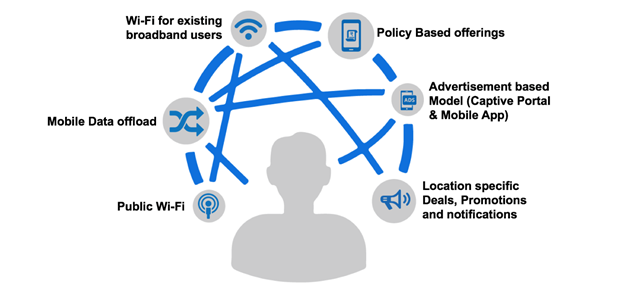
BSNL is in line with end-user expectations vis a vis Wi-Fi whether they are daily commuters or foreigners visiting the country. These users want Wi-Fi that simply works and provide them with a great experience from network discovery to onboarding to web surfing with as little friction from passwords and payments as possible including when roaming across India. At the same time, they want secure networks that they can rely on to conduct sensitive business such as banking. If they are going to be marketed products and services, consumers expect ads to be context aware and relevant to them.
On the other hand, venue owners and service providers need a management system that is agile and easy to implement so they can adjust their marketing strategies to rapid changes as well as test new offerings without requiring whole new software development.
Service providers want to be able to monetize their Wi-Fi network both at the retail and wholesale levels. For example, launching new marketing campaigns geared at both their current subscribers as well as their competitor’s end-users or visitors through a simple to create captive portal. They want to be able to make partnerships and deals with venues or brands quickly and test new business models including through MVNOs and roaming agreements.
BSNL strategy towards Wi-Fi is also in line with the level of industry confidence in Wi-Fi investment reported by is at its highest-ever as reported by the Wireless Broadband Alliance in its Annual Industry Report for 2017. The new global study by Maravedis has revealed that over 80 per cent of those surveyed feel as or more confident about Wi-Fi than they did a year ago.
As industry attention moves toward monetizing Wi-Fi, the study also highlights the services most important to monetization strategies for 2018 according to respondents included location based services (37.5 per cent), roaming (33 per cent) and marketing analytics (almost 33 per cent). The three Wi-Fi use cases tipped to drive near term revenue potential include: extending internet access and media to a full smart home, richer and more efficient enterprise services driven by cloud managed networks and security, and expansion of the Wi-Fi roaming model.
Conclusions
India is a leader in ICT-enabled outsourcing services. BSNL’s efforts in extending fiber-optic backbones to rural areas and deploying low cost and high-quality Wi-Fi is expected to result in lower costs and greater affordability and likely to narrow the gap in ICT access between rural and urban areas. Sterlite Tech plays a central role in enabling BSNL to deploy, manage and monetize its Wi-Fi network thanks to its 2017 WBA award winning Wi-Fi Service Management Platform (SMP).
Sterlite Tech’s Wi-Fi Service Management Platform (SMP) is a modular, pre-integrated solution for Carrier Wi-Fi, Enterprise Wi-Fi, Public Wi-Fi, Smart City Services. With a comprehensive cloud ready platform, Wi-Fi SMP helps CSPs to offer innovative services and launch unique business cases, thus ensuring service differentiation, create new revenue opportunities and enhance customer experience.
For more information please visit www.elitecore.com/service-provider-wifi.htm
About the Author
Mr. Fellah, Senior Analyst, authored various landmark reports on Wi-Fi, LTE, 4G and technology trends in various industries including retail, restaurant and hospitality. He is regularly asked to speak at leading wireless and marketing events and to contribute to various influential portals and magazines such as RCR Wireless, 4G 360, Rethink Wireless, The Mobile Network, Telecom Reseller to name a few. He is a Certified Wireless Network Administrator (CWNA) and Certified Wireless Technology Specialist (CWTS).
The post BSNL Driving Digital India with Wi-Fi Strategy by Adlane Felah, Senior Analyst, Maravedis LLC appeared first on Core Sector Communique.
]]>The post Energy Storage Outlook Strengthens as Cumulative Installed Base to Reach 52 Gigawatts in 2025 From Under Four GW Installed Today, Says IHS Markit appeared first on Core Sector Communique.
]]>Julian Jansen, senior analyst, solar and energy storage, IHS Markit
In 2016, 1.3 gigawatt (GW) of grid-connected energy storage was deployed, which will grow to 4.7 GW in 2020 and 8.8 GW in 2025.
- The grid-connected energy storage market is projected to grow from annual revenues of $1.5 billion in 2016 to more than $7 billion in 2025 with a CAGR of 16 percent.
- Today utility-scale storage dominates the global market: In 2020 for the first time more than 50 percent of cumulative annual installs will be deployed behind-the-meter.
- The United States will be the largest market, deploying 1.2 GW in 2020, seeing a CAGR of 21 percent from 2017 to 2025. In the short term, South Korea, Japan, Germany, Australia and the United Kingdom will be the next biggest markets.
- Lithium-ion battery module prices have fallen 70 percent since 2012, and will fall below $200/kWh by 2019.

Energy storage outlook strengthens as the market for longer-duration systems establishes.
The global market for energy storage remains poised for growth, with the market outlook strengthening until 2025, reaching a total installed base of 52 GW. Overall, IHS Markit predicts that annual deployment if grid-connected energy storage will grow from 1.3 GW in 2016 to 4.7 GW in 2020 and 8.8 GW in 2025.
As part of the continuous research carried out by IHS Markit across the energy storage industry, a number of macro-trends are emerging. Early markets for energy storage from 2013-2015 were driven by single applications, such as frequency regulation in the PJM market, or self-consumption in the German residential segment. However, over the course of 2016 and the first half of 2017, new value is emerging for utility-side-of-meter storage, primarily from capacity requirements, the integration of utility scale solar and island micro-grids. This leads to greater growth in the longer duration storage segment, especially systems of 2-4 hour duration.
At the same time in the behind-the-meter segment, system aggregation and demand response programmes are enabling value stacking and improving economics, aided by regulatory support and subsidy programmes in California, South Korea, Japan or Germany. Therefore IHS Markit predicts that in 2020 for the first time more than 50 percent of cumulative annual installs will be deployed behind-the-meter.
On a regional level, three key markets currently stand out:
- IHS Markit is seeing a continuous increase in the forecast for the United States behind-the-meter market with SGIP funding in California driving deployment across the various applications and revisions to NEM programmes supporting the long-term development of residential markets.
- Sustained growth in South Korea, despite the completion of major frequency regulation projects in 2017. Over the coming years increasing utility-lead programmes for renewable integration and mandates for energy storage in public building support annual deployment of more than 300 MW p.a. from 2018 onwards.
- Public tenders and large-scale solar plus energy storage are igniting the Australian utility-side-of-meter market, as shown by major announcements from players such as Tesla and Lyon Group.
As prices for energy storage systems continue to fall, previously uneconomical applications, such as the co-location of battery storage with solar PV, are becoming feasible. Driven by declining Lithium-ion battery module prices, which have fallen 70 percent since 2012, the technology will dominate the market over the coming years. With prices for Lithium-ion battery modules predicted to fall further, reaching less than $200/kWh by 2019, Li-ion batteries will also establish themselves as the leading chemistry in longer duration systems aimed at the two-to-four hour duration segment.
IHS Markit Technology Energy Storage Research
IHS Markit Technology Smart Grid and Energy Storage provides a detailed and accurate view into the market for energy storage systems across all key segments of the industry, including small and large-scale renewable integration, grid support, and behind-the-meter storage. Whether you are a new entrant in the market, looking to capitalize on this growing opportunity, or looking to understand developing market trends, this service delivers the market intelligence and insight you need to understand this complex market.
The post Energy Storage Outlook Strengthens as Cumulative Installed Base to Reach 52 Gigawatts in 2025 From Under Four GW Installed Today, Says IHS Markit appeared first on Core Sector Communique.
]]>The post Double Honors for Telstra at the 2017 Frost & Sullivan Asia PacificICT Awards appeared first on Core Sector Communique.
]]>SINGAPORE, July 7, 2017 /PRNewswire/ — Telstra has bagged two awards at the annual Frost & Sullivan Asia-Pacific ICT Awards banquet, held at the Shangri-La Singapore. The two awards Telstra were honored with include the 2017 Frost & Sullivan Asia-Pacific Telco Cloud Service Provider of the Year and M2M Service Provider of the Year Awards.

Ms. Yu Xuan Ng, Industry Analyst, Digital Transformation, Frost & Sullivan said that Telstra has achieved significant revenue growth in 2016 and continues to lead the Asia-Pacific Telco Cloud Service Provider market.
“The growth can be attributed to its integrated hybrid cloud infrastructure portfolio bundled with connectivity and managed services. In addition, Telstra has also demonstrated strong commitments to expand its global portfolio by partnering with RightScale in 2016 to introduce the ‘Telstra Cloud Management Platform’,” she added.
She noted that Telstra is also offering “Network-as-a-Service” via the launch of Telstra Programmable Network. The offering helps customers embrace cloud computing by combining networks, cloud platforms, data centres, as well as Software Defined Networking (SDN)/Network Function Virtualization (NFV) capabilities into an integrated platform, offered on an on-demand and near real-time deployment basis.
“These value-added connectivity and cloud orchestration offerings have enabled Telstra to offer a robust end-to-end portfolio of managed cloud and ICT offerings,” Ms. Ng said.
In the area of M2M, Telstra’s efforts in this space were also recognized as the company continues to revolutionize businesses through its industry-leading IoT-enabled solutions.
“Telstra offers a highly modular and scalable IoT platform that delivers cost-efficient solutions, network security and best practices drawing from its vast experience and end-to-end ecosystem partnerships,” noted Mr. Avinash Sachdeva, Senior Analyst, Digital Transformation, Frost & Sullivan.
“The M2M Control Centre simplifies service management using advanced tools that allow remote provisioning, management, near real-time notifications, diagnostics, and troubleshooting. Telstra offers an extensive range of SIM form factors, along with ruggedized SIMs that can withstand extreme environmental conditions to suit clients’ unique requirements,” Mr Sachdeva explained.
The recipients of the annual Frost & Sullivan Asia-Pacific ICT Awards were identified based on an in-depth research conducted by Frost & Sullivan’s analysts. The award categories offered each year are carefully reviewed and evaluated to reflect the current market landscape and include new emerging trends. The short-listed companies were evaluated on a variety of actual market performance indicators which include revenue growth; market share and growth in market share; leadership in product innovation; marketing strategy and business development strategy.
About Frost & Sullivan
Frost & Sullivan, the Growth Partnership Company, works in collaboration with clients to leverage visionary innovation that addresses the global challenges and related growth opportunities that will make or break today’s market participants.
For more than 50 years, we have been developing growth strategies for the global 1000, emerging businesses, the public sector and the investment community. Is your organization prepared for the next profound wave of industry convergence, disruptive technologies, increasing competitive intensity, Mega Trends, breakthrough best practices, changing customer dynamics and emerging economies?
The post Double Honors for Telstra at the 2017 Frost & Sullivan Asia PacificICT Awards appeared first on Core Sector Communique.
]]>The post Cloudera Launches Altus to Simplify Big Data Workloads in the Cloud appeared first on Core Sector Communique.
]]>Managed Service for Data Engineers Delivers a Job-First Experience and Reduces Cloud Migration Risk

New Delhi — May 29, 2017 — Cloudera, Inc, (NYSE:CLDR) the provider of the leading modern platform for machine learning and advanced analytics, announced the release of Cloudera Altus, a Platform-as-a-Service (PaaS) offering that makes it easier to run large-scale data processing applications on public cloud. The initial Altus service helps data engineers use on-demand infrastructure to speed the creation and operation of elastic data pipelines that power sophisticated, data-driven applications.
Data engineering applications like ETL (Extract, Transform and Load) or batch scoring are often large, batch-oriented workloads that run for a fixed period of time and help companies extract critical insights from raw data. Organizations can gain significant flexibility and efficiency advantages by running these pipelines on elastic infrastructure. Enterprises want to leverage cloud infrastructure alongside familiar large-scale data processing tools and technologies.
The Cloudera Altus Data Engineering service simplifies the development and operations of elastic data pipelines; putting data engineering jobs front and center and abstracting infrastructure management and operations that can be both time consuming and complex. Altus also reduces the risk associated with cloud migrations. It provides users with familiar tools packaged in an open, unified, enterprise-grade platform service that delivers common storage, metadata, security, and management across multiple data engineering applications.
“Data engineering workloads are foundational for today’s data-driven applications,” said Charles Zedlewski, senior vice president of Products at Cloudera. “Altus simplifies the process of building and running elastic data pipelines while preserving portability and making it easy to incorporate data engineering elements into more complex BI, data science and real-time applications.”
Cloudera makes it easy, cost-effective, and convenient to deploy these workloads on cloud providers, such as Amazon Web Services (AWS), taking advantage of cloud elasticity, low-cost storage and compute options, and rapid provisioning to deliver a modern data service that can tackle even the most challenging business problems. Cloud object stores such as Amazon Simple Storage Service (Amazon S3) are becoming increasingly popular for their resiliency, scalability, and relatively low cost.
According to IDC, public cloud deployments are now at 12% of the overall worldwide business analytics software market and expected to grow at a 25% CAGR through 2020[1]. Cloud is one of the fastest growing deployment environments for Cloudera customers, and Altus makes it easier than ever to run data engineering workloads in the cloud.
Features and benefits of Altus include:
- Managed service for elastic data pipelines – Cloudera Altus is a PaaS that allows data engineers to easily and quickly provision Apache Spark, Apache Hive, Hive on Spark, and MapReduce2 capacity on cloud-native infrastructure. Altus presents intelligent default cluster settings and environments that dramatically reduce cluster deployment times and operations, automating processes like cluster provisioning, configuring, and termination.
- Workload orientation – Cloudera Altus centers around data pipelines rather than clusters or infrastructures, so users can easily submit, clone, and troubleshoot pipelines with minimal attention paid to the underlying infrastructure.
- No data siloes – The Altus Data Engineering service enables data engineers to run direct reads from and writes to cloud object storage as does the rest of Cloudera’s platform. This data is immediately available for use by other Cloudera workloads without requiring data replication, ETL or changes to file formats. In doing so users can more easily incorporate data engineering into their data science, BI and real time DB applications.
- Backward compatibility and platform portability – Altus supports multiple versions of CDH the most widely used open source platform in the industry. Users can easily move workloads to and from the cloud without needing to modify their applications. Because CDH is backward compatible across minor releases, customers can harness the latest innovation from the Apache big data open source community without fear of breaking their applications from release to release.
- Built-in workload management – Altus automates and simplifies the common operational issues related to elastic data pipelines with workload management. Users can troubleshoot failed jobs with or without the clusters or compute infrastructure being present. In addition Altus’ workload management flags significant performance deviations and proposes a root cause analysis. In doing so customers can run their data pipelines with greater reliability and lower cost.
The initial rollout of Cloudera Altus includes support for Apache Spark, Apache Hive on MapReduce2, and Hive on Spark. It is available today in most Amazon Web Services (AWS) regions. Over time Cloudera plans to expand Altus to support other leading public clouds such as Microsoft Azure, etc. For more information or to review the reference architecture, please visit www.cloudera.com/altus.
451 Research
“Data and analytics, particularly in the cloud, continues to be one of the most significant areas of growth and investment for many enterprises., said But organizations also faces challenges with cloud-based cluster management, data processing, and migration, which is right where Cloudera is focusing its efforts with Altus.”
— James Curtis, senior analyst, data platforms and analytics
Amazon Web Services
“Customers are increasingly choosing AWS for their large-scale data processing workloads. The Altus service on AWS will make it easier for Cloudera customers to take advantage of the cloud with on-demand data processing and cost optimization through Amazon Elastic Compute Cloud (Amazon EC2) Spot Instances.”
— Ken Chestnut, global segment lead
CyberZ
“Altus gives us the ability to quickly and easily provision and deploy data engineering clusters on AWS, and enables our ETL developers to run their business-critical workloads without the hassle of ongoing cluster operations and management from CyberZ. We are also pleased to see that we can use the same enterprise technology stack in the cloud as is deployed on-premises to make our cloud migration that much easier.”
–– Takahiro Moteki, Big Data Architect of F.O.X
Talend
“We’re excited to be the first integration provider to support Cloudera Altus and enable our customers to deploy big data projects dramatically faster with far less operational support. Together with Cloudera, we are empowering organizations to transparently build big data integration jobs that can run on-premises or in the cloud, making it easier for them to run their business on their hybrid cloud and on-premise infrastructure.”
— Ciaran Dynes, VP Products
About Cloudera
Cloudera delivers the modern platform for machine learning and advanced analytics built on the latest open source technologies. The world’s leading organizations trust Cloudera to help solve their most challenging business problems with Cloudera Enterprise, the fastest, easiest and most secure data platform available for the modern world. Our customers efficiently capture, store, process and analyze vast amounts of data, empowering them to use advanced analytics and machine learning to drive business decisions quickly, flexibly and at lower cost than has been possible before. To ensure our customers are successful, we offer comprehensive support, training and professional services. Learn more at cloudera.com.
Connect with Cloudera
About Cloudera: cloudera.com/more/about.html
[1]IDC MARKET FORECAST, Worldwide Business Analytics Software Forecast, 2016–2020
The post Cloudera Launches Altus to Simplify Big Data Workloads in the Cloud appeared first on Core Sector Communique.
]]>The post Research as a Service: Assessing the Implications of MiFID II on Investment Research appeared first on Core Sector Communique.
]]>
NEW YORK – Celent has released a new report titled Research as a Service: Assessing the Implications of MiFID II on Investment Research. The report was written by John Dwyer, a Senior Analyst with Celent’s Securities & Investments practice.
 Research Aggregators have emerged offering the buy side access to research via a platform with transparent pricing, usage-analytics, and budgeting tools.
A key driver of the success of these platforms will be the pricing strategy; we explore the implications of a “per report” pricing approach versus a subscription-based Research as a Service approach.
Research as a Service harnesses best-in-class technology to optimize transparency, compliance, and pricing of research. In addition, it also combines digital publishing and alignment of incentives to create a network generating actionable alpha. Smartkarma is pioneering the Research as a Service model across Asian markets. Its recent partnership with Société Générale reflects an important milestone for the investment research industry. Real consensus among the buy and sell side remains elusive – other than an expectation that the regulatory picture is likely to remain mixed.
“The regulatory pulse is likely to quicken through 2017 as evidenced by the FCA’s recent announcements regarding firms failing to meet their expectations in a number of key research related areas including monitoring, pricing, budgeting, and record-keeping,” commented Dwyer.
“The initial focus of the incumbents on the buy side and sell side is likely to be on compliance. However, as new operating procedures are put into place and the research evolves to a P2P approach then greater scrutiny will emerge on commercial implications of how alpha-generating research should be monetized,” he added.
About Celent
Celent is a research and advisory firm dedicated to helping financial institutions formulate comprehensive business and technology strategies. Celent publishes reports identifying trends and best practices in financial services technology and conducts consulting engagements for financial institutions looking to use technology to enhance existing business processes or launch new business strategies. With a team of internationally experienced analysts, Celent is uniquely positioned to offer strategic advice and market insights on a global basis. Celent is a member of the Oliver Wyman Group, which is part of Marsh & McLennan Companies [NYSE: MMC].
The post Research as a Service: Assessing the Implications of MiFID II on Investment Research appeared first on Core Sector Communique.
]]>The post Customers Accelerate the Move to the Mobile, Digital Office appeared first on Core Sector Communique.
]]>New Capabilities in ShareFile Enable Customers to Streamline Document Workflows, Increasing Productivity and Collaboration Across Teams and Clients
 SANTA CLARA, Calif. – November 21, 2016 – The benefits of becoming a digital office are well-documented, and businesses have much to gain from adopting technology that streamlines employees’ workflows and routine processes, while maintaining high levels of security and compliance. The modern workplace is experiencing dramatic gains in productivity and efficiency, while also improving the way teams and clients collaborate from anywhere, at any time, on any device. Industry analyst firm IDC indicates that 80 percent of businesses have processes that still rely on paper and that most organizations are just beginning to transform their businesses with document and information management leading the way. Yet, 72 percent of businesses agree that improving document processes would increase customer satisfaction and/or increase brand value[1].
With these market drivers and the influence of the more than 80,000 business customers and 20 million business users, Citrix continues to drive innovation in its leading file sync-and-sharing solution. These include a smarter and simpler user experience, as well as a more streamlined way to view and take concise action on files of all types, including getting feedback and approvals on documents, sharing DICOM medical images, viewing 3D architectural renderings, and even requesting and tracking audit lists. ShareFile customers are more productive, collaborative, and secure, as they transition to the workplace of the future by evolving their business workflows and processes from paper to digital.
What’s New in ShareFile
In today’s business environment, there is an explosion of data and apps, and an ever-growing need for collaboration across geographies. However, there has been no systematic way to store, share, review or approve documents that are critical to business functions and services until ShareFile. ShareFile is built – from the ground up – for business, giving customers a simpler way to collaborate with teams and clients with built-in feedback and approval workflows.
- Users can get feedback, request approvals and e-signatures – all within ShareFile’s web interface.
- Track feedback and approvals in real time with the ability to set due dates and view status at any time.
- Eliminate the need to send documents via email and track for version control.
ShareFile gives customers a smarter way to work with a new, web-based dashboard and interface.
- Recently opened files are easily accessible.
- Users can do more in less time with easy-to-find actions and a clean, straightforward design that enhances productivity.
- Quick access to tutorials and links are available upon log-in to guide users step-by-step.
ShareFile provides a better, more convenient way to view every file with its new content viewer.
- Users see a clear view of 60+ file types without the need to wait for downloads and have the ability to preview the most common file formats, including PDFs, without having to leave the web browser.
- Users can conveniently share files, and request feedback and approvals through workflows – right from the viewer.
New and Enhanced Solutions for Industry-Specific Solutions
Many industries, including finance, insurance, and real estate, have specific workflow and compliance needs – including support for FINRA, HIPAA and CFPB. ShareFile addresses these needs, and can be configured in a way that streamlines many of the common, industry-specific use cases – particularly in Accounting and Healthcare. The high level of customization and industry knowledge that ShareFile provides enables customers to have workflows and peace of mind that is tailored to their individual needs.
ShareFile for medical imaging enables customers in healthcare-related fields to reduce their need for CDs with its diagnostic-quality DICOM viewer and storage that supports HIPAA compliance. Healthcare providers and payers can now request, upload, view and share medical images in a simple, cloud-based environment. For nearly a decade, CPAs using ShareFile for Accounting have been able to easily exchange large QuickBooks files, monthly statements, and tax returns. Thanks to the most-recent improvements to ShareFile, CPAs can now create and track PBC lists (Provided By Client Lists), and request e-signatures for IRS forms 8879s. The request list feature eliminates the painstaking need to rely on email and spreadsheets, reducing complexity and error.
Terri McClure, Senior Analyst, Cloud Infrastructure and File Sharing, ESG
“Business leaders recognize the need to embrace a modern, digital workplace to drive greater efficiency in business processes. This means taking a close look at their document and information management workflows and embracing technologies to take the friction out of these processes while keeping data secure. By using ShareFile’s collaborative workflow and security features, customers and their clients benefit from more streamlined and structured processes, speeding time to complete projects, deliver results, and increase customer satisfaction, all while complying with stringent security requirements.”
Byron Patrick, Managing Director, CPA Practice, Network Alliance
“Innovations in technology, like the Citrix ShareFile new approval workflow and request list, just keep getting better. The approval workflow capability simplifies the cumbersome process of collecting source documents while keeping a CPA client’s information safe, secure and private. Firms I work with are more efficient when collaborating with their clients, who appreciate the simplicity of the system.”
Kevin Gardner, Operations Manager, US Framing International
“As far as time saved, the approval workflow capability helps out tremendously. Instead of sending multiple emails back and forth and tracking comments and changes, they can go and comment on every page of the document in one go around. That saves us time in the approval conversation. We probably had a three-day turn around for approvals before, and with the approval workflow we’ve been able to cut a day out of that process.”
Samantha Rice, Firm Administrator, McMahan, Thomson & Associates, P.C.
“The approval workflow feature has helped us improve our communication on projects that require more than one team member. It has eliminated email chains and provided a centralized location for all feedback and changes to documents.”
Nate Spilker, Vice President ShareFile and Cloud Services, Citrix
“Customers of all sizes are looking for solutions that allow them to work and collaborate seamlessly from anywhere, transforming their businesses to be more efficient and mobile. Citrix is continuing to drive innovation in ShareFile beyond file sharing and storage to address the workflow needs of the modern worker. Now with a simpler user interface and industry-specific solutions, ShareFile is helping its customers to increase productivity and collaboration.”
About Citrix
Citrix (NASDAQ:CTXS) aims to power a world where people, organizations and things are securely connected and accessible to make the extraordinary possible. Its technology makes the world’s apps and data secure and easy to access, empowering people to work anywhere and at any time. Citrix provides a complete and integrated portfolio of Workspace-as-a-Service, application delivery, virtualization, mobility, network delivery and file sharing solutions that enables IT to ensure critical systems are securely available to users via the cloud or on premise and across any device or platform. With annual revenue in 2015 of $3.28 billion, Citrix solutions are in use by more than 400,000 organizations and over 100 million users globally. Learn more at www.citrix.com.
The post Customers Accelerate the Move to the Mobile, Digital Office appeared first on Core Sector Communique.
]]>The post Dell Streamlines Patient Care in India with New Cloud-Based Healthcare Solution appeared first on Core Sector Communique.
]]>
 · An affordable, scalable and flexible solution supports better healthcare delivery and operational efficiency
· Tailor made for emerging markets; a game changer for Indian healthcare
· Dell collaborates with ubq Technologies and Ramco Systems to build an integrated, end-to-end healthcare solution
BANGALORE, India, March 24, 2014 — Dell Services today unveiled a cloud-based solution that seamlessly and cost effectively delivers integrated clinical and financial systems for healthcare providers in India. This is a highly scalable, widely accessible and flexible solution to suit the unique needs of Indian healthcare providers.
With this solution, end-users (physicians, nurses and back office staff) can access cloud-based applications and reports through the use of a simple conventional browser. The solution also allows users to remain connected via smart phones and other hand-held devices, ensuring secure and anytime, anywhere access to information.
Commenting on the role of cloud in enabling better healthcare outcomes, Dr. Ashwin Naik, Founder and CEO, Vaatsalya, India’s first hospital network focused on Tier II and Tier III towns said, “The healthcare industry in India is increasingly turning to IT adoption to improve patient outcomes. As hospitals and providers expand their operations with new referral centers, facilities, and acquisitions in new geographies, the need to access, integrate and connect these disparate systems is gaining importance. Cloud-based technology has the potential to addresses most of the IT-related issues — access to the right information at the right time and operational efficiency, among others. More importantly it is affordable, scalable and flexible.”
Delivered as a Software-as-a-Service (SaaS) model, the solution allows healthcare providers to quickly respond to increasing demands of infrastructure and storage, and train staff without huge capital investments and recurrent readiness costs.
“There is a seismic shift happening in the global healthcare industry. The overarching trend is to integrate and move information to the right person or system at the right time — whether it’s a provider’s staff, external service provider, or the consumer (patient or prospect),”said Sudhanshu Bhandari, Senior Analyst, Forrester Research. “The ability to create an information infrastructure that brings together the micro level of personalized health and the macro level of epidemiologic mappings to institutional quality and evidence-based practices will be a key differentiator for healthcare providers in future. Cloud-based end-to-end business services would help healthcare companies jump start these business initiatives and collaborate with global peer institutions. However, the Indian healthcare market is still very cost competitive and more maturity is needed to effectively leverage cloud-based solutions.”
This solution is available today in India and is an integral part of Dell’s vision of building future-ready IT platforms to provide cutting-edge technology and services that enable innovation in Health IT. The cloud-based solution also extends Dell’s Cloud strategy of providing choice and flexibility to customers to drive tangible business results through cloud computing.
Dell Inc. listens to customers and delivers innovative technology and services that give them the power to do more. Dell Services develops and delivers a comprehensive suite of services and solutions in applications, business process, consulting, infrastructure and support to help customers succeed. Learn more at www.dell.com
The post Dell Streamlines Patient Care in India with New Cloud-Based Healthcare Solution appeared first on Core Sector Communique.
]]>The post Dissecting The Role Of Real Estate Regulator In India: Karan Khetan, Senior Analyst – Research & REIS, Jones Lang LaSalle India appeared first on Core Sector Communique.
]]>
The Central Government Cabinet approved the Real Estate (Regulation & Development) Bill on 5 June 2013. The aim of the bill is to create a Real Estate Regulatory Authority and an Appellate Tribunal that will act as a watchdog for the housing sector, primarily towards protecting consumer interests while creating an alternative redress mechanism for any disputes that may arise.
The bill demands greater disclosure from the developer community and a higher level of project accountability to remove the information asymmetries from the housing market.
Like the US, where local city laws hold primacy over county and national laws in matters relating to real estate, land and urban planning, including housing, is a state subject in India. In a quasi-federal state like India, states act as independent, autonomous agents in respect of subjects that are under their purview.
While the US does not have a single window regulator, this bill seeks to remove this obstacle by letting the states set up their respective Regulatory Authority. Another major positive step is the compulsory registration of real estate agents, which is likely to provide another level of protection to buyers while also preventing concerns regarding money laundering by the non-organised broker community. A major bill provision is the standardisation of area measurement, with carpet area to be the measure when this bill is enacted.
Effective legislation, judicial activism and regulatory mechanism together lead to a vibrant industry with greater emphasis on protecting consumer interests. With a literally exploding housing demand, there was a definite need to bring in greater disclosure norms. Developers would need to provide the status of all approvals as well as sanctioned plans to buyers and will not be able to sell their project without obtaining the required approvals.
The bill has also sought to ensure that the buyer’s payment is utilised for the development of the particular project by necessitating the creation of an escrow account where the customer advances paid will be used only for that project’s completion. This limit has been revised from 70% earlier to 70% or less as decided by the respective states. The bill also seeks to make the developer responsible for adhering to the timelines and specifications committed to for project completion.
However, there is a need to analyse if certain inherent challenges facing the housing sector have been given a miss in this draft. At first glance, the Government is yet to streamline the approval process, which significantly slows down the project launch date and adds to the cost burden of the developer.
There is no clarity on which law will have precedence in the case of a dispute between the Central Government and state policies. The idea of fostering greater transparency may come at the cost of housing projects becoming more expensive if the approval process adds to the holding cost of the developer.
That the regulator will be effective and that this is a positive step is not debatable. However, the extent of effectiveness and the implementation at the state level are possible hindrances going forward.
Karan Khetan, Senior Analyst – Research & REIS, Jones Lang LaSalle India
The post Dissecting The Role Of Real Estate Regulator In India: Karan Khetan, Senior Analyst – Research & REIS, Jones Lang LaSalle India appeared first on Core Sector Communique.
]]>