The post Global Survey Reveals Coming Shift in Cyber Security Priorities appeared first on Core Sector Communique.
]]>Barracuda Networks surveyed more than 1,500 IT leaders and security professionals in North America, EMEA, and APAC about their IT security priorities, how those priorities have shifted, and where they’re headed next.
Overall, the study indicates that while the top security priorities have remained consistent over the past 15 years, the types of threats organizations are protecting against has shifted significantly. Looking ahead, respondents believe that the cloud will be a higher priority 15 years in the future and that AI will be both a threat and an important tool. Let’s take a closer look.

Consistent focus on email and network security
The IT professionals we surveyed identified email and networks as their top two priorities in both 2003 and 2018. A full 25 percent of respondents said email was their top security priority in 2003, and 23 percent said the same about their current priorities. Network security came in a close second for both 2003 and 2018 priorities, with 24 percent and 22 percent respectively.
Evolution of email-borne threats
Although what organizations care most about protecting has stayed consistent over the past 15 years, the threat landscape has changed dramatically. Respondents identified viruses (26%) and spam and worms (18%) as the top two threats they were concerned about in 2003. When asked about current concerns, ransomware (24%) and phishing/spear phishing (21%) topped the list.
This shift fits with how Barracuda’s approach to email security has developed over the years. Growing from the spam filter the company was founded on, Barracuda added critical capabilities to better fight much more targeted threats, such as spear phishing, phishing, zero-day malware, as well as secure data, and help with regulatory compliance. To keep up with changing threats and protect against phishing, spear phishing and other threats like account takeover and business email compromise, we were the first company to pioneer the use of artificial intelligence to stop spear phishing and detect account takeover, and we were the first company to add simulation and training to our email security portfolio.
Cloud security is a top priority for the future
While email and network security are currently a higher priority than cloud security for most of the IT professionals we surveyed, that order shifts when they look to the future. A full 25 percent said the cloud would be their most important security priority 15 years from now, outranking email, network, and data security, which were each selected by 14 percent of respondents.
This change has been gradual. Only 3 percent of respondents said cloud security was a top priority for them in 2003. That number when up to 14 percent when they were asked to rank their current security priorities. We don’t believe this shift means email protection will be less important to organizations in the future, simply that questions about how to secure the cloud loom large as IT professional try to predict the way their responsibilities will evolve over the next decade and a half.
AI: High hopes and big worries
Artificial intelligence is another technology that is top of mind for many of the IT professionals we spoke with—both as an opportunity to improve security and as a theat. It’s an interesting contrast.
A full 31 percent of respondents chose AI as the new technology that they will rely on to help improve security, and 43 percent identified the increasing use of artificial intelligence and machine learning as the development that will have the biggest impact on cyber security in the next 15 years. On the other hand, 41 percent believe the weaponization of AI will be the most prevalent attack tactic in the next 15 years. We share our customers’ concern about the weaponization of AI. Imagine how social engineering attacks will evolve when attackers are able to synthesize the voice, image, or video of an impersonated target.
Barracuda Networks has made significant investments in solutions powered by AI, such as Barracuda Sentinel, which provides AI-based protection from spear phishing, account takeover, and business email compromise. With strong investment in AI and a robust big data infrastructure across different products, Barracuda Networks plan to stay several steps ahead in the upcoming cybersecurity AI arms race.
BJ Jenkins, Barracuda’s CEO said: “At Barracuda, we feel it’s important to see where customers’ concerns and priorities are moving and getting there ahead of the need, so we can provide the solutions they’ll be looking for as threats get more sophisticated. We’ve come a long way over the past 15 years, and we’re looking forward to finding new ways to protect businesses. We’re excited to celebrate this milestone with our customers and channel partners, as well as introducing a refresh brand identity that reflects the way the company has evolved.”
The post Global Survey Reveals Coming Shift in Cyber Security Priorities appeared first on Core Sector Communique.
]]>The post Majority of women do not know early signs of breast cancer, finds global survey by Avon appeared first on Core Sector Communique.
]]>– Less than half (42%) are confident that they know what changes to their breast could be a sign of cancer
– A quarter (25%) think that a lump is the only sign of breast cancer that can be identified without medical equipment
– Avon Breast Cancer Promise launches today, a multi-year commitment to educating women about the disease

LONDON, Sept. 25, 2017 /PRNewswire/ — Only two in five people (42%) are confident about recognising the changes to their breasts that could be a sign of cancer, according to a new survey of 19,000 respondents by Avon Products, Inc., the world’s leading social selling company[i]. The findings also show there is a knowledge gap amongst women globally about what the symptoms are for breast cancer and how to lower the risk of developing the disease.
The World Health Organization estimates that breast cancer kills more than 500,000 women globally every year, a number that could be greatly reduced if cancer were detected at an earlier stage.
Despite 73% of respondents saying they look out for changes to the appearance of their breasts, many report that they aren’t confident recognising the early signs of breast cancer. Moreover, more than half of those surveyed (60%) would hesitate to seek medical advice for a variety of reasons, including embarrassment, fear and not having access to a regular doctor.
The survey also found a lack of knowledge when it comes to identifying signs and knowing the risks of breast cancer, which may be due to a lack of information — 30% said that they haven’t been given any information about changes to their breasts that could be a cause for concern. A quarter (25%) think that a lump is the only sign of breast cancer that can be identified without medical equipment. When asked to identify 10 common symptoms of breast cancer, only 2% managed to select all 10 correctly.[ii]
There is also low awareness of some of the important lifestyle factors that could prevent breast cancer, with almost two-thirds (64%) unaware that exercise could help lower the risk of developing breast cancer. Similarly, 63% of those surveyed do not know that alcohol consumption is linked to a higher risk of breast cancer.
Over the last 25 years, Avon and the Avon Foundation for Women[iii] have donated more than US$800 million globally to breast cancer causes, educated 180 million women about this disease, and funded breast health screenings for nearly 20 million women.
The research comes as Avon launches its new Breast Cancer Promise, a renewed multi-year commitment to educating women about breast health that builds on its legacy of supporting the breast cancer cause. Avon will work with a host of educators, partners, health organisations and experts to deliver greater public awareness of breast cancer and make sure every woman knows how to take action.
Sheri McCoy, Avon CEO, said: “Early detection is crucial to fighting breast cancer, yet our survey found that women don’t know their risks or what signs to look for. We want to change this lack of knowledge by using the power of our global network of women — 6 million Avon Representatives and more than 26,000 Associates – and our breast cancer partners, to educate women. Our Promise outlines our long-term commitment to ensure every woman is breast health aware, every day.”
Dr Paul Goss, Chairman of the Avon Foundation Scientific Advisory Board and Director of Breast Cancer Research at Massachusetts General Hospital, said: “These figures show just how much work still has to be done in raising awareness of breast cancer, particularly its signs, risks and how to act on concerns about it. Awareness is essential, since it ensures that breast cancer is detected at an early stage. Early detection is the most effective way of saving lives, it is crucial to tackling breast cancer.”
The Avon Breast Cancer Promise will see the world’s leading social selling company commit to:
- Working in partnership with charities and breast cancer experts to activate the largest global movement focused on making sure everybody is aware of and understands their breast cancer risks.
- Galvanising its network of six million Avon Representatives and using its brochures and digital tools to help 50 million women a year — 250 million women over the next five years — recognise the early signs of breast cancer.
- Helping every woman know when and where to seek medical advice, through connecting them with local health services and charities, or through Avon-funded helplines and mammogram screenings.
The Avon Breast Cancer Promise
Breast health aware. Every woman. Every day.
Early detection of breast cancer saves lives. At Avon, we believe that no woman should die because she was left in the dark about breast cancer.
Too many women still don’t know enough about this disease. Join us to help change this.
Together we will…
…help every woman know the risks…
…so, no matter her age, she understands the risks of developing breast cancer, and what she can do to manage them.
…help every woman know the signs…
…so she knows what breast health means for her, and can recognise the early signs of breast cancer.
…help every woman know how to take action…
…so she can seek help and medical advice when it’s needed.
Join us.
Avon. Beauty for a Purpose.
For more information, go to: www.avoncompany.com/breast-cancer-crusade
About Avon Products, Inc.
Avon is the Company that for 130 years has proudly stood for beauty, innovation, optimism and, above all, women. Avon products include well-recognized and beloved brands such as ANEW, Avon Color, Avon Care, Skin-So-Soft, and Advance Techniques sold through nearly 6 million active independent Avon Sales Representatives.
[i] Avon surveyed more than 19,000 people from 15 countries in which it operates – including Argentina, Brazil, Italy, Mexico, Philippines, Russia, Turkey and the UK – on their knowledge of breast cancer and the disease’s risks.
[ii] Breast Cancer Awareness Measure developed by Cancer Research UK, King’s College London and University College London in 2009 and validated with the support of Breast Cancer Care and Breakthrough Breast Cancer.
[iii] The Avon Foundation for Women is the world’s largest corporate-affiliated philanthropy focused on issues that matter most to women. Since its inception in 1955, the Avon Foundation has promoted or aided charitable, scientific, educational, and humanitarian activities, with a special emphasis on activities that improve the lives of women and their families. Through 2016, Avon and the Avon Foundation have contributed over $1 billion in over 50 countries. Today, Avon global philanthropy programs focus on funding breast cancer research and advancing access to quality care through the Avon Breast Cancer Crusade, and efforts to reduce domestic and gender violence through its Speak Out Against Domestic Violence program. Visit www.avonfoundation.org for more information.
The post Majority of women do not know early signs of breast cancer, finds global survey by Avon appeared first on Core Sector Communique.
]]>The post Global survey reveals that most people are ill equipped to deal with ransomware appeared first on Core Sector Communique.
]]>15 May 2017 – Friday’s ransomware attack, which affected 200,000 computer systems in 150 countries and crippled hospitals across the United Kingdom, is a frightening reminder of how much damage can be done by this type of malicious cyberattack. A new global survey of Internet users in 23 countries and Hong Kong (China) reveals that most people are ill equipped to deal with ransomware.

“It is simply unacceptable that people do not get the care they need because of cybercriminals attacking hospitals. We have a shared responsibility to collaboratively get this under control,” says Kathy Brown, President and Chief Executive Officer of the Internet Society (ISOC) which helped to fund the survey. “Law enforcement, IT professionals, consumers, business, and the public sector all have responsibility to act to keep enabling the good that the Internet brings.”
According to the joint CIGI, ISOC and UNCTAD Global Survey on Internet Security and Trust, conducted by global research company Ipsos, before the latest attack, 6 per cent of Internet users globally had already been personally affected by ransomware, with Internet users in India, Indonesia, China and the United States the most likely to be affected. An additional 11 per cent knew someone who has been hit by these malicious programs.
“Cyber thieves now operate on a global scale, as the most recent attack illustrates, and just about anybody can launch a ransomware attack,” says Fen Osler Hampson, Distinguished Fellow and Director of Global Security at CIGI. “Ransomware attackers have discovered that they don’t have to steal or destroy your data to enrich themselves, they just have to hold it hostage. Our survey data shows that many people are willing to pay to get their data back, which makes such attacks highly profitable.”
People remain largely unprepared for this new form of cyberattack, which encrypts their data and renders it inaccessible until they pay a ransom. Twenty-four percent of people admit they would have no idea what to do if their computer were to be hit with ransomware.
Many would turn to the authorities: 22 per cent would contact law enforcement, 15 per cent would contact their Internet Service Provider and 9 per cent would contact a private firm to try to retrieve their data. Unfortunately, the authorities are often unable to help. Once the data is locked, it is extraordinarily difficult to retrieve without either paying the ransom or restoring the files from a backup.
Here again, Internet users are woefully unprepared. Only 16 per cent of people globally indicate that they would retrieve their data from a backup.
Among those who had been affected by ransomware, 41 per cent said they had paid to have their device unlocked. Among those affected who did not pay the ransom, 45 per cent refused to pay, claiming that it is not right to pay criminals.
In any event, there remains some honour among thieves, as 91 per cent of Internet users who paid the ransom indicated that their device had subsequently been unlocked. Internet users in North America (10%) and Europe (15%) were the least likely to have their devices unlocked after they paid the ransom.
“The evolution of cybercrime has a negative impact on the willingness among people and enterprises to use the Internet for e-commerce and other productive activities,” says Torbjörn Fredriksson, Chief of ICT Analysis Section at the UN Conference on Trade and Development (UNCTAD) which helped to fund the survey. “This underlines the importance of legal and regulatory responses that include criminalizing conduct, enhancing law enforcement powers and putting in place cybersecurity frameworks that include prevention and permit active defense.”
About the Global Survey on Internet Security and Trust
The survey of 24,225 Internet users was conducted by global research company Ipsos, on behalf of the Centre for International Governance Innovation (CIGI) in collaboration with the Internet Society (ISOC) and the United Nations Conference on Trade and Development (UNCTAD) between December 23, 2016, and March 21, 2017. The survey was conducted in 24 countries—Australia, Brazil, Canada, China, Egypt, France, Germany, Hong Kong (China), India, Indonesia, Italy, Japan, Kenya, Mexico, Nigeria, Pakistan, Poland, Republic of Korea, South Africa, Sweden, Tunisia, Turkey, United Kingdom and the United States.
About the Centre for International Governance Innovation
We are the Centre for International Governance Innovation: an independent, non-partisan think tank with an objective and uniquely global perspective. Our research, opinions and public voice make a difference in today’s world by bringing clarity and innovative thinking to global policy making. By working across disciplines and in partnership with the best peers and experts, we are the benchmark for influential research and trusted analysis.
CIGI would like to recognize and thank the following sponsors for their generous support which facilitated the work of the Global Survey on one of the most pressing global public policy issues of our time, Internet governance: International Development Research Centre (IDRC), the Internet Society (ISOC), and the United Nations Conference on Trade and Development (UNCTAD).
The post Global survey reveals that most people are ill equipped to deal with ransomware appeared first on Core Sector Communique.
]]>The post Global survey reveals the impact of declining trust in the Internet on e-commerce appeared first on Core Sector Communique.
]]>24 April 2017 (Geneva) – A new global survey reveals that Internet users are increasingly concerned about their online privacy, and that 49 percent of users polled say lack of trust is their main reason for not shopping online.
 The survey, conducted by Ipsos and the Centre for International Governance Innovation (CIGI), in collaboration with the United Nations Conference on Trade and Development (UNCTAD) and the Internet Society, comes as data breaches and the reported hacking of elections in several European countries continues to capture international headlines. The survey results suggest that the resulting impact on trust is hindering further development of the digital economy.
Released today at the UNCTAD E-Commerce Week in Geneva, the 2017 CIGI-Ipsos Global Survey on Internet Security & Trust shows that among those worried about their privacy, the top sources of concern were cybercriminals (82%), Internet companies (74%) and governments (65%).
“The lifeblood of the Internet is trust, and when that is damaged, the consequences for the digital economy are nearly irreparable,” said Director of CIGI’s Global Security & Politics program Fen Osler Hampson. “The results of this global survey offer a glimpse into why policymakers should be concerned, and why there is a strong link between user trust and the health of e-commerce,” he said.
Lack of trust is most likely to keep people off e-commerce platforms in the Middle East, Africa and Latin America, suggesting that the potential gains of e-commerce are not spread evenly around the globe.
The survey also revealed great differences in e-commerce behavior when it came to how users are purchasing goods online. For example, in China, India and Indonesia, more than 86 percent of respondents expect to make mobile payments on their smartphone in the next year, compared with less than 30 percent in France, Germany and Japan.
Even in the digital world, location still matters. Fifty-five percent of global respondents indicated that they prefer purchasing online goods and services made in their own country.
“The survey confirms the importance of having adequate consumer protection and data protection in place, areas where many developing countries are lagging behind,” said Shamika N. Sirimanne, Director of UNCTAD’s Division on Technology and Logistics. “More capacity-building is therefore urgently needed,” she added.
The survey of 24,225 Internet users was conducted by global research company Ipsos, on behalf of the Centre for International Governance Innovation (CIGI) between December 23, 2016, and March 21, 2017. The survey was conducted in 24 countries—Australia, Brazil, Canada, China, Egypt, France, Germany, Hong Kong (China), India, Indonesia, Italy, Japan, Kenya, Mexico, Nigeria, Pakistan, Poland, Republic of Korea, South Africa, Sweden, Tunisia, Turkey, United Kingdom and the United States.
“Nearly 50 percent of Internet users surveyed do not trust the Internet and this lack of trust is affecting the way they use it. The findings of this year’s CIGI-Ipsos survey underscore the importance of taking action now to build stronger online trust by addressing users’ concerns and using technologies such as encryption to secure communications,” said Sally Wentworth, Vice President of Global Policy for the Internet Society.
For more information and to see additional data collected as part of the 2017 CIGI-Ipsos Global Survey on Internet Security and Trust, please visit: www.cigionline.org/internet-survey
We are the Centre for International Governance Innovation: an independent, non-partisan think tank with an objective and uniquely global perspective. Our research, opinions and public voice make a difference in today’s world by bringing clarity and innovative thinking to global policy making. By working across disciplines and in partnership with the best peers and experts, we are the benchmark for influential research and trusted analysis. More at: www.cigionline.org.
CIGI would like to recognize and thank the following sponsors for their generous support which facilitated the work of the Global Survey on one of the most pressing global public policy issues of our time, Internet governance: International Development Research Centre (IDRC), the Internet Society (ISOC), and the United Nations Conference on Trade and Development (UNCTAD).
The post Global survey reveals the impact of declining trust in the Internet on e-commerce appeared first on Core Sector Communique.
]]>The post Egon Zehnder Leaders & Daughters Global Survey Reveals Professional Ambitions Rise Throughout Early Career, Fall as Women Strive to Reach C-Suite appeared first on Core Sector Communique.
]]>
|

The post Egon Zehnder Leaders & Daughters Global Survey Reveals Professional Ambitions Rise Throughout Early Career, Fall as Women Strive to Reach C-Suite appeared first on Core Sector Communique.
]]>The post GULF MANAGEMENT NEED TO TAKE MORE RISKS AND DRIVE INNOVATION – GLOBAL SURVEY appeared first on Core Sector Communique.
]]>
PA Consulting Group study shows organisations in UAE, Saudi, Qatar must develop staff to think creatively to boost productivity
Abu Dhabi, UAE, 30 August 2015: Management in the Gulf need to take more risks and develop staff to think creatively, according to a new global innovation survey designed to help companies stop wasting their best ideas and flushing hundreds of billions of dollars down the drain.
Announced in Abu Dhabi today by PA Consulting Group, the report highlights an overwhelming view that leadership of organisations in the UAE, Saudi Arabia and Qatar is not good at nurturing innovation.
It says that companies in the three Gulf countries are not big risk-takers when it comes to innovation, and only 27% are striving to be pioneers or pursuing risky but high potential innovations.
The survey findings have been revealed following the announcement by HH Sheikh Mohammed bin Rashid Al Maktoum, Vice President and Prime Minister of the UAE and Ruler of Dubai, of a new UAE Innovation Week, set to take place 22-28 November.
The overriding message of the PA Consulting Group global innovation survey of 750 senior executives, spanning 15 countries and nine sectors is that innovation, one of the key factors that determine productivity levels, is broken.
Speaking from his company’s regional headquarters in Abu Dhabi, Jason Harborow, Head of PA Consulting Group, Middle East and North Africa, said: “Seven years on from the global financial crisis, many executives still refuse to invest in projects that do not guarantee a strong ROI.
Yet these tight expenditure controls are actually stifling future growth by preventing potentially brilliant ideas from making it to market.”
According to 67% of survey respondents in the Gulf, less risky types of incremental innovation deliver greater value to them than breakthroughs. Only 22% say they talk more about innovation than they do it.
“These figures are encouraging, but a low failure rate does not mean the best ideas are being developed in the Gulf,” said Harborow. “Managers in the region appear to acknowledge the need for more creative approaches, with 78% saying they need to develop staff to think more creatively.”
The PA Consulting Group innovation study is based on an international survey conducted between March and May 2015 involving 750 senior business and government executives from Denmark, Germany, the Gulf (Qatar, Saudi Arabia and UAE), Mexico, the Netherlands, Norway, Sweden, Austria, Belgium, Luxembourg, Switzerland, the UK and USA.
Private sector respondents comprised 75% of the total, and of these 47% had annual revenues between $100 million and $1 billion, and 32% had revenues exceeding $1 billion.
The research identified five common ‘innovation killers’ that are stopping organisations from realising the potential of their innovation activity.
These are fear of backing high potential risky innovations, lack of focus and a clear innovation strategy, failure by organisations to develop and commercialise their best ideas at pace, difficulty in measuring ROI and reluctance to invest.
“Taken together, it points to a deeply ingrained culture of risk-aversion where cost-cutting almost always takes precedence and investment in innovation is viewed as a ‘nice to have’, said Harborow.
“Our overall view is that companies need to shake up the board and bring in new skills and talent, create a Chief Innovation Officer role; focus on value, not profit and loss; make innovation a whole-company priority and incentivise employees by making innovation part of their total reward. We think getting innovation right, and preventing brilliant ideas failing for avoidable reasons, can solve the productivity crisis.”
PA Consulting Group estimates that UK organisations alone are flushing GBP£64.7 billion down the drain each year on innovation failures. This is the equivalent of over half of the EU’s annual budget of €145 billion and the opportunity cost in terms of lost revenue will be many times this figure.
Gulf survey scorecard
(Main survey findings from respondents in UAE, Saudi Arabia and Qatar)
16% – Have seen a brilliant idea fail for reasons that could have been avoided
27% – Are striving to be pioneers
60% – Are developing digital capabilities to disrupt or lead their sector
38% – Say innovation has, at times, proven to be a costly failure
22% – Talk about innovation more than they do innovation
35% – Say people use ‘innovation’ to describe different things
4% – Provide rewards or bonuses to staff to encourage innovation
0% – Strongly agree their leadership is good at nurturing innovation
Top barrier to innovation (44%): Difficulty in measuring ROI
Top strategy to improve innovation (78%): Developing staff to think creatively
Top area for investment (49%): Product and service development
A copy of the Innovation As Unusual Report can be downloaded here: www.paconsulting.com/our-thinking/innovation-research/.
The post GULF MANAGEMENT NEED TO TAKE MORE RISKS AND DRIVE INNOVATION – GLOBAL SURVEY appeared first on Core Sector Communique.
]]>The post Remote Control Functionality is the Top Driver of Smartphone Upgrades: Peel Global Survey appeared first on Core Sector Communique.
]]> India, China, South Korea and the U.S. lead the emerging global demand for remote control feature on smartphones, while mobile payments functionality is the leading factor in Europe
New Delhi, India— A global survey by Peel, the California-based company funded by ecommerce giant Alibaba, shows that infrared-based universal remote control functionality has emerged on the top of the list for buyers looking to upgrade to a new smartphone. The online survey had participation from 2140 smartphone owners worldwide. At 58%, users rated remote control capabilities way ahead of mobile payment capabilities (19%), finger print sensors (13%) and heart rate monitors (10%) as the feature they would be “most likely to use”.
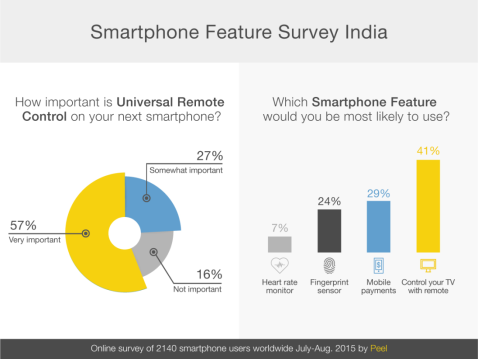
Smartphone users in India, which is among the fastest growing smartphone markets, expressed a keen interest in remote control features, with 84% of respondents saying they were an “important” factor in their decision to purchase a new smartphone, just behind China (89%) and South Korea (85%). In the U.S., 52% said it was an important factor in their next smartphone purchase.
“While they have emerged globally as a major new use case for smartphones, universal remote capabilities are even more desirable in countries such as India because of the wider range of devices they can control in the home such as air conditioners, ceiling fans and heaters,” said Peel co-founder and CEO Thiru Arunachalam.
When asked to choose just one new feature to be available on their smartphone, 41% of the respondents from India chose “controlling their TV, etc. with IR remote,” followed by mobile payment capabilities (29%), fingerprint sensors (24%) and heart rate monitors (7%).
Remote control capabilities were first introduced on Android smartphones over two years ago and seem to be growing popular among users very fast. Today, many of the latest Android smartphones come equipped with an IR port which enables users to dump their plastic remotes in favor of using their phone to control their TV, set-top box, DVD player and other home electronics. Smart remote apps also allow users to find content to watch more easily, set reminders and even program DVRs.
In contrast, European smartphone owners surveyed by Peel appeared less aware of or interested in smart remote options with mobile payments ranking ahead of remote control features, followed by fingerprint sensors and heart rate monitors as influencing purchase decisions.
Where on one hand, IR remote capabilities are available in the U.S. and other developed nations only on high-end phones such as the Galaxy S and Note series from Samsung or the HTC One M8 and M9, yet on the other, several manufacturers in China, including Xiaomi, ZTE and TCL, and in India (Celkon, Panasonic, Alcatel OneTouch, Xolo) have begun to offer Android phones with advanced IR capabilities for as little as Rs.3199, including the recently announced A35K Remote from Celkon. The Peel Smart Remote has become the most popular app globally taking advantage of IR capabilities, with more than 115 million registered users who have generated over 100 billion remote commands to date.
While Apple so far has chosen not to include an IR port on any of its competing phones or tablets, two in five iPhone users surveyed said they would be interested in the same remote capabilities enjoyed by Android users.
Peel makes it easy for Indian consumers to switch to a smartphone remote because it works with all popular brands of TVs and air conditioners sold in India, and 600 set-top boxes, including those from Airtel, Tata Sky, Dish TV, Hathway, DEN and Siti Cable. For Indian consumers, Peel features TV listings from WhatsOnIndia. India is one of the fastest growing markets for Peel with users doubling every six months.
The use of smartphones to control the home is expected to continue to increase in popularity as more consumers add Internet connected household devices such as thermostats, plugs and lighting. Many believe that remote control will emerge as one of the valuable use cases driving the adoption of smart watches as well.
About Peel
Peel is revolutionizing the home entertainment and home control experience by integrating device control and live or streamed content discovery into one easy-to-navigate universal Peel Smart Remote app, which has 115 million registered users who have generated 100 billion-plus remote commands to date. Peel drives brand engagement and TV tune-in for major TV networks and producers through its True Tune-in advertising products and Peel in Platform.
The post Remote Control Functionality is the Top Driver of Smartphone Upgrades: Peel Global Survey appeared first on Core Sector Communique.
]]>The post Global survey highlights consumers fears about indoor air quality at home and in the office appeared first on Core Sector Communique.
]]>
 Stockholm/Chicago, 7 February 2014 –– Over half of consumers in Asia, Europe and the USA are worried about their indoor air quality, according to exclusive new research by CINT research commissioned by Blueair, the global indoor air purifier manufacturer. Some 57 percent of men and women aged between 25-50 years in China, Japan, Sweden, the UK and United States said they were concerned about the quality of their indoor air, although just 37 percent said they were worried enough to buy an indoor air purifier.The research of 1,500 men and women consumers provides an interesting snapshot of what consumers really worry about when it comes to the air they breathe at home and work. For example, householders are far more likely to be offended by cooking and baking smells at home than any other odors, including smoking, according to the Blueair survey, while office workers most worried about their air being contaminated by highly infectious airborne cold and flu viruses . Stockholm/Chicago, 7 February 2014 –– Over half of consumers in Asia, Europe and the USA are worried about their indoor air quality, according to exclusive new research by CINT research commissioned by Blueair, the global indoor air purifier manufacturer. Some 57 percent of men and women aged between 25-50 years in China, Japan, Sweden, the UK and United States said they were concerned about the quality of their indoor air, although just 37 percent said they were worried enough to buy an indoor air purifier.The research of 1,500 men and women consumers provides an interesting snapshot of what consumers really worry about when it comes to the air they breathe at home and work. For example, householders are far more likely to be offended by cooking and baking smells at home than any other odors, including smoking, according to the Blueair survey, while office workers most worried about their air being contaminated by highly infectious airborne cold and flu viruses .
The Blueair study found smelly pets, cooking and baking smells and tobacco and cigar smoke offend people the most at home, while fear of cold and flu bugs spreading is widespread among office workers. Men and women in China (94%), the USA (65%) and UK (56%) were most concerned about their indoor air quality, while Japanese (40%) and Swedish (28%) consumers were least worried. For Chinese, British, Swedish and American consumers the worst offending odor in their homes was cooking and baking smells, while their Japanese equivalents rated flatulence the worst offending odor. Chinese respondents were the least bothered by smoking related smells with just 4% saying they found it offensive, a major difference compared to their counterparts in the other four countries where tobacco and cigar smells were widely considered offensive. For office workers, the biggest fear concerned the spread of cold and flu bugs, especially in Japan where 65% rated the problem their greatest concern. Work related causes of bad indoor air such as dust particles was the second greatest overall concern (63%), while a sizeable majority (55%) also admitted to being concerned about airborne chemicals leeching from office furniture and building materials and from use of cleaning fluids. The research was carried out online in China, Japan, UK, USA and Sweden in national languages between December 29, 2013 and January 6, 2014. A total 1,500 consumers aged between 25-30 years took part, with 300 confirmed respondents in each country and equal 50/50% gender split. |
The post Global survey highlights consumers fears about indoor air quality at home and in the office appeared first on Core Sector Communique.
]]>The post Global Survey Identifies Mobility as a Top Priority for the Enterprise appeared first on Core Sector Communique.
]]> Citrix Research Finds Companies Accelerating Mobile App Development, File Sharing, Collaboration and BYOD Initiatives, Collaboration and BYOD Initiatives Citrix Research Finds Companies Accelerating Mobile App Development, File Sharing, Collaboration and BYOD Initiatives, Collaboration and BYOD Initiatives |
India, November 7, 2013: According to a global survey commissioned by Citrix, 71 percent of enterprises believe mobility is a top priority for their business and 63 percent believe it to be the greatest factor in helping their organization gain a competitive advantage.
Of the organizations surveyed, approximately half have implemented technologies to support mobile devices, with 48 percent using mobile device management (MDM) and 47 percent using mobile application management (MAM). Organizations are also recognizing the need to provide Windows apps and desktop to mobile workers, with 41 percent of businesses using or planning to use application virtualization and 40 percent leveraging desktop virtualization. In addition, file sharing, sync and storage have been or will be implemented by 40 percent of companies to support mobile users.
Commissioned by Citrix to produce insight into mobility strategies of businesses around the globe, The Citrix Mobility in Business Report polled a total of 1,700 senior IT decision-makers across 17 countries. Respondents were asked about the advantages and challenges of implementing mobile initiatives, their current policies toward mobile devices and the impact that the consumerization of IT is having on their businesses. The report outlines results from the research and sheds light on the perceptions of mobility, its importance for companies and its perceived impact for improving flexibility, productivity and agility.
Other notable findings regarding mobile strategies include:
- · The top two mobile initiatives for businesses are increasing development on mobile apps and increasing adoption of secure file sharing and collaboration tools. Improving network performance and access is the third most important mobile initiative.
- · 51 percent of organizations say they are changing management processes to better manage those working on any device from anywhere.
- · Organizations are most focused on measuring the impact that mobility has on productivity and employee motivation.
Bring Your Own Device (BYOD)
BYOD is quickly becoming the norm, with 71 percent of companies allowing, accommodating and encouraging the use of personally owned devices. Of these companies, 76 percent estimate that more than 100 unidentified devices access their networks each day. Worldwide, organizations report a daily average of 425 such connections, with the highest figures from businesses in Brazil (994), Canada (649) and Japan (618).
Mobile Platforms
The research reveals that enterprises are embracing a variety of mobile platforms. Android is by far the most popular platform according to respondents, with 72 percent saying they support or are planning to support Android this year, and another 65 percent seeing an increased use of Android in their organization. Apple iOS remains popular, with 54 percent supporting or planning to support the platform, and 48 percent seeing an increase in its use from last year. Microsoft Windows 8 has become more popular than Windows Mobile, with 46 percent of companies supporting or planning to support the full-featured operating system, compared with 32 percent for the mobile version. BlackBerry still retains a significant presence, supported by 35 percent of companies, though only 18 percent have seen an increase in its use since last year.
Impact of Consumerization of IT
The survey findings also reveal the impact that consumer-orientated technologies continue to have on the workplace. According to the report, 29 percent of the global workforce is now believed to be using their own mobile apps for work purposes. Globally, the most popular mobile apps being demanded by employees are sales, CRM or database related, with 48 percent reporting such a trend. Other popular apps include employee intranet portals (46 percent), messaging applications (43 percent), social media platforms such as Facebook, Twitter and LinkedIn (43 percent), and file sync and sharing platforms (41 percent).
Findings around mobile applications also included:
- · Exactly half (50 percent) of organizations surveyed said that the acquisition of mobile apps would be a mixture of in-house development and off-the-shelf purchases, while a quarter said they would rely purely on off-the-shelf purchases for mobile apps.
- · Nearly one in five (17 percent) organizations said they would acquire applications strictly through in-house development, while 8 percent were not sure how they would acquire applications.
Barriers to Mobility
The survey also shows the barriers organizations are facing when implementing their mobility initiatives. Organizations reported an average of three main barriers preventing formal support for mobility initiatives, the most common being a lack of security controls for new devices and clients (38 percent), legacy systems unfit for mobile purposes (37 percent) and challenges supporting multiple mobile operating systems (36 percent).
Overall Findings
The results of this survey show that in just a few years, mobility has become a top priority for businesses around the world. Companies have moved quickly to identify the business values of mobility, develop strategies and policies to harness it, and implement the technologies needed to support it. Employees have responded enthusiastically, embracing the freedom to work the way they want – anywhere, on any device – to achieve higher productivity and satisfaction.
Methodology
The “Mobility in Business” report was compiled by Vanson Bourne on behalf of Citrix, with the aim of creating a global snapshot of mobility in business across the globe. The report draws on data from 1,700 senior IT decision makers in 17 countries to create an uncompromising and informative investigation of preparedness for and attitudes towards mobility. Responses came from IT leaders in the UK, USA, Canada, China, India, Brazil, Russia, France, Germany, Denmark, Sweden, Australia, Singapore, Japan, South Korea, Thailand and Taiwan.
About Vanson Bourne
Vanson Bourne is an independent specialist in market research for the technology sector. Our reputation for robust and credible research-based analysis, is founded upon rigorous research principles and our ability to seek the opinions of senior decision makers across technical and business functions, in all business sectors and all major markets. For more information, please visit www.vansonbourne.com.
About Citrix
Citrix (NASDAQ:CTXS) is a cloud company that enables mobile workstyles—empowering people to work and collaborate from anywhere, securely accessing apps and data on any of the latest devices, as easily as they would in their own office. Citrix solutions help IT and service providers build clouds, leveraging virtualization and networking technologies to deliver high-performance, elastic and cost-effective cloud services. With market-leading cloud solutions for mobility, desktop virtualization, networking, cloud platforms, collaboration and data sharing, Citrix helps organizations of all sizes achieve the speed and agility necessary to succeed in a mobile and dynamic world. Citrix products are in use at more than 330,000 organizations and by over 100 million users globally. Annual revenue in 2012 was $2.59 billion. Learn more at www.citrix.com.
The post Global Survey Identifies Mobility as a Top Priority for the Enterprise appeared first on Core Sector Communique.
]]>The post JLL global survey reveals five risks and rewards companies face when balancing cost cutting with revenue-enhancing strategies appeared first on Core Sector Communique.
]]> Corporations Looking to Real Estate Purely for Cost Cutting Face Major Financial and Operational Risks
SINGAPORE, LONDON and CHICAGO, April 29, 2013 — Long a go-to for corporate cost cutting, corporate real estate has turned a corner and is becoming a solid productivity driver, with CEOs starting to reap the rewards of enhanced revenue, shareholder value and employee performance. A new Jones Lang LaSalle (JLL) report reveals that companies that view real estate assets singularly as a source of short-term cost reduction are actually incurring hidden long-term financial and operational risks.
JLL’s second biennial report on Global Corporate Real Estate Trends unearths the five top corporate real estate risks, including possible negative impacts to competitive advantage and profitability from cost cutting, procurement processes, lack of collaboration between functions and failure to drive productivity.
The 2013 survey, which measures insights from more than 630 corporate real estate executives in 39 countries, points to the prodigious pressure corporate real estate decision-makers are under as 68 percent of respondents recognize increasing demand from senior business leaders to enhance productivity of the real estate portfolio.
“The global financial crisis moved real estate up in importance to CEOs as a tangible lever for enhancing revenue growth. Our survey shows that more CEOs today are realizing that investing in long-term, revenue-focused corporate real estate strategies can best leverage their real estate assets to mitigate risks and increase long-term profitability,” said John Forrest, Global Director and CEO of Jones Lang LaSalle’s Corporate Solutions business in Asia Pacific. “While short-term cost cutting is tempting, sustainable financial and operational benefits are more often achieved when cost reduction and revenue-enhancing investments are considered together.”
JLL addresses the outcomes of these increased pressures in its Global Corporate Real Estate Trends report, which details the top five risks and rewards corporate real estate users are facing in 2013:
1. Singular focus on real estate cost cutting undermines potential rewards from revenue-enhancing investments
2. Procurement drives price- rather than value-driven outsourcing partnerships
3. Workplace productivity is frequently miscalculated in cost-per-square-foot terms, when contribution to business performance better characterizes returns
4. Collaboration with HR, IT and finance is a must for enhancing workplaces, yet silos continue to constrain joint efforts
5. Compromising real estate quality to enter high-growth global markets is dangerous
The post JLL global survey reveals five risks and rewards companies face when balancing cost cutting with revenue-enhancing strategies appeared first on Core Sector Communique.
]]>