Notice: Function _load_textdomain_just_in_time was called incorrectly. Translation loading for the basic domain was triggered too early. This is usually an indicator for some code in the plugin or theme running too early. Translations should be loaded at the init action or later. Please see Debugging in WordPress for more information. (This message was added in version 6.7.0.) in /home/dh_ndki7k/corecommunique.com/wp-includes/functions.php on line 6170
Data – Core Sector Communique https://www.corecommunique.com at the very Core of it all ... is Content! Sat, 05 Jan 2019 13:37:49 +0000 en-US hourly 1 https://wordpress.org/?v=7.0.4 https://www.corecommunique.com/wp-content/uploads/2013/12/Core-Logo-21-150x150.jpg Data – Core Sector Communique https://www.corecommunique.com 32 32 In 2018 Over a Billion People’s Data was Compromised https://www.corecommunique.com/in-2018-over-a-billion-peoples-data-was-compromised/?utm_source=rss&utm_medium=rss&utm_campaign=in-2018-over-a-billion-peoples-data-was-compromised Sat, 05 Jan 2019 13:37:32 +0000 http://corecommunique.com/?p=101754

NordVPN Reviews the Most Significant and Worst Data Breaches of 2018

If your data wasn’t leaked this year, you’re lucky. The information of over a billion people was compromised in 2018 as many of the companies we trust failed to protect our data.

From credit card skimming to bugs and ‘leaky’ backends, Daniel Markuson, Digital Privacy Expert at NordVPN, reviews the most significant and worst data breaches the world faced in 2018.

British Airways (380,000 accounts)

380,000 transactions made between August 21st and September 5th were compromised on the British Airways (BA) website and app. The attackers accessed customers’ names, addresses, emails, and payment details. The airline assured passengers that passport and travel details remained secure.

The technique used in this attack was like a digital version of ‘credit card skimming’. It allowed hackers to copy users’ information while it’s being typed into a data entry form. Such attacks tend to target companies that have poor security.

In this case, hackers found a loophole in BA’s booking page, injected malicious code, and instantaneously sent customer data to their own server. The attack didn’t involve hackers penetrating the servers, which is why they only managed to gather the information over a very specific time frame and why they got data not normally stored by the airline, like credit card CVV numbers.

Google+ (500,000 accounts)

A bug recently found in the Google+ platform gave third-party developers access to 500,000 accounts, which included users’ full names, birth dates, genders, profile photos, occupations and even places where they lived.

What’s surprising is that the bug wasn’t noticed for three years. Eventually, when Google found it and patched it, they decided not to inform the public because they feared another scandal just like Cambridge Analytica. Google says that 438 apps had access to sensitive information, but that there’s no evidence that developers misused this data.

Unlike other social media platforms, Google+ struggled to get new users. With the latest data leak, they decided that it’s now time to shut down the platform completely.

Ticket Fly, owned by Eventbrite (27 million accounts)

Ticket Fly, an event ticketing website, was hacked by a cybercriminal calling himself IsHaKdZ who stole the data from 27 million accounts. The hacker broke into Ticket Fly’s systems and replaced its homepage with an image from the ‘V for Vendetta’ film depicting the fictional British Anarchist who protests and fights the fascist government.

He then asked Ticket fly for a one bitcoin ransom and warned them that their security is poor threatening to publish the database after his next attack. However, even though the hack disrupted many events taking place in the US, the company refused to speak to the hacker or pay the ransom.

The hacker never released the data publicly, but Washington Post journalists spoke to the hacker and confirmed that the data was authentic. Despite the havoc, the website was back up and running in about a week.

Uber (57 million users)

This revolutionary taxi company isn’t immune to hacking either. In November 2016, hackers accessed Uber’s cloud servers and downloaded the data of almost 35 million users, including their full names, phone numbers, email addresses and the locations where they first signed up for the service.

If this happened two years ago, why are we talking about this now? Because Uber brushed it under the carpet and failed to notify its customers (and the 3.7 million drivers whose trip summaries, weekly payments, and even driver’s license numbers were also exposed). Instead, Uber paid the hacker a $100,000 ransom, called it a ‘bug bounty,’ and waited for a year to start monitoring the affected accounts.

Lack of communication with their users and failing to follow the procedures of the ‘bug bounty reward scheme’ resulted in Uber receiving a hefty fine of $148m in the US £385,000 in the UK. Director of Investigations at Information Commissioner’s Office UK, Steve Eckersley said:

“This was not only a serious failure of data security on Uber’s part, but a complete disregard for the customers and drivers whose personal information was stolen. At the time, no steps were taken to inform anyone affected by the breach, or to offer help and support. That left them vulnerable. Paying the attackers and then keeping quiet about it afterwards was not, in our view, an appropriate response to the cyber attack.” – Steve Eckersley, ICO Director of Investigations

Facebook (147 million accounts)

Of course, no ‘naughty’ list this year would be complete without Facebook.

50 million users in March

Cambridge Analytica, a British political consulting firm, were given permission to use more than 50 million Facebook profiles for “research purposes.” However, they instead collected user information to create psychographic profiles to influence the US presidential campaign in 2016. This data mining and data analysis company was employed by Donald Trump and helped him shape and predict the votes.

90 million users in September

In September, the social media giant hit the headlines once again as they compromised the security of almost 90 million users. A bug in Facebook’s ‘View As’ feature was discovered that could be used to steal users’ access tokens, which keep the user logged into a website or an app during a browsing session.

Access tokens do not save the user’s password, so Facebook logged out everyone potentially affected to restore the security. However, hackers still managed to steal usernames, genders, and information about their hometowns.

Facebook claims that, so far, it hasn’t noticed any suspicious behavior on compromised accounts. However, this doesn’t mean that this data won’t be used at a later date.

7 million users in December

As if this wasn’t enough to lose trust in Facebook, another bug was announced only a few days ago. It appears that hundreds of third-party apps had unauthorized access to 7 million users’ photos. Worst of all, these included pictures people might have started uploading but never posted.

It’s unknown whether anyone had seen these photos or used them in any malicious way. However, it shows once more how much data Facebook collects and how little control they have over their cybersecurity.

“A lot of people who are worried about privacy and those kinds of issues will take any minor misstep that we make and turn it into as big a deal as possible. We realize that people will probably criticize us for this for a long time, but we just believe that this is the right thing to do.” – Mark Zuckerberg, CEO of Facebook

My heritage (92 million users)

A company that can test people’s DNA to find their ancestors and build their family trees leaked the email addresses and hashed passwords of over 92 million users. The attack was noticed in June when the company’s security researcher found their users’ data sitting in a private server that doesn’t belong to the company.

My Heritage stated that the most sensitive user data, such as their DNA info and family trees, is stored on separate systems that weren’t compromised.

Quora (100 million users)

The question-and-answer website Quora was recently hacked and put 100 million users at risk. Quora representatives said they’d noticed that ‘a malicious third party’ had accessed sensitive information on Quora’s database. These cybercriminals gained access to nearly everything, from users’ names and IP addresses to their Q&A history, access tokens, and private messages.

Quora claimed that none of their partners’ financial information or any anonymous Q&A’s had been affected. The attack is under investigation, and no further comments have been made by the company.

Firebase (100 million users)

Firebase, a Google-owned development platform, leaked the sensitive information of over 100 million users. The platform might not be well known to everyone, but it’s widely used by mobile developers.

Appthority researchers scanned 2.7 million iOS and Android apps that connect to and store their data on Firebase. They found that over 3,000 of those apps were connected to a misconfigured database that could be accessed by anyone.

These apps with ‘leaky backends’ had been downloaded on the Google Play Store over 620 million times and could have exposed highly sensitive data, including user IDs, plaintext passwords, users’ locations, bank details, bitcoin transactions, social media accounts, and even health records.

Google was notified of the ‘leaky’ apps and their backends.

My Fitness Pal (150 million users)

At the beginning of the year, My Fitness Pal, a food and nutrition app owned by Under Armour, leaked the data of 150 million users. Once the company noticed the breach, they notified their users in almost record time(compared to other companies) – 4 days.

The company confirmed that hackers got hold of usernames, email addresses and hashed passwords. My Fitness Pal stated that other information, such as credit card numbers, wasn’t compromised because it was stored separately from generic user information.

It’s unknown how hackers broke into the systems, but Under Armour is working with data security firms to investigate the attack and take precautionary measures to avoid similar break-ins in the future.

Twitter (330 million users)

Twitter rarely makes the headlines when it comes to data breaches, but this year was different. A security bug exposed 330 million users’ passwords, all in plain text.

Twitter stated that there was an issue with their password hashing system. It failed to encrypt passwords and was saving them in plain text. Their investigators claimed that no one had actually accessed the data, but if any of the affected accounts had been hacked, their passwords would have been visible to the attacker. Their information could then be used to access other accounts.

Twitter has advised a number of users to change their passwords as a precautionary measure. The bug has now been fixed.

Marriott (500 million users)

The biggest data breach of the year (if not ever) exposed the data of half a billion users. Marriott said that hackers broke into its booking system and accessed customer data for the last four years. This major data breach affected the following Starwood properties: St. Regis, Westin, Sheraton, Aloft, Le Meridien, Four Points, and W Hotels. Marriott’s hotel databases are separate and haven’t been compromised.

Cybercriminals stole Starwood’s customers’ names, addresses, phone numbers, card numbers, passport numbers and even the information of where and who they were traveling with.

Because this information wasn’t used for any known financial gains or identity thefts, there are rumors that this could’ve been a state-sponsored attack. A former British intelligence officer said that the aim of this attack could’ve been to get valuable information on spies, diplomats and military officials who’ve stayed in Marriott hotels over the years. It’s strange that the attack remained unnoticed for such a long time and that none of the information was monetized.

Cybersecurity and privacy in 2019

The scope of these attacks shows that even the biggest corporations are vulnerable and are prone to errors. This means that it’s becoming more difficult to trust them as we never know when our data is going to end in the wrong hands. Unfortunately, we have little to no control over when the next company will be hacked, but we can take a few precautionary steps to protect our data:

– Use strong and unique passwords.

– Think twice before posting anything on social media. This information can be used against you.

– If you shop online, use a credit card. You will have less liability for fraudulent charges if your financial information leaks.

– Provide companies only with necessary information. The less information they have, the less they can leak.

– Look out for fraud. If notified that your data was leaked, change your passwords and take the steps advised by the company that compromised your data.

ABOUT NORDVPN

NordVPN is the world’s most advanced VPN service provider that is more security oriented than most VPN services. It offers double VPN encryption, ad blocking & Onion Over VPN. The product is very user-friendly, offers one of the best prices on the market, has over 5,000 servers worldwide and is P2P-friendly. One of the key features of NordVPN is zero log policy. For more information: nordvpn.com.

]]>
Microsoft and Nielsen accelerate retail innovation through data and AI, announce strategic alliance https://www.corecommunique.com/microsoft-and-nielsen-accelerate-retail-innovation-through-data-and-ai-announce-strategic-alliance/?utm_source=rss&utm_medium=rss&utm_campaign=microsoft-and-nielsen-accelerate-retail-innovation-through-data-and-ai-announce-strategic-alliance Wed, 14 Nov 2018 13:48:02 +0000 http://corecommunique.com/?p=101016

New York, NY and Redmond, WA – (November 13, 2018) – Nielsen (NYSE: NLSN) and Microsoft (Nasdaq: MSFT) today released details around a newly developed enterprise data solution that democratizes one of the largest consumer data sets in the world.  This strategic alliance has been brought to life through Nielsen Connect, powered by Microsoft Azure, the trusted and global-scale intelligent cloud platform.

In today’s rapidly changing marketplace, Microsoft and Nielsen are together focused on helping Fast Moving Consumer Goods (FMCG) and retail companies find growth and accelerate innovation within an open data environment.

Already, Nielsen Connect is inspiring companies to glean more value from their data and sparking a movement for the industry to reimagine its approach to data strategy.  Through advanced analytics and artificial intelligence services built on Azure, Nielsen Connect is helping companies integrate data assets to more easily spot emerging trends, diagnose performance gaps, and act faster on opportunities to grow. Most notably, this platform enables clients to use their data as an enterprise asset across all parts of their organization.

“Nielsen’s powerful data is as much of an enterprise asset as people and products,” said John Tavolieri, President, U.S. FMCG and Retail and Chief Technology and Operations Officer at Nielsen. “It’s our priority to make sure clients are maximizing their data assets, so Nielsen and Microsoft are breaking down the silos of the status quo. We are helping the retail industry reimagine its approach to data by creating a truly open and global environment of collaboration, encouraging companies to evolve beyond mere data management. Adopting a holistic data strategy will be the only way to win in FMCG and retail.”

“The first critical step toward digital transformation, especially among retailers, is breaking down the barriers between customer and operational data to fuel insights for the business,” said Judson Althoff, executive vice president of Microsoft’s Worldwide Commercial Business. “Because retail happens wherever customers are and whenever they choose, Nielsen Connect provides high reliability at a global scale 24/7. Microsoft is a natural partner for Nielsen, trusted by global enterprises to protect their data and power their critical business solutions.”

Grounded by the richest data available in the fast-moving consumer goods space, Nielsen Connect brings clarity to what’s happening in the market from every angle.  Nielsen’s deep media and consumer measurement (including retail point-of-sale data, consumer panel, e-commerce, fresh food and cross-platform media data), is integrated with a robust variety of data sources, including  data provided directly from clients as well as from Nielsen Connect Partners. Nielsen’s reference data, which provides structure to the world’s most robust retail and shopper information, powers this system to make integration across data sources and countries simple. Within this open and agile platform running on Microsoft Azure, customers can easily access data sets via APIs and connectors, allowing them to extract the data they need to fit their own technology strategy.

The joint Microsoft and Nielsen solution is live today and will serve as a one-stop-shop in creating scalable, high-performance data environments that enable greater real-time collaboration for faster results. Through this strategic alliance, the two companies will continue to work toward a mutual vision of an open and connected data universe, empowering a new generation of solutions for the FMCG retail marketplace.


ABOUT MICROSOFT

Microsoft (Nasdaq “MSFT” @microsoft) enables digital transformation for the era of an intelligent cloud and an intelligent edge. Its mission is to empower every person and every organization on the planet to achieve more.

ABOUT NIELSEN

Nielsen Holdings plc (NYSE: NLSN) is a global measurement and data analytics company that provides the most complete and trusted view available of consumers and markets worldwide. Our approach marries proprietary Nielsen data with other data sources to help clients around the world understand what’s happening now, what’s happening next, and how to best act on this knowledge. For more than 90 years Nielsen has provided data and analytics based on scientific rigor and innovation, continually developing new ways to answer the most important questions facing the media, advertising, retail and fast-moving consumer goods industries. An S&P 500 company, Nielsen has operations in over 100 countries, covering more than 90% of the world’s population. For more information, visit www.nielsen.com.

]]>
Over 79% Indians Vitamin D deficient, 19% suffer from high blood sugar says SRL diagnostics data https://www.corecommunique.com/over-79-indians-vitamin-d-deficient-19-suffer-from-high-blood-sugar-says-srl-diagnostics-data/?utm_source=rss&utm_medium=rss&utm_campaign=over-79-indians-vitamin-d-deficient-19-suffer-from-high-blood-sugar-says-srl-diagnostics-data Fri, 06 Apr 2018 11:24:18 +0000 http://corecommunique.com/?p=93155


–       Nutritional disorders prevalent in urban areas, 38 % women suffer from anaemia

–       Uric Acid, lipid profile tests also come up with worrisome statistics

–       Preventive health check-up, need of the hour


New Delhi, April 6, 2018: Increasing urbanisation coupled with rapidly changing lifestyles is leading to deficiencies across several important health parameters amongst Indians. While ailments related to important organs such as kidney and liver are on the rise, urban citizens of the country also fared poorly in other important counts including important vitamin deficiencies. An analysis of the data collected by SRL Diagnostics – India’s largest and most trusted diagnostics chain – showed a worrisome trend. The data was collected by SRL Diagnostics over a period of three years during 2015 – 2017 from across its centers in 29 states and four union territories.

“We have noticed an alarming level of Vitamin D inadequacy in the country. And this finding is in sync with the findings of other medical research studies conducted in the country earlier. Of the total samples analysed, 79.12 percent had either Vitamin D deficiency or insufficiency. While women were more commonly Vitamin D insufficient, men showed more cases of Vitamin D deficiency. Similarly, an analysis of Kidney Function Test results showed that 10.40 percent had abnormal values of Blood Urea Nitrogen (BUN), Serum Creatinine or both. The results also showed that there was a rapid rise in abnormal KFT values in the ages above 60 years,” said, Dr B.R Das, Advisor and Mentor – R&D, SRL Diagnostics


The analysis of Lipid Profile results meanwhile indicated that 34 percent of the population had abnormal values for one or more of the four parameters – HDL, Triglycerides, LDL and Total Cholesterol. While men have more deranged LDL, HDL and Triglyceride levels than women, on an average the total Cholesterol level was found to be higher in women.

Another worrisome trend came from the analysis of glucose tests, which are conducted to establish the inability to process sugars correctly – precursor to diabetes. In pan India analysis on samples received mainly from urban areas, 19.22% of individuals were observed to be either pre-diabetic or diabetic, with men accounting for 20.80 percent and women, 17.36 percent.

“When we compared abnormal values across age groups, we observed that the age groups of 46-60 and 61-85 years showed the highest prevalence of (26.71% and 27.01% respectively) of presumed diabetics or pre-diabetics across four zones of India,” added Dr. Das.

Similarly, analysis of various other important tests like Vitamin B12, Thyroid Stimulating Hormone, Haemoglobin and Uric Acid too threw up abnormal results in individuals who had come for preventive health check tests.

For haemoglobin particularly, 38 percent of women were diagnosed with anaemia (16 % in men). Women from the eastern part (~50%) of India showed higher number of anaemia cases as compared with the other three zones.  Of all the individuals who enrolled for Preventive Health Check tests, 13.46% showed high levels of uric acid.

“These results highlight the importance of preventive health check-ups and the growing awareness among people for availing diagnostic services. With recent development in medical science and technology, many diseases can be prevented or cured to a large extent with right and early diagnosis. On the important occasion of World Health Day, we reaffirm our commitment for creating awareness in the society for a healthy India,” he added.

Speaking on the occasion of World Health Day, Mr. Arindam Haldar, CEO, SRL Diagnostics said, “This year, World Health Day’s theme of “Universal health coverage: everyone, everywhere” – essentially focuses on the fact that every individual must have access to affordable and quality healthcare, without prejudice of any kind. This is in line with SRL’s vision of providing quality diagnostics services to the masses at reasonable cost. For some time now, SRL has been working towards shifting the mindset of people from illness based diagnostics to wellness based preventive healthcare approach. As leaders and decision makers we need to understand that the absence of a disease is always going to be of higher value to the society than achieving excellence in treating it. With the Government of India picking up pace with the Preventive Healthcare, it is now the turn of the private sector to play its role in creating awareness about Preventive care, by leveraging our reach and  resources.”

“We must maintain our focus on leveraging technology, both biomedical and communication to the best of our capabilities thereby accelerating our progress towards universal health coverage (UHC). A multi-stakeholder approach with policymakers, private players, medical professionals, academicians and above all people from all strata of the society must be adopted to mobilise resources and accomplish the goal of healthcare for all,” he added

Some important findings of the report:


Vitamin D Test Analysis:

ü  Of the total samples analyzed for Vitamin D, 79.12% had either Vitamin D deficiency or insufficiency.

ü  Men showed a more deranged Vitamin D level (81.08%) compared to women (77.08%). Women were more commonly vitamin D insufficient while men were vitamin D deficient.

ü  South zone (85.04%) had the most deranged values of vitamin D while North (77.42%) zone showed the least deranged values.

ü  There is a decreasing trend in the subnormal levels of Vitamin D with increasing age. The derangement is most common in younger population of 16 to 35 years while it’s the least deranged in older population above 60 years.

Liver Enzymes Analysis:

ü  Among the liver enzymes, SGPT levels were the most deranged followed by SGOT and ALP in the analysed population.

ü  Men had higher SGPT and SGOT levels compared to women while women reflected higher ALP levels compared to men.

ü  East zone had the most deranged levels of liver enzymes compared to the other three zones of India.

ü  Derangement in SGPT and SGOT values showed a continuous decrease post the age of 45. On the contrary, ALP levels were found to increase consistently with age.


Kidney Function Test Analysis:

ü  Of the total individuals enrolled for preventive health check-up, 10.40% had abnormal values of blood urea nitrogen (BUN) and serum creatinine (SCr) or both.

ü  More number of women had deranged KFT values than men.

ü  Similar to liver chemistries, East zone had the most deranged KFT values, while the North zone reflected the least derangement in KFT levels.

ü  There was a rapid rise in abnormal KFT values in the age group of 61 to 85.

Lipid Profile Analysis:

ü  Approximately 34% of the population who enrolled for preventive health check-up showed abnormal levels in one of the four parameters.

ü  Men revealed more deranged LDL, HDL and Triglyceride levels than women; while Total Cholesterol level was found to be higher in women than men.

ü  Total and LDL Cholesterol levels were found to be most deranged in West India and the least deranged in East India. Derangement in HDL values was the highest in North zone and the least in West zone. Triglycerides levels were more or less non-variable across all zones.

ü  Deranged levels of Total Cholesterol, LDL and Triglycerides are negligible in the age group 16 to 30 years. They are seen to be increasing in age between 31 to 60 years, however population above 60 years have showed a comparative drop in the deranged levels of Total Cholesterol, LDL and Triglycerides, possibly because of medication. Abnormal HDL, the most commonly deranged lipid test across India, however remains more or less similar in all age groups.

Glucose Test Analysis: In pan India analysis, 19.22% of individuals were observed to be diabetic or prediabetic as per the consideration of two out of the three test values to be higher than the normal range (FBS; PPBS,HbA1c).

ü  Men (20.82%) were observed to have higher % of abnormal sugar levels than women (17.36%).

ü  Cutting across the zones of India, individuals from the western part (20.47%) threw up most number of diabetic/prediabetic candidates.

ü  When we compared abnormal values across age groups, we observed that the age groups of 46-60 and 61-85 years showed the highest prevalence of (26.71% and 27.01% respectively) of glucose metabolism defects across four zones of India.

Vitamin B12 Test Analysis:

ü  Among the individuals scanned for preventive health checks, approximately 30% of the samples analyzed showed abnormal levels of vitamin B12.

ü  Prevalence of abnormal levels of vitamin B12 was more commonly found in men (33.28%) than women (27.85%).

ü  Abnormal levels of vitamin B12 were more prevalent in the western part of India than the other three zones.

ü  Age-group of 31-45 years showed majority of abnormal levels of vitamin B12.


Thyroid Function Test Analysis:

ü  Among the preventive health check samples, the thyroid levels were observed to be above the normal range in approximately 45000 (18.17%) individuals across pan India.

ü  Abnormal thyroid function levels were more common in women (21.45%) than in men (15.06%).

ü  Individuals from the eastern part of India showed most number of abnormal thyroid cases than the other three zones.

ü  Majority of abnormal thyroid level individuals were more commonly observed in the 61-85 age group (21.32%)


HBsAg Test Analysis:

ü  In pan India analysis, less than 1% of individuals were observed with hepatitis B infections.

ü  Men and women across the country are equally vulnerable to contract hepatitis B infection.


Haemoglobin Test Analysis:

ü  Based on the haemoglobin concentration in this pan India analysis, women (around 38%) were more frequently observed with anaemia cases than men (16%).

ü  Women from the eastern part (~50%) of India showed higher number of anaemia cases as compared with the other three zones.

ü  Women aged 61 years onwards were more likely to suffer from anaemia.


Uric Acid Test Analysis:

ü  Of all the individuals who enrolled for Preventive Health Check Up, 13.46% showed high levels of uric acid.

ü  Men had a higher level of derangement in the Uric Acid level that women. The probable cause of decreased level of Uric Acid can be attributed to the protective role of estrogen in women.

ü  East zone showed the most deranged uric acid level compared to other zones, while North India reflected the least derangement in uric acid levels.

ü  An increasing trend in the derangement in Uric acid levels was observed with increasing age. Age group 61 to 85 had the most abnormal levels compared to age group 16 to 30

]]>
TIESDB AND CREDITS MARRY DATA AND SELF-EXECUTING SMART CONTRACTS https://www.corecommunique.com/tiesdb-credits-marry-data-self-executing-smart-contracts/?utm_source=rss&utm_medium=rss&utm_campaign=tiesdb-credits-marry-data-self-executing-smart-contracts Thu, 15 Feb 2018 12:33:42 +0000 http://corecommunique.com/?p=90744

February 14, 2018 – Rotterdam, The Netherlands –  Public data registry and self executing smart contracts now can source data directly from blockchain-native databases as TiesDB makes Singapore-based Credits PTE LTD a strategic partner.

A distributed blockchain database maker, TiesDB enables its customers to store data in native to blockchain formats and to host it in a distributed cloud, mixing up secure public and private hosting environment using blockchain logic. With Credits on board as a partner, a customer would be able to use this data, and other data from blockchain-based public registries, in combination with self-executing smart contracts. The net effect of this combination would be instant trusted transactions, where a variety of application layer and business process specific transactions, such as authentication, settlement, privacy checks and so forth would migrate into blockchain’s infrastructure layer, speeding up international commerce.

TiesDB and Credits would benefit from Credits’ private blockchain infrastructure, which performance characteristics surpass existing blockchains by a factor of magnitude. Based on own smart nodes, Credits’ blockchain supports an average transaction time of 0.01 to 3 seconds, and over 1,000,000 transactions per second.

CREDITS’ unique architecture, autonomous smart contracts, new consensus protocol and unsurpassed speed of transactions will enhance the benefits of the TiesDB database for scores of customers in financial, trade, medicine, identification, IoT, and many other fields,” said Alexander Neymark, TiesDB CEO and co-founder.

TiesDB database is a unique infrastructure solution for the burgeoning market of decentralized applications and blockchain-based businesses. TiesDB has launched the first public, decentralized and distributed database that has been created by members of the crypto community for widespread use. This cutting edge B2B product offers an outstanding solution for the soaring demands of data storage.

TiesDB distinct feature is its flexibility and adaptability of its database for any blockchain project, or app, either on Ethereum, Ark, Waves, Rchain or any other blockchain.  TiesDB is enabled via blockchain infrastructure which is how it allows for decentralized storage of data.

CREDITS is an open blockchain platform incorporating autonomous smart contracts. The platform enables services via a distributed ledger, self-executing smart contracts, and CREDITS’ native “CS” token.  The platform offers a new extended application programming interface (API), helping create services using unique cycles, schedules, and functions.

About TiesDB

TiesDB is an independent software provider and the maker of the first public, decentralized, distributed NoSQL database, TiesDB. TiesDB is Byzantine fault tolerant.

TiesDB, formerly known as Ties.Network, was founded by Alexander Neymark and Dmitry Kochin.  Alexander Neymark has been launching and developing financial services for banks and telecommunication companies since 2000.  In 2012, he began creating a platform for aggregating financial user data (account aggregation technology), which was implemented in the final development of Krawlly. Dmitry Kochin has extensive experience in IT. He holds a PHD in Technical Sciences and has been a serial entrepreneur in the IT sector since 2005. Dmitry has been involved in a variety of software projects related to payment processing, account aggregation, computer telephony and even financial services within online games. In October 2017, TiesDB held a Token Generation Event, which raised over $9.5 million, and distributed over 59 million tokens.

For more information, please, visit www.tiesdb.com

]]>
The future of Digital India lies in seamless control of data https://www.corecommunique.com/future-digital-india-lies-seamless-control-data/?utm_source=rss&utm_medium=rss&utm_campaign=future-digital-india-lies-seamless-control-data Thu, 18 Jan 2018 13:46:19 +0000 http://corecommunique.com/?p=89521

Dell EMC’s data protection & data recovery solutions will help businesses to embark on their digital transformation journey seamlessly

India, 18 Jan 2018

With digitization at its peak, Indian businesses realize the importance of security. Securing data by implementing the right data protection and data recovery solutions, against any kind of traditional as well as emerging threats is crucial and unavoidable.

Indian organizations are increasingly adopting data protection solutions across verticals. However, it is critical for them to ensure that their data protection solutions are well suited to meet the needs of the organisation. This means that the recovery of the data should be almost near instant so that the businesses do not suffer.

As India inches closer towards becoming a digital economy, there has been an increased focus on data protection from the businesses as well as the Indian government. Hence, here are few trends to watch out in 2018, when it comes to data protection:

  • Seamless control of data: There will be a shift in the movement of data from devices to data centres to cloud operating environment. Data is the new currency and as it is bound to grow larger and complex in the virtual environment, adaptation to fast and efficient data protection infrastructure will be critical. Moreover, organisations are now realising the value of data recovery too. Both data protection & recovery combined together will aid organisations in having seamless control over their data and be prepared for any kind of data breaches.
  • Health and BFSI to be early adopters of data protection: These two sector will be the prime sectors that need to secure their data, more than ever. As hospitals increasingly store EMR records online & banking witnessing an exponential increase in online payments, the influx of all this data hold high value. Hence, it needs to be protected. Hence, generating the need of data protection.

  • Securing your backups: Today there are a host of solutions available. However, what is crucial is the response time during a data breach along with its effectiveness. Therefore, need to have an Isolated recovery solutions by businesses in India, will increase. This will help businesses safeguard their critical data despite any external threat.

Dell EMC provides a wavelength of right & suitable data protection & recovery solutions to its customers/businesses of all kinds from small to midsize to large enterprises. Its portfolio ranges from Integrated Data Protection Solutions (IDPA) to Data Protection Suits to Data Backup & Protection solutions. Dell EMC is a one stop to cover the complete continuum of data protection for businesses.

Ripu Bajwa, Country Manager- Data Protection Solutions, India, Dell EMC

“With India embarking on its digital journey, awareness regarding the importance of data protection & recovery solutions has grown phenomenally. As the Indian industry landscape is rapidly changing, it is important for to provide customers with solutions that are easy to deploy as well as are cost effective. Dell EMC’s Data Protection & Recovery portfolio equips businesses with complete data protection, anywhere and anytime.”

About DELL EMC

Dell EMC, a part of Dell Technologies, enables organizations to modernize, automate and transform their data center using industry-leading converged infrastructure, servers, storage and data protection technologies. This provides a trusted foundation for businesses to transform IT, through the creation of a hybrid cloud, and transform their business through the creation of cloud-native applications and big data solutions. Dell EMC services customers across 180 countries – including 98 percent of the Fortune 500 – with the industry’s most comprehensive and innovative portfolio from edge to core to cloud.

]]>
Middle East retakes the title of world’s fastest-growing region for crude steel production recording an increase of 29.03 million tonnes according to World Steel data https://www.corecommunique.com/middle-east-retakes-title-worlds-fastest-growing-region-crude-steel-production-recording-increase-29-03-million-tonnes-according-world-steel-data/?utm_source=rss&utm_medium=rss&utm_campaign=middle-east-retakes-title-worlds-fastest-growing-region-crude-steel-production-recording-increase-29-03-million-tonnes-according-world-steel-data Fri, 15 Dec 2017 13:43:41 +0000 http://corecommunique.com/?p=88189

TEKNO 2017 to shed light on the growth of iron and steel


Dubai, UAE, 15 December 2017:  A report by World Trade Organisation indicated that the European Union remained the top exporter with a 38 per cent share of world exports of iron and steel. The Russian Federation rose from sixth to fifth position in 2016, while India climbed from tenth to eighth place.

“With growth in infrastructure and construction, the demand for iron and steel is on a surge. This growing demand is an indication of a robust world economy. While countries of the world are witnessing a gush in demand for steel, progress in the Middle East steel market has also been positive,” said Satish Khanna, General Manager of Al Fajer Information & Services, organizers of TEKNO 2017.

Organised by Al Fajer Information and Services, TEKNO 2017 is the region’s only international trade show exclusively for the manufacturing, technology and solutions, featuring specialised areas as Tube Middle East, Metal Middle East, Wire and Cable Arabia and Welding and Cutting Middle East.

“With new construction and infrastructure projects underway, the demand for steel will continue to grow across the region and internationally. With this goal in mind, TEKNO 2017 will showcase some of the latest innovations in the iron and steel industry and also outline the trends in the coming year” added Satish Khanna.

It is noted that the overall demand for the iron and steel will increase 1.6 per cent to 1.65bn tonnes next year, according to estimates by the World Steel Association. That compares with an underlying growth rate of 2.8 per cent in 2017. Additionally, in 2016 the Middle East retook the title of world’s fastest-growing region for crude steel production, as its four largest-producing nations recorded a combined 7.6 per cent year-on-year output increase to 29.03 million tonnes, according to World Steel data. Reports indicate that the steel industry is worth about $900 billion a year.

“Steel is used across varied sectors. As such it is used as a barometer to measure the economic growth of the country. With the Middle East witnessing uplift across diverse industries, the region is all set to maintain a positive momentum in the year to come. This year at TEKNO 2017, exhibitors and visitors will not only have an opportunity to connect to some of the world’s best players in the iron and steel industry, but also be able to witness some ground-breaking technologies surrounding the sector,” said Rupashree Singh, Exhibition Manager.

Featuring various sectors in the manufacturing industry, TEKNO is set to bring together a wide array of innovative and cutting edge technologies, smart machinery and material technologies.

]]>
Can Airlines and airports use smart contracts for shared control of data? SITA Lab publishes research findings https://www.corecommunique.com/can-airlines-airports-use-smart-contracts-shared-control-data-sita-lab-publishes-research-findings/?utm_source=rss&utm_medium=rss&utm_campaign=can-airlines-airports-use-smart-contracts-shared-control-data-sita-lab-publishes-research-findings Thu, 09 Nov 2017 12:48:27 +0000 http://corecommunique.com/?p=86527

INDIA – 9 November 2017 – SITA Lab, the research team of the air transport industry’s IT provider SITA, today revealed the learnings from research it carried out with British Airways, Heathrow, Geneva Airport and Miami International Airport into ‘smart contracts’ residing on a blockchain.

Blockchain has been heralded as a transformational technology for many industries. While several use cases have been identified for the air transport industry, the opportunity of using ‘smart contracts’ for shared control of data by airlines and airports is one which promises real benefits. SITA Lab today issued FlightChain, a paper outlining the findings of its research conducted with its airline and airport partners.

The air transport industry is highly-connected and there is a need for ‘single source of truth’ for various data used by different stakeholders. Control of shared data is a key concern for all. Blockchain offers potential to share data in a controlled way. SITA recognizes, however, that there is a need for research so the industry can take the right approach, to ensure governance, standards, compliance, security and more.

This research project was initially established by SITA Lab with Heathrow Airport Holdings Limited (HAL) and International Airlines Group (IAG) with Geneva Airport and Miami International Airport participating. Called FlightChain, it was devised to investigate a single source of truth for flight data.  The “flight data problem” is a well-known issue in the industry – namely, there is no single source of the truth and the data that does exist, is not easily accessed by all parties.

While there are many cases of airlines and airports collaborating to share flight data, this data still resides in separate silos. When there are flight delays, this results in differences between passenger apps, airport FIDS, airline agents. FlightChain ensures all stakeholders have the same information.

Jim Peters, CTO, SITA, said: “Our FlightChain project has demonstrated that blockchain is a viable technology to provide a single source of truth for data for airlines and airports, specifically for real-time flight information. While there are other technologies available for sharing data, the use of blockchain, and smart contracts in particular, provides ‘shared control’ and improves the trustworthiness of the data. This research with our partners shows the potential of blockchain for sharing data across the air transport industry.”

FlightChain was established as a private permissioned blockchain (implemented on both Ethereum and Hyperledger-Fabric) that stores flight information on the blockchain, using a smart contract to arbitrate potentially conflicting data. British Airways, Geneva Airport, Heathrow and Miami International Airport provide flight data that is merged and stored on the blockchain. During this project more than two million flight changes were processed by the smart contract and stored on FlightChain.

Stuart Harwood, Heathrow Automation and Innovation, HAL, said: “Heathrow’s participation in FlightChain with SITA Lab has been very valuable. We are still early in the blockchain technology cycle and more research is required but FlightChain has shown the opportunities for shared control of data with our industry partners.”

Peters, added: “In a real-world network, it will be important to manage the changes to the smart contract as it affects all participants. Industry bodies such as ACI and IATA, working with SITA as the neutral IT provider to the air transport community, could be involved in the establishment of the contract. In fact, we can imagine a future where industry standards are written directly as smart contracts instead of published as PDF documents.”

Glenn Morgan, Head of Digital Business Transformation at International Airlines Group (IAG), said: “Now we’ve proven the technology, we are really excited by the opportunities that blockchain can create in the industry. We will work with IATA and ACI to ensure the best practices are in place.”

The research paper published today details key lessons learned regarding governance, smart contracts, system security and system performance, scalability and reliability. Along with a view on the use of public versus private blockchain networks for the air transport industry.

About SITA

SITA is the communications and IT solution provider that transforms air travel through technology for airlines, at airports and on aircraft. The company’s portfolio covers everything from managed global communications and infrastructure services, to eAircraft, passenger management, baggage, self-service, airport and border management solutions. Owned 100% by more than 400 air transport industry members, SITA has a unique understanding of its needs and places a strong emphasis on technology innovation.

Nearly every airline and airport in the world does business with SITA and its border management solutions are used by more than 30 governments. With a presence at more than 1,000 airports around the world and a customer service team of 2,000+ staff, SITA delivers unmatched service to more than 2,800 customers in more than 200 countries.

In 2016, SITA had consolidated revenues of US$1.5 billion. SITA’s subsidiaries and joint ventures include SITAONAIR, CHAMP Cargosystems and Aviareto.

For further information go to www.sita.aero

]]>
Strava Data Showcases Historic Mount Everest Summit with Unique Style of Social Storytelling https://www.corecommunique.com/strava-data-showcases-historic-mount-everest-summit-unique-style-social-storytelling/?utm_source=rss&utm_medium=rss&utm_campaign=strava-data-showcases-historic-mount-everest-summit-unique-style-social-storytelling Wed, 31 May 2017 02:09:21 +0000 http://corecommunique.com/?p=77857

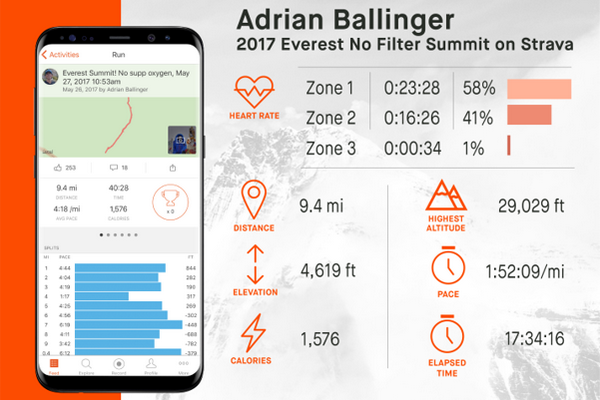
Professional alpinists Adrian Ballinger and Cory Richards summited Mount Everest on May 27, 2017, using Strava to share every step of the journey

SAN FRANCISCO – May 29, 2017 – Professional climber and Strava mountaineer Adrian Ballinger celebrated his first successful summit of Mount Everest without the use of supplemental oxygen, a feat that just over 200 people have ever been known to accomplish. Adrian climbed alongside Eddie Bauer alpinist Cory Richards, who summited Everest for his second time. In a nerve wracking turn of events, Cory, determined to make it to the peak rather than turn around, decided to continue the climb with oxygen approximately 780 feet from the summit. In doing so, both Adrian and Cory stood atop Mount Everest together early Saturday morning. The teammates used Strava, the social network for athletes, to tell the story of their entire expedition and offer unique insights into the effort it takes to climb the highest mountain in the world.

View Adrian’s full Mount Everest summit data at Strava here.

“Hats off to Adrian and Cory on their hard won summits, their safe return, and their epic display of friendship,” says Andrew Vontz, Communications Lead at Strava. “By sharing their entire journey with us on Strava, they inspire all of us to do more than we think is possible and to pursue more audacious summits of our own. This is sport at its best.”

Strava provided Adrian and Cory a platform to show the effort behind their climb through data and give a behind-the-scenes look at the expedition and their remarkable athletic achievement through social storytelling using athlete posts. Strava has the most engaged community of athletes in the world, from people training for their first 10k to elite athletes like Adrian and Cory. A passion for sport is what brings Strava athletes together. The community cheered Adrian and Cory along throughout the expedition with an outpouring of thousands of kudos and comments.

View the entire 2017 expedition on Adrian Ballinger’s and Cory Richards’ Strava accounts or at blog.strava.com/everest-no-filter/. You can also find the expedition on Instagram by following @adrianballinger@coryrichards and #EverestNoFilter.

Last year Strava was one of three social platforms to document the first Mount Everest expedition, allowing outdoor enthusiasts to stay updated on their journey via Ballinger’s Strava feed. While Richards made his first successful summit without supplemental oxygen in 2016, Ballinger was forced to turn back just 250 meters from the summit.

In addition to Strava, expedition partners include Eddie Bauer, Samsung, Alpenglow Expeditions and Hiball Energy.

About Strava

Strava is the social network for athletes. Our mobile apps and website connect millions of active people every day. All athletes belong on Strava, no matter where they live, which sport they love or what device they use. Join the community at strava.com.

Our favorite stats:

  • 16 activities uploaded every second, 10 million every week
  • 100+ compatible mobile phones and GPS devices
  • 130+ employees, most in San Francisco with more in Hanover and Bristol
  • 600+ professional athletes are on Strava
  • 1 million athletes join every 45 days
  • 1.3 billion kudos given between athletes last year
  • $7.99 a month to make the most of your sport with Premium, or $59.99 a year
  • 100+ cites making commuting better with Strava Metro

About Adrian Ballinger

Adrian Ballinger is one of the USA’s premier high-altitude ski mountaineers and mountain guides, and the only American guide to have both AMGA/IFMGA guide certification (one of 75 in the USA) and more than 10 summits of 8,000 meter peaks (12 total, including 6 summits of Mt. Everest). As founder and head guide of Alpenglow Expeditions, Adrian has been guiding full-time for twenty years and has led over 100 international climbing expeditions on 6 continents. His personal ski descents include the first descent of Manaslu (8th tallest peak in the world), and Cho Oyu (6th tallest peak in the world), making him the only American to have successfully skied two 8000-meter peaks.

About Cory Richards

Cory Richards is an esteemed alpine athlete as well as a National Geographic Photographer Fellow and filmmaker whose expeditions to the greater ranges of the world has made a leader in adventure and expedition photography. His film work has won awards at nearly every major adventure film festival including the grand prize at the Banff Mountain Film Festival. In 2011, he was awarded the National Geographic Adventurer of the Year Award for his efforts as both a climber and visual storyteller. He’s the first and only American to summit an 8000m peak in winter and this is his third attempt to climb Everest without oxygen. He joined the Eddie Bauer Guide Team as an alpine climbing athlete in October 2015.


]]>
Strava Data Offers Insight into How Athletes Train for the Boston Marathon https://www.corecommunique.com/strava-data-offers-insight-athletes-train-boston-marathon/?utm_source=rss&utm_medium=rss&utm_campaign=strava-data-offers-insight-athletes-train-boston-marathon Fri, 14 Apr 2017 05:37:07 +0000 http://corecommunique.com/?p=75153

SAN FRANCISCO – April 12, 2017 – Strava, the social network for athletes, has revealed unique insights into the Boston Marathon from race day data as well as 12-weeks of training data taken from the 2016 Boston Marathon runners. Highlights include:

  • The most popular time to train was early morning, prior to 8:00 a.m.
  • Average weekly mileage peaks at 45.7 miles three weeks prior to the race and tapers off to just 17.6 miles the week of the race
  • On average, men training for the marathon ran 5.3 times per week with a weekly mileage average of 41 miles. Women training for the marathon ran an average of 4.9 times each week with a weekly mileage average of 35.6 miles.
  • Boston Marathon racers are quick to recover, running again after just 5.4 days of rest on average

Weekly Training
Athletes training for the Boston Marathon should be prepared to dedicate most of the week to training. On average, men training for the marathon ran 5.3 times per week with a weekly mileage of 41 miles. Women training for the marathon ran an average of 4.9 times each week with a weekly mileage average of 35.6 miles.


Building and Tapering
While the average number of runs remained relatively unchanged in the 12 weeks leading up to the race, the distance steadily increased until two weeks from the race. After that, athletes tapered off their distance. The average weekly mileage 3 weeks prior to the race rose to an all-time high of 45.7 miles, while the average weekly mileage the week prior to the race was just 17.6 miles.

Long Runs
Athletes’ runs qualified as long runs if they logged 15 miles or more in one session. Boston Marathon runners averaged a total 4.2 long runs over the course of 12 weeks, with the average long distance run coming in at 19.1 miles.

Training Times
Rise and shine! The most popular time for runners to train was between 3 a.m. and 8 a.m., with 30% of athletes training for the Boston Marathon logging activities between these times.

Community
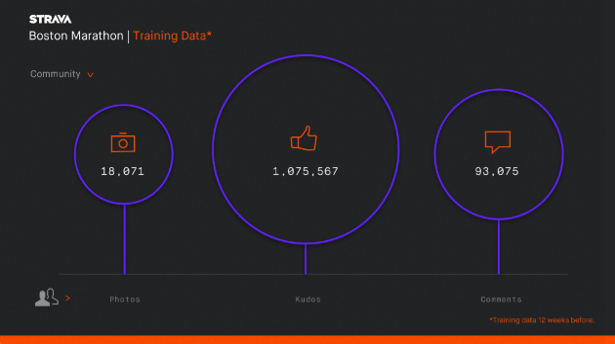
Boston Marathon runners engaged frequently with the Strava community, taking more than 18,000 photos, receiving more than 1 million kudos, and commenting more than 93,000 times during training.

Race Day Data for Men and Women
According to Strava data, both men and women experienced their fastest mile at mile 4, and their slowest mile at 21, Heartbreak Hill. Running quickly at mile 4, while a slightly downhill segment, is also possibly an indicator of new-found freedom from the crowded early miles allowing runners to ramp back up to their planned target pace.

Race Day Data per Age Group
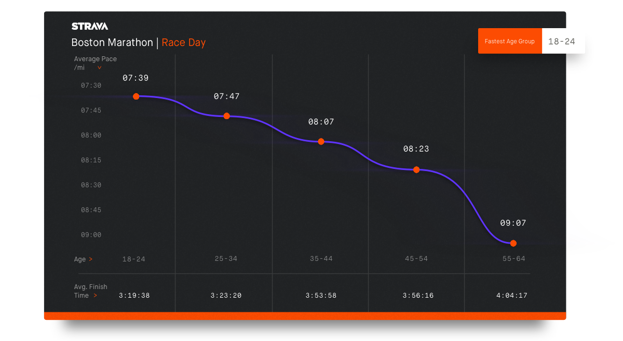
Strava race day data shows that the younger an athlete is, the more likely he or she had a faster finish time at the Boston Marathon. Considering the qualifying times do get easier as you get older, this isn’t a total surprise. The 24 and under age group was the fastest, with an average a finish time of 3 hours and 19 minutes and an average pace of 7:39. This is followed by the 25-34 age group who finished in 3 hours and 23 minutes with an average pace of 7:47, and the 35-44 age group in third, with an average finish time of 3 hours and 31 minutes and an average pace of 8:07. The slowest age group was 65+ with a finish time average of 4 hours and 18 minutes and an average pace of 9:54.

Recovery
These are some serious athletes. Boston Marathon racers were the fastest to recover, with an average of just 5.4 days of recovery before their first post run race activity was logged.

One million new members sign up for Strava every 45 days, and the platform boasts approximately 8 million activity uploads put on the platform each week globally. In 2016, globally, Strava runners uploaded 86.7 million runs, with the U.S. contributing 21 million of the runs covering 105 million miles. For more information on Strava, click here.

Press interested in detailed training data for certain age groups or data specific to male or female athletes can contact strava@maxborgesagency.com for more information.

About Strava
Strava unlocks potential through the power of sport. Designed by athletes, for athletes, Strava’s mobile apps and website connect millions of runners and cyclists every day. For more information visit www.strava.com.

]]>
G20 countries are breaking commitments to publish data that helps tackle corruption – Transparency International  https://www.corecommunique.com/g20-countries-breaking-commitments-publish-data-helps-tackle-corruption-transparency-international/?utm_source=rss&utm_medium=rss&utm_campaign=g20-countries-breaking-commitments-publish-data-helps-tackle-corruption-transparency-international Thu, 23 Feb 2017 11:14:56 +0000 http://corecommunique.com/?p=72141

Research published today by Transparency International and the Web Foundation finds that five key G20 countries are failing to meet commitments to publish data that helps tackle corruption. If the data was publicly available it could be used to curb criminal activities, including money laundering and tax evasion.

In 2015 the G20 agreed that in order to help stop corruption, governments should publish data on open data platforms so that civil society could monitor the use of public resources, including how taxes are spent, how contracts are awarded and how money is funnelled into political campaigns.

Connecting the Dots: Building the Case for Open Data to Fight Corruption looked at how much progress Brazil, France, Germany, Indonesia and South Africa have made in implementing the G20 Anti-Corruption Open Data Principles. These countries were chosen as a representative global and economic cross-section of G20 countries.

The conclusion is clear: there is not enough progress. No country has released all the information and much of the information that has been released is hard to find and use.

None of the countries posted any information about who owns companies (beneficial ownership information). France was the only country to publish some information on lobbying activities and only Brazil published information about government spending.

“Governments need to step up their game if open data is to put a dent in global corruption. They must work to change attitudes among civil servants, invest in vital technology and the development of skills, and crucially, they must enshrine G20 Principles into national law,” said Robin Hodess, interim Internal Managing Director of Transparency International and a co-author of the report.

“The Panama Papers showed us the scale of corruption happening in the shadows that datasets can help reveal. These developments called for urgent solutions. That governments are instead dragging their feet on mobilising open data raises questions about their commitment to transparency,” said Craig Fagan, Web Foundation Policy Director.

Transparency International and the Web Foundation analysed ten datasets linked to anti-corruption measures. These included public information on lobbying, land registrations, government spending, beneficial ownership of companies and political financing.

Researchers scored the quality of each data set using a nine-point checklist that includes an assessment of the timeliness for publication and updates, ease of access, provision of supporting documents, and the ability to cross-reference data sets.

France performed best, scoring an average of 5.4 out of a possible 9 points. Indonesia received the lowest score, managing just 1.5 points.

The dataset that had the most information was on government budgets with an average score of 7.8 across the five countries. However, government spending and lobbying registers each scored 1.6 and land registers scored 1.8. This shows that governments are not collecting or disseminating crucial information in key areas prone to corruption.

Key findings:

No country released all anti-corruption datasets

  • France showed the most progress, publishing eight of ten datasets identified as key to anti-corruption
  • Brazil was the only country to publish data on government spending
  • No country has a beneficial ownership register – despite all showing some level of commitment to do so at last year’s Anti-Corruption Summit in London.

When released, data is not always useful and useable

  • In many cases the data is stale and lacks granularity – making meaningful insights difficult to draw
  • Access is a problem in all countries, with datasets hard to find and not all available from a single platform, meaning those looking to identify corruption need to dig further to find critical information

Data not published to open data standards

  • Only France published the majority of its datasets in line with open data standards
  • This lack of adherence to open data standards makes merging and comparing datasets difficult, particularly between countries

Lack of open data skills

  • Although some countries do offer some level of open data training for staff, these rarely incorporate an anti-corruption focus

Transparency International and the Web Foundation call for governments to take immediate steps to publish more information that can be used to fight corruption. The report makes recommendations on the required legal measures needed to enforce open data and for commitments to invest in training. Finally, the report suggests that in order for governments to make open data the default option, there will need to a change of culture, which will only come about when there are formal incentives for openness.

The full report can be downloaded here.

You can also read the five country case studies: Brazil, France, Germany, Indonesia and South Africa.

]]>