The post A photographic tour of the cinemas that have graced Cuba from the Revolution onwards appeared first on Core Sector Communique.
]]>Cines de Cuba Carolina Sandretto, photographer
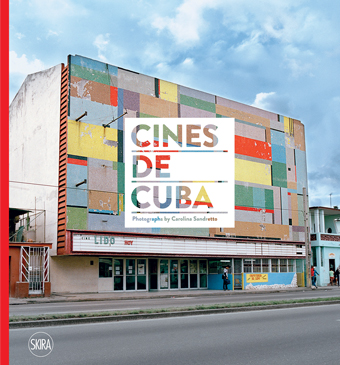
A photographic tour of the cinemas that have graced Cuba from the Revolution onwards
With more than 500 color photographs shot on a 1950s medium-format camera, this beautifully illustrated book offers an exceptional exploration of the hundreds of cinemas which for decades have decorated Cuba. In 1953, Cuba had 694 cinemas and theaters. Havana alone had 134, more than either New York or Paris. In 2014, documentary photographer Carolina Sandretto set out to find and record these deteriorated but exquisite island jewels. This book is the visual document of her journey. “The book is a voyage around the Island during which I documented what are the cinemas now and how do they look like outside and inside. These buildings, that were once the gathering of the people, have fallen into the oblivion of their own society.” – Carolina Sandretto
About the Author Carolina Sandretto is an Italian photographer based in New York City. Her experience includes both the management of non-profit organizations and documentary photography
Publication: November 2017
Length: 396 pages
Size: 28 x 30 cm
Illustrations: 541 colour
Binding: Hardcover
Price: £ 60.00 € US 75.00
CAN $100.00
ISBN: 978-88-572- 3439-7
The post A photographic tour of the cinemas that have graced Cuba from the Revolution onwards appeared first on Core Sector Communique.
]]>The post Shadow trade: how North Korea’s barter trade violates United Nations sanctions appeared first on Core Sector Communique.
]]> (Stockholm, 17 July 2013) Barter trade in essential goods and long-standing diplomatic relations are key to understanding the most recent attempted violation of the United Nations arms embargo on the Democratic People’s Republic of Korea (DPRK, North Korea).
Expert Comment by SIPRI Researchers Hugh Griffiths and Lawrence Dermody
.On 16 July the President of Panama announced that his country had seized a North Korean ship transporting undeclared military cargo from Cuba destined for North Korea. The cargo consists of missile components, prohibited under the UN arms embargo.
However, while the world’s media focuses on the illicit missile technology it is the Cuban sugar destined for famine-stricken North Korea that highlights the barter trade that has played a central role in North Korea’s relations with countries willing to flout the highly restrictive sanctions regime imposed by the UN Security Council.
North Korea’s abundances and shortages
North Korea is poor and its people hungry but it has an abundance of Soviet-era military equipment as well as the technicians to service, repair and upgrade old Soviet or Chinese military equipment in exchange for food or much-needed foreign currency. In the past, this could have been rice (in the case of Myanmar) and Cuba is not short of sugar. Both commodities are in short supply in Pyongyang.
North Korea’s elite seeks to capitalize on the narrow range of goods and services its highly militarized society has to offer in exchange for basic foodstuffs. In a world of globalized, international trade, North Korea’s poverty and in particular its isolation makes its few remaining traditional ties to states such as Cuba all the more important for the regime’s psychological well-being.
Cold war era connections with Cuba
In the post-cold war era, North Korea’s trading partners outside of North East Asia – including Burma, Cuba, Democratic Republic of the Congo (DRC), Congo (Brazzaville), Eritrea, Ethiopia, Iran, Pakistan, Yemen and Zimbabwe – have also been named in connection to North Korean military or sensitive dual use missile technology transfers.
In some of these cases, precious foreign currency earnings played a major role but in the case of Cuba – another poor country — the value of the relationship is barter trade and a highly prized diplomatic and political relationship for North Korea, now the world’s most isolated UN member state.
North Korea’s Cuban connection has its roots in a bygone age when both countries benefited from subsidies and favourable trade agreements with the former Soviet Union. However, there are echoes from that past today. For example, a number of North Korean arms brokers — one of whom offered North Korean missiles to a British arms dealer subsequently convicted in the United Kingdom in 2012 — speak fluent Spanish.
The need for greater international information sharing
Nevertheless, the world has moved on since 1989 and North Korea’s most recent missile and nuclear tests have isolated the country further and have led to a tightening of UN sanctions that provide explicit wording on the inspection of suspect North Korean vessels. While barter trade and associated military transfers will continue to occur, greater international cooperation and information-sharing may also lead to an increase in the number of seizures.
For detailed analysis of North Korean ships and their involvement in arms and narcotics trafficking, download Maritime Transport and Destabilizing Commodity Flows, SIPRI Policy Paper No. 32, by Hugh Griffiths and Michael Jenks.
Hugh Griffiths (United Kingdom) is Head of the SIPRI Countering Illicit Trafficking—Mechanism Assessment Projects (CIT-MAP).
Lawrence Dermody (Australia) is a Researcher with CIT-MAP.
Stockholm International Peace Research Institute (SIPRI)
SIPRI is an independent international institute dedicated to research into conflict, armaments, arms control and disarmament. Established in 1966, SIPRI provides data, analysis and recommendations, based on open sources, to policymakers, researchers, media and the interested public.
SIPRI is regularly ranked among the top five international ‘go-to’ think tanks.
www.sipri.org
The post Shadow trade: how North Korea’s barter trade violates United Nations sanctions appeared first on Core Sector Communique.
]]>